“Cherubim” is the plural of “cherub,” a term for celestial beings associated in the Bible with God’s presence, holiness, throne, and heavenly worship. In Scripture, cherubim are not usually portrayed as small, chubby children with wings. They are described as powerful, composite living creatures or divine attendants who guard sacred space, surround God’s throne, bear or move the divine throne, and continually praise God.
The word’s exact etymology cannot be established with certainty. English versions influenced by the Septuagint sometimes used “cherubim” as though it were singular, which eventually produced the nonstandard form “cherubims” as a supposed plural. The singular form is cherub, and the plural form is cherubim.
The basic meaning of cherubim
In Jewish, Christian, and Islamic literature, a cherub is a celestial winged being with human, animal, or birdlike characteristics who functions as a throne bearer of the Deity. These celestial beings serve important liturgical and intercessory functions in the hierarchy of angels.
Hebrew Bible descriptions of the cherubim emphasize their supernatural mobility and their cultic role as throne bearers of God, rather than their intercessory functions. In Christianity the cherubim are ranked among the higher orders of angels and, as celestial attendants of God, continually praise him. Known as karūbiyūn in Islam, the cherubim continuously praise God by repeating the tasbīḥ (“Glory to Allah”) and dwell in peace in an area of the heavens that is inaccessible to attacks from Iblīs, the Devil.
The term most likely derives from the Akkadian kāribu or kūribu, from the verb karābu, meaning “to pray” or “to bless.” However, the etymology of the Hebrew word cannot be ascertained with certainty, and a Babylonian origin of the Hebrew cherubim is neither proved nor disproved.
What cherubim do in the Bible
The biblical descriptions present cherubim in several closely related roles. They guard the way to the tree of life, protect sacred space, attend God’s throne, serve as the throne’s bearers or movers, and participate in heavenly praise.
| Role | Biblical setting | Meaning or function |
|---|---|---|
| Guardians | Garden of Eden | They guard the way to the tree of life and protect the sanctity of God’s presence. |
| Throne attendants | Tabernacle and temple | They surround and symbolize the divine throne over the ark and mercy seat. |
| Throne bearers | Psalms and prophetic visions | They are associated with the movement and manifestation of God’s heavenly throne. |
| Living creatures | Ezekiel and Revelation | They represent extraordinary heavenly beings surrounding God’s throne. |
| Worshipers | Isaiah, Revelation, and later Jewish tradition | They continually proclaim God’s holiness and glory. |
Cherubim in Genesis: guardians of Eden
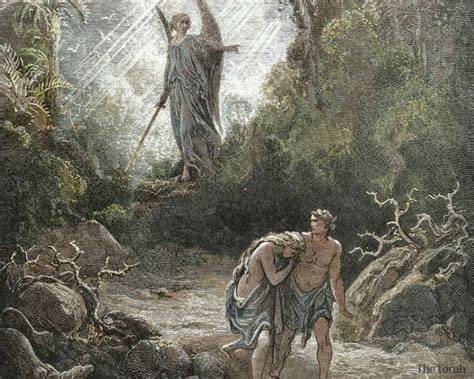
Cherubim first appear in Genesis 3:24, after Adam and Eve are expelled from the garden of Eden: “He drove out the man, and at the east of the garden of Eden he placed the cherubim and a flaming sword that turned every way to guard the way to the tree of life.”
The entrance to the garden of Eden-and with it to the presence of God-is closed, guarded by cherubim, along with a flaming sword (Gen. 3:24). The cherubim are stationed on the east side of the garden because that is where the entrance is, as with the tabernacle.
In this scene, the cherubim are fearsome guardians assigned to guard God’s holiness. They will not fail to protect the sanctity of the garden, as Adam has failed. No longer will access into the presence of the Lord be easy and untroubled for humanity, as it once was.
As composite creatures the cherubim sum up and unite the highest forms of all creation. They are appointed to bar the way back into God’s presence, preventing any intrusion of sinful mankind into the realm of God’s holiness.
The cherubim’s presence outside Eden also communicates that the garden is more than an ordinary place. If we read between the lines of the Paradise account, the garden of Eden, the primeval abode of man, reveals itself as more than that: it was apparently the dwelling-place of God.
In the polytheistic story of the creation of the world and early life of man, which, while in several respects analogous, is devoid of the more spiritual notions of Hebraism, the garden was the abode of the gods who alone had access to the tree of life from the fruit of which they derived their immortality.
Adam, before the fall, is conceived as a superhuman being; for while he is forbidden to taste of the fruit of the tree of knowledge, the way to immortality is open to him; for it is only after transgressing the Divine command that he merits death and becomes mortal. The choice of immortal innocence and mortal knowledge lay before him; he elected death with knowledge.
Some of the angelic attendants of the Deity within are placed in Genesis without, to do service as guardians of the unapproachable holy garden. The cherubim thus mark the boundary between fallen humanity and the immediate presence of the holy God.
Cherubim as attendants of God
The cherubim are associated with God’s heavenly court. In Ezekiel 28:13, the fall of the king of Tyre is likened to that of primeval man. The garden is situated on a holy mountain of Elohim, a wonderful place adorned with all manner of precious stones.
There man, perfect from the day he was created, resplendent with beauty, excelling in wisdom, walks among the fiery stones, like a cherub with outstretched wings. The cherubs are apparently the attendants of the Deity, beauteous angels, of whom man was to be one: but he fell from glory and was hurled from the sanctuary which he had polluted.
In this imagery, the cherub is not a decorative baby or a harmless winged child. The cherub is a glorious heavenly figure connected with the sanctuary, the presence of God, beauty, wisdom, and holiness.
Cherubim as bearers of God’s throne
The Bible repeatedly associates God with a throne above or upon the cherubim. As attendants of God, they bear the throne upon which He descends from His high abode.
Psalm 18 describes a divine manifestation in these words: “He bowed the heavens also, and came down; And thick darkness was under his feet. And he rode upon a cherub and did fly; Yea, he soared upon the wings of the wind.”
Hence, the Lord, or, as the fuller title goes, the Lord of Hosts, is repeatedly styled “He that sitteth, or is enthroned, above the cherubim” (Psalms 80:1; 99:1; 1 Samuel 4:4, and elsewhere).
There is certainly no trace here of bull figures: bulls do not fly. The underlying conception is, it seems, rather that of the storm cloud. Psalm 104:3 similarly says: “Who maketh the clouds his chariot; Who walketh upon the wings of the wind.”
The Hebrew for “chariot” is rekhubh, a sort of inverted kerubh. This wordplay reflects the close association between the cherubim, divine movement, clouds, wind, and the heavenly chariot.
The cherubim in Ezekiel’s vision
The function of the cherubim as bearers and movers of the Divine throne is brought out most clearly in the vision of Ezekiel. In chapter 1 the prophet designates them as “living creatures,” but upon hearing God’s words addressed to the “man clothed in linen,” he perceives that the living creatures which he saw in the first vision were cherubim.
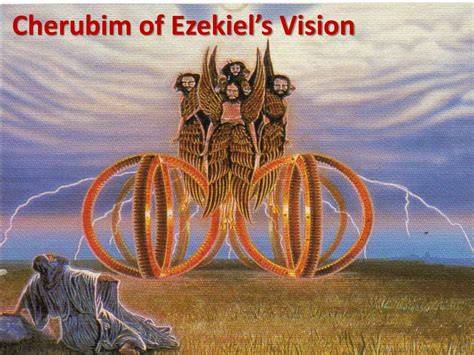
The following is a description in detail of the cherubim as seen by Ezekiel. They are represented as four living creatures, each with four faces: man, lion, ox, and eagle. They have the figure and hands of men and the feet of calves.
Each has four wings, two of which are stretched upward, meeting above and sustaining the “firmament,” that is, the bottom of the Divine throne, while two are stretched downward, conformable the one to the other, so as to cover their bodies.
In appearance, the living creatures resemble coals of fire, burning like torches, the fire flashing up and down among the creatures, a bright fire out of which lightning goes forth. Thus the creatures run and vanish as the appearance of a flash of lightning.
The cherubim do not turn as they change direction, but always go straight forward, as do the wheels of the cherubic chariot with rings full of eyes round about. The cherubim represent the spirit, or will, in the wheels: at the direction of the spirit, the wheels are lifted up from the bottom and the chariot moves upward. The cherubim are thus the moving force of the vehicle.
The Lord’s throne-chariot is drawn by four living creatures, which the prophet will later identify as cherubim. These extraordinary winged creatures with humanlike bodies have four faces each, that of a man, a lion, an ox, and an eagle.
The four faces represent the highest forms of living creation: the man represents humanity, the lion the highest of the wild animals, the ox the highest domestic animal, and the eagle the highest of the birds. The cherubim therefore embody within themselves all the highest attributes of living creation.
If the Lord’s attendants thus embody wisdom, strength, majesty, speed, and procreative power, how much more fully does he himself embody these attributes?
The title “living creatures” points back to the creation account in Genesis 1-3, reminding us that the God who created all things has the power and the right to destroy what he has made, just as a potter recycles a less-than-perfect pot.
Here, however, the living creatures do not merely have a defensive character. They are described as being like torches or burning coals of fire. Lightning is flashing back and forth among them, and the creatures themselves are in rapid motion, like flashes of lightning. This is the threatening language of God’s judgment, here marshaled not against Israel’s enemies but against his own land and people.
How many faces and wings do cherubim have?
The biblical descriptions do not give one uniform physical description of every cherub. In Ezekiel, each of the four living creatures has four faces: a human face, a lion’s face, an ox’s face, and an eagle’s face.
Each creature has four wings. Two wings are stretched upward and support the heavenly platform, while two cover the creature’s body. The creatures have humanlike hands, straight legs, and feet resembling the feet of calves.
In Exodus, however, the cherubim on the mercy seat are described as winged creatures with faces. They apparently stand at the two ends of the lid, stretch their wings over it, and face one another. Whether all cherubim look exactly the same is unclear, making it difficult to know how much of Ezekiel’s description should be read back into Exodus.
In fact, the cherubim in Ezekiel have four faces, whereas those in Exodus apparently have only one. The descriptions therefore should not be forced into a single literal image.
In Revelation, the four living creatures do not each have four faces. Instead, one resembles a lion, one an ox, one has a face like a human being, and one resembles an eagle in flight. Each of the creatures has six wings and is full of eyes.
The author uses similes in Revelation; the creatures are not identified as a lion, ox, human being, or eagle. Instead they share a likeness with them. The representations of these creatures, then, are symbolic and should not be taken literally.
Cherubim in the tabernacle
In the tabernacle, two cherubim of solid gold were placed upon the golden slab of the lid, or mercy seat. They faced each other with wings outstretched above, so as to constitute a throne on which the glory of the Lord appeared and from which He spoke.
Exodus describes the mercy seat and its cherubim in these words: “You shall make a mercy seat of pure gold. Two cubits and a half shall be its length, and a cubit and a half its breadth. And you shall make two cherubim of gold; of hammered work shall you make them, on the two ends of the mercy seat.”
“Make one cherub on the one end, and one cherub on the other end. Of one piece with the mercy seat shall you make the cherubim on its two ends. The cherubim shall spread out their wings above, overshadowing the mercy seat with their wings, their faces one to another; toward the mercy seat shall the faces of the cherubim be.”
“And you shall put the mercy seat on the top of the ark, and in the ark you shall put the testimony that I shall give you. There I will meet with you, and from above the mercy seat, from between the two cherubim that are on the ark of the testimony, I will speak with you about all that I will give you in commandment for the people of Israel.”
On top of the lid are two cherubim, celestial figures made of hammered gold and of one piece with the lid. In terms of function, cherubim serve as guardians, a metaphorical chariot on which the Lord rides, or divine attendants at his throne.
The latter fits the context well since the tabernacle functions as the Lord’s palace-tent, making it natural to see the Most Holy Place as the Lord’s throne room, where he sits enthroned over the ark and surrounded by his heavenly attendants.
Whatever their exact form here, the cherubim are stationed at each end of the ark, facing one another with heads toward the mercy seat, either bowed in reverence, looking on as guards, or both.
Just as the cloud on Sinai prevents direct sight of the Lord, the cherubim’s wings spread forward over the atonement lid, screening the place where the Lord will manifest his presence.
The curtains of the tabernacle were made from fine twined linen and colorful yarns, materials elsewhere associated with royalty. Cherubim, the Lord’s heavenly attendants, were woven into them.
When the curtains were joined and spread over the frame, the view from inside would be remarkable. Any priest entering the Holy Place would be bathed in golden light as the lampstand’s seven lamps reflected off the golden table, the golden altar, and the golden frames along the northern and southern walls.
Looking up, the priest would see the ornate tapestry, with cherubim “floating” above him. Similarly, as he looked forward, he would see cherubim floating before him on the veil in front of the Most Holy Place.
Clearly this is the palace-tent of the King of heaven. On the other side of the veil is the Most Holy Place, approximately 15 feet, or 4.6 meters, square. It contains the ark of the testimony with its atonement lid and serves as the Lord’s throne room within his royal palace-tent.
The veil thus separates the rooms, its cherubim symbolically standing guard to prevent illicit entry.
Were cherubim objects of worship?
The cherubim in the tabernacle and temple were not presented as gods to be worshiped. They served as symbolic figures connected with God’s throne, holiness, and presence.
The prohibition concerned making an image for the purpose of worshiping or serving that image. The cherubim were included within the sacred furnishings of the tabernacle and temple as representations connected with divine authority and the heavenly throne.
The cherubim on the ark were not independent objects placed alongside God as rival deities. They were formed as part of the mercy seat, and the mercy seat itself signified the place where God manifested his presence and spoke to his people.
The cherubim were to have wings spreading upward and sheltering the mercy seat. Their position and posture directed attention toward the divine presence rather than toward themselves as objects of devotion.
Cherubim in Solomon’s temple
In Solomon’s temple, two gigantic cherubic images of olive wood plated with gold, ten cubits high, stood in the innermost sanctuary, the debir, facing the door.
Their wings were five cubits each. Two wings met in the middle of the room to constitute the throne, while two extended to the walls. The Chronicler represents them as the chariot of the Lord.
There were also images of the cherubim carved on the gold-plated cedar planks that constituted the inner walls of the temple and upon the olive-wood doors. Cherubim were also carved on the bases of the portable lavers, interchanging with lions and oxen.
According to the Chronicler, cherubim were also woven into the veil of the Holy of Holies. Their presence throughout the sanctuary emphasized that the temple was the earthly representation of the heavenly palace and throne room of God.
In 1 Kings, the dimensions and construction of the temple are detailed, starting with the external designs and moving inward to the inner sanctuary. The structure of the temple, with concentric courts leading to the Most Holy Place in the center, conveys both that the holy God dwells at the center of the life of the nation and that there is a proper and improper way to approach him.
A cherub is a winged creature often functioning as a throne-bearer in ancient Near Eastern iconography, usually to provide divine sanction for the king sitting on it. In Scripture, however, the cherubim do not hold up a throne as such. Instead, God is “enthroned on the cherubim.”
In other words, the cherubim represent God’s heavenly throne. This is why the ark itself has two such creatures facing inward on its lid, the mercy seat, where God arrives to meet his people.
Cherubim in Ezekiel’s temple
Ezekiel represents the inner walls of the temple as carved with alternating palm trees and cherubim, each with two faces: the lion looking on one side and the man on the other.
This description shows that the form of cherubim could vary in different biblical visions and artistic settings. The figures continued to communicate the connection between sacred space, creation, divine presence, and heavenly guardianship.
Cherubim and seraphim
Ezekiel’s cherubim are clearly related to the seraphim in Isaiah’s inaugural vision. Like the cherubim, the seraphim are attendants of God as He is seated upon a throne high and exalted.
They are also winged creatures: with two wings they cover their faces, with two they cover their feet, and with two they fly. Like the Levites in the sanctuary below, they sing a hymn of adoration: “Holy, holy, holy, is Yahweh of hosts: the whole earth is full of his glory.”
The cherubim and seraphim are not identical in every description, but both belong to the heavenly court and are associated with God’s throne, holiness, worship, and glory.
In the Book of Enoch, the cherubim, seraphim, and ophannim, or wheels, and all the angels of power constitute the “host of God,” the guardians of His throne and the singers of praise ascribing blessedness to “the Lord of Spirits,” with the archangel Gabriel at their head.
In Jewish daily liturgy, the seraphim, ophannim, and “living creatures” constitute the heavenly choir who, the elect ministers of the Living God, ready to do the will of their maker with trembling, intone in sweet harmony the Thrice-holy.
Cherubim in Jewish interpretation
In the Talmud, the cherubim are represented as having the likeness of youths. This interpretation is associated with a fanciful etymology, ke plus rubh, meaning “like a youth.”
According to the Midrash, they have no definite shape, but appear indifferently as men or women, or as spirits and angelic beings.
The Talmud in Sukkah 5b teaches that each cherub had the image of a child’s face, and the Zohar teaches that one was the face of a boy and the other that of a girl. These later traditions helped contribute to the association of cherubim with youthful or childlike figures.
Such interpretations should be distinguished from the popular modern image of cherubs as chubby babies with small wings. Biblical passages, especially Ezekiel, describe them as awesome, mobile, composite heavenly beings connected with the throne of God.
Cherubim in Revelation
The “four living creatures” of Revelation 4 are clearly modeled upon Ezekiel, with supplementary touches from Isaiah. Full of eyes before and behind, they are in the midst of the throne and round about it.
One resembles a lion, the other a calf or ox, the third a man, and the fourth a flying eagle. Each of the creatures has six wings. “They have no rest day and night, saying, Holy, holy, holy, is the Lord God, the Almighty, who was and who is and who is to come.”
There are remarkable creatures guarding and surrounding the throne, again highlighting God’s awesome holiness. Perhaps these creatures bear up the moveable throne of God.
John draws here on the vision of Ezekiel, who sees four living creatures and later identifies them as cherubim. These strange and wonderful creatures in Revelation, like the cherubim in Ezekiel, protect and surround God’s throne.
In the Old Testament, cherubim guarded the way to the tree of life. In the tabernacle and the temple, cherubim hovered over the mercy seat, symbolizing their guarding of God’s presence. Cherubim were also woven into the curtains of the tabernacle and carved on the walls of the temple.
The Old Testament speaks of Yahweh being enthroned on cherubim. In Ezekiel, the cherubim play an important role as God’s presence leaves the temple because of Israel’s sin.
The cherubim were associated, as are the four living creatures, with God’s presence and throne. The “eyes” do not signify omniscience, as only God is omniscient, but they show the four living creatures searching the entire creation, vigilantly watching over the world as God’s agents.
The four living creatures represent all of creation, signifying the calling of all creatures everywhere to praise God. Nothing is more beautiful and satisfying than worshiping God before his throne.
The Living Creatures Anthem | The Throne Room of Revelation 4
Why cherubim are often shown as babies
In the art of the Renaissance, cherubim, or cherubs, are depicted as chubby babies with wings. Hence, a person with a chubby, childlike face may be called “cherubic.”
This artistic tradition is not the main biblical meaning of the word. It developed from later religious art and from interpretations that associated cherubim with youthful figures.
In ordinary modern English, cherub can mean a beautiful, usually winged child in painting and sculpture. It can also mean an innocent-looking, usually chubby and rosy person.
These everyday meanings explain why “cherubic” often describes someone with a sweet, innocent, or childlike appearance. In biblical usage, however, cherubim are primarily heavenly guardians and attendants of God’s throne.
Cherubim in ancient Near Eastern imagery
In their function as guardians of Paradise, the cherubim bear an analogy to the winged bulls and lions of Babylonia and Assyria, colossal figures with human faces standing guard at the entrance of temples and palaces, just as in Egypt the approaches to the sanctuaries are guarded by sphinxes.
But the Babylonian colossi go by the name of lamassu or shedu; no designation at all approaching the Hebrew kerubh has so far been found in the Assyrian language.
Nor are thus named the winged figures, half human and half animal, which in Babylonian and Persian art are found on both sides of the “sacred tree.” Thus, a Babylonian origin of the Hebrew cherubim is neither proved nor disproved.
Other analogies include the fabulous griffins, usually represented as having the heads and wings of an eagle and the body and hindquarters of a lion. The Greeks believed that griffins inhabited Scythia and kept jealous watch over the gold of that country.
These comparisons help explain the broader ancient imagery of winged guardians and composite creatures, but they do not establish that the biblical cherubim were copied from any particular foreign figure.
Are cherubim angels?
Cherubim are commonly understood within Jewish and Christian tradition as heavenly or angelic beings. They are attendants of God, guardians of sacred space, and members of the heavenly court.
In the Book of Enoch, the cherubim are included among the host of God. In Christianity, they are ranked among the higher orders of angels and continually praise God as celestial attendants.
At the same time, the Bible does not always describe them using the general word “angel.” Ezekiel calls them “living creatures,” and Revelation likewise speaks of “four living creatures.” Their specific imagery distinguishes them from more ordinary popular ideas about angels.
They are therefore best understood as a particular class or representation of heavenly beings whose primary biblical associations are God’s holiness, throne, presence, movement, judgment, and worship.
What cherubim symbolize
The recurring biblical appearances of cherubim give the word several related symbolic meanings.
- God’s holiness: Cherubim guard the garden of Eden and the entrance to sacred space.
- Restricted access: After the fall, they stand between humanity and the way to the tree of life.
- God’s presence: Their images surround the mercy seat and appear in the tabernacle and temple.
- God’s kingship: God is repeatedly described as enthroned above or upon the cherubim.
- Divine mobility: In Psalms and Ezekiel, cherubim are associated with God’s chariot and the movement of his throne.
- Creation in its fullness: The human, lion, ox, and eagle features represent the highest forms of living creation.
- Divine judgment: Their fire, lightning, and rapid movement in Ezekiel accompany the threatening language of judgment.
- Heavenly worship: In Isaiah, Jewish tradition, and Revelation, heavenly beings around God’s throne proclaim his holiness.
- Vigilance: Their eyes and their guarding function symbolize alertness before the divine throne.
Thus, the most complete answer to “What does cherubim mean?” is that cherubim are powerful heavenly beings associated with God’s throne and presence, serving as guardians, attendants, throne bearers, and worshipers.