The Eucharistic Prayer is the central prayer and high point of the Mass. It is not merely a prayer said by the priest while the congregation watches the consecration of the bread and wine; it is the prayer of the whole Church, offered by Christ the priest and his Body, the Church, to God the Father in the Holy Spirit.
During the Eucharistic Prayer, bread and wine become the Body and Blood of Jesus Christ through the power of the Holy Spirit and the instrumentality of the priest. The whole Christ is truly present-body, blood, soul, and divinity-under the appearances of bread and wine. At the same time, Christ’s saving action-his Passion, death, Resurrection, and Ascension-is made present sacramentally, so that the faithful can unite themselves to his perfect sacrifice and offer themselves with him to the Father.
The Eucharistic Prayer as the Heart of the Mass
The Eucharistic Prayer forms the centre of the Mass, opening with the dialogue between priest and people in which we are called to “lift up [our] hearts” to the Lord as we begin this most solemn prayer and continuing up to the great “Amen” which precedes the Our Father. According to the General Instruction of the Roman Missal, “Now the center and high point of the entire celebration begins, namely, the Eucharistic Prayer itself, that is, the prayer of thanksgiving and sanctification.”
The priest calls upon the people to lift up their hearts to the Lord in prayer and thanksgiving; he associates the people with himself in the Prayer that he addresses in the name of the entire community to God the Father through Jesus Christ in the Holy Spirit. Furthermore, the meaning of this Prayer is that the whole congregation of the faithful joins with Christ in confessing the great deeds of God and in the offering of Sacrifice.
The Eucharistic Prayer requires that everybody listens to it with reverence and in silence. The Mass concentrates the path of three days into about an hour of intense meaning, and the center and core of the Mass, the Eucharistic prayer, transports us mystically to the hours from the lifting up of Jesus’ own heart to the Father to the moment of His death and resurrection.
Why the Prayer Is Addressed to the Father
The Eucharistic Prayers make clear that these prayers are offered, not to Christ, but to the Father. It is worship offered to the Father by Christ as it was at the moment of his passion, death and resurrection, but now it is offered through the priest acting in the person of Christ, and it is offered as well by all of the baptized, who are part of Christ's Body, the Church.
Read carefully any of the Eucharistic Prayers. You will see that that prayer is offered, not to Christ, but to the Father: Father, you are holy indeed …; Father, we bring you these gifts …; Father, we ask you …. The Eucharistic prayer is addressed to the Father, not to Jesus.
Christ is not excluded from this prayer. Rather, the Father is worshiped through Christ, with Christ, and in Christ, in the unity of the Holy Spirit. The Eucharistic Prayer gives thanks and praise to the Father for all his actions in the world, especially for sending his Son as our Savior.
The Meaning of “We” in the Eucharistic Prayer
The priest offers the Eucharistic Prayer in the first person plural, for example, “Therefore, O Lord, we humbly implore you…” This “we” signifies that all the baptized present at the Eucharistic celebration make the sacrificial offering in union with Christ, and pray the Eucharistic Prayer in union with him.
That we signifies that all the baptized present at this Eucharistic celebration make this offering in union with Christ, pray this prayer in union with Him. This is the action of Christ's Body, the Church at Mass.
We do not offer Christ alone; we are called to offer ourselves, our lives, our individual efforts to grow more like Christ and our efforts as a community of believers to spread God's Word and to serve God's people, to the Father in union with Christ through the hands of the priest.
Most wonderful of all, although our offering is in itself imperfect, joined with the offering of Christ it becomes perfect praise and thanksgiving to the Father. The Eucharistic Prayer therefore involves the whole baptized assembly, not as spectators, but as participants in Christ’s worship and self-offering.
The Eucharistic Prayer and the Liturgy of the Eucharist
The Liturgy of the Eucharist begins with the preparation of the gifts and the altar. As the ministers prepare the altar, representatives of the people bring forward the bread and wine that will become the Body and Blood of Christ.
The celebrant blesses and praises God for these gifts and places them on the altar, the place of the Eucharistic sacrifice. In addition to the bread and wine, monetary gifts for the support of the Church and the care of the poor may be brought forward. The Prayer over the Offerings concludes this preparation and disposes all for the Eucharistic Prayer.
| Part of the Liturgy of the Eucharist | Role in the celebration |
|---|---|
| Presentation of the Gifts and Preparation of the Altar | The bread and wine are brought forward and placed on the altar. |
| Prayer over the Offering | The preparation of the gifts is concluded. |
| Eucharistic Prayer | The central prayer of thanksgiving and sanctification. |
| Communion Rite | The faithful are led to the Eucharistic table. |
| Prayer after Communion | The benefits of the Eucharist are asked to remain active in daily life. |
The Basic Structure of the Eucharistic Prayer
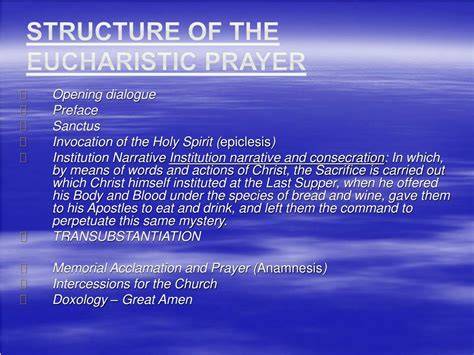
The General Instruction of the Roman Missal identifies eight main elements of the Eucharistic Prayer: thanksgiving, acclamation, epiclesis, the institution narrative and consecration, anamnesis, oblation, intercessions, and the concluding doxology.
These elements may appear in slightly different forms or orders in different Eucharistic Prayers and rites, but all of them share a basic structure and fulfil the same function. The Eucharistic Prayer is simultaneously an act of thanksgiving, a proclamation of God’s saving deeds, a sacramental making-present of Christ’s sacrifice, an offering of the Church, a prayer for the living and the dead, and a glorification of the Trinity.
1. The Introductory Dialogue
The Eucharistic Prayer begins with a dialogue between the priest and the people. The introductory dialogue establishes that this prayer is the prayer of the baptized and ordained, is offered in the presence of God, and has thanksgiving as its central focus.
At the beginning of the Eucharistic prayer, the priest, who stands in the person of Christ, invites the people to join with him in lifting our hearts to God. We begin the Eucharistic prayer by acknowledging together that it is right and just to give thanks to the Lord our God.
2. The Preface: Thanksgiving and Praise
First of all, the priest praises God, acknowledging in what is known as the “Preface” of our Prayer of Thanks-for “Eucharist” is the Greek for thanksgiving-that we do well always and everywhere to give God thanks and praise.
The thanksgiving is expressed especially in the Preface, in which the priest, in the name of the whole of the holy people, glorifies God the Father and gives thanks to him for the whole work of salvation or for some particular aspect of it, according to the varying day, festivity, or time of year.
This section can vary in accordance with the particular feast or celebration. It recalls God’s saving work and directs the attention of the Church toward the mystery being celebrated.
3. The Sanctus: “Holy, Holy, Holy”
The Preface concludes by recalling that, in this praise and worship of God in which we are engaging, we join already in the activity of the saints and angels in heaven, and so we are called to join in the Sanctus, the heavenly song.
The acclamation is the part by which the whole congregation, joining with the heavenly powers, sings the Sanctus, or “Holy, Holy, Holy.” This acclamation constitutes part of the Eucharistic Prayer itself and is pronounced by all the people with the priest.
4. The Epiclesis: Calling Down the Holy Spirit
The word epiclesis is Greek for “calling down.” In this part of the prayer, the Church implores the power of the Holy Spirit so that the gifts offered by human hands may be consecrated and become Christ’s Body and Blood.
Closely linked to the blessing of the gifts is the prayer for God’s blessing upon the bread and wine in the section of the prayer which we call the Epiclesis. In Eucharistic Prayer II, the priest says, “Let your Spirit come upon these gifts to make them holy, that they may become for us the body and blood of our Lord, Jesus Christ”.
The epiclesis also asks that the sacrificial Victim received in Communion may bring salvation to those who partake of it. In this way, the Holy Spirit’s action concerns both the consecration of the gifts and the transformation of the people who receive them.
There is an earlier Epiclesis before the institutional narrative, where the Spirit is called down upon the bread and wine. In the other eucharistic prayers the Epiclesis is explicit, but brief.
5. The Institution Narrative and Consecration
Central to the Eucharistic Prayer is the recounting of Jesus’ actions at the Last Supper-the so-called Institution Narrative-in which we believe that Jesus, speaking through the instrument of his priest, declares the bread and wine on the altar to be his Body and Blood.
The words of institution form the centre of the Eucharistic Prayer and are based on the Gospel accounts of Jesus’ institution of the Eucharist the night before his Passion. Jesus took bread and wine, blessed them, broke the bread and gave them to his disciples, declaring them to be his Body and Blood.
Likewise in the Mass, the priest takes the bread and wine at the Offertory, and later breaks the Sacred Host before giving the Body and Blood of Christ in Holy Communion. In between, however, comes the Eucharistic Prayer, which represents and brings about Jesus’ action of blessing.
The institution narrative and Consecration are the part by which, through the words and actions of Christ, that Sacrifice is effected which Christ himself instituted during the Last Supper, when he offered his Body and Blood under the species of bread and wine, gave them to the Apostles to eat and drink, and left with them the command to perpetuate this same mystery.
The Real Presence of Christ
In the celebration of the Eucharist, bread, and wine become the Body and Blood of Jesus Christ through the power of the Holy Spirit and the instrumentality of the priest. The whole Christ is truly present-body, blood, soul, and divinity-under the appearances of bread and wine, the glorified Christ who rose from the dead.
This is what the Church means when she speaks of the “Real Presence” of Christ in the Eucharist. The transformed bread and wine are truly the Body and Blood of Christ and are not merely symbols.
When Christ said “This is my body” and “This is my blood,” the bread and wine are transubstantiated. Though the bread and wine appear the same to our human faculties, they are actually the real body and blood of Jesus.
The Eucharistic Prayer as Memorial
The anamnesis is Greek for “recollection.” In the Eucharistic Prayer, the Church recalls the great deeds of God throughout salvation history, especially the Passion, death, Resurrection, and Ascension of Christ.
As we give thanks for God’s great mercy, the Sacrifice of the Cross, in which we see the fullness of that mercy, is made present. The anamnesis is therefore not a simple recollection of an event that happened in the past; it is a sacramental memorial in which Christ’s saving sacrifice is made present for the Church here and now.
The anamnesis of the Roman Canon shows this very well when it says: Father, we celebrate the memory of Christ, your Son. We, your people and your ministers, recall his passion, his resurrection from the dead, and his ascension into glory; and from the many gifts you have given us we offer to you, God of glory and majesty, this holy and perfect sacrifice: the bread of life and the cup of eternal salvation.
The apostolic Church called this part of the Mass the anaphora, from the Greek verb meaning “to carry back,” since each celebration of the Eucharistic prayer carries us back to the Upper Room with Jesus, to live anew the precious sacrifice of His own flesh and blood.
A Living Remembrance, Not Mere Mental Recall
The Mass is a family gathering for an important event, where stories are told about our family’s past in the Liturgy of the Word and then we share a meal in the Liturgy of the Eucharist, which in truth is so much more than a simple meal-it is the sacrifice that brings us salvation.
At the heart of this family event is the Eucharistic prayer, the anaphora, or the canon of the Mass. These are the family memories of the last words and actions of Jesus, brought to life.
For the Jews, the Passover and Seder are not simply times to remember the past, but also sacrificial meals that reaffirm their acceptance of the same covenant that God offered to their ancestors. Through eating the sacrifice, the Jews were united with God, entered into communion with God and renewed their covenant commitment.
So, too, with Christians. The Eucharist, more than a thanksgiving for the past, unites us with the sacrifice of Christ and renews the covenant the Father offered us in Jesus.
The Oblation: Offering Christ and Ourselves
The oblation is the part of the Eucharistic Prayer in which the Church, in this memorial, offers the unblemished sacrificial Victim in the Holy Spirit to the Father. The Church’s intention is that the faithful not only offer this unblemished sacrificial Victim but also learn to offer their very selves.
Remembering, thanking and praising of the Father in the eucharistic prayer is followed by uniting ourselves with Christ's offering to the Father. The eucharistic prayer is sometimes referred to as the anaphora, which comes from the Greek anaphero, “I offer up.”
The sacrificial nature of the Eucharist takes up only a few lines in the eucharistic prayers. Eucharistic Prayer II says, “As we celebrate the memorial of his death and resurrection, we offer you, Lord, the Bread of Life and the chalice of salvation.”
Likewise, Eucharistic Prayer III says, “We offer you in thanksgiving this holy and living sacrifice.” And it continues, “Look, we pray, upon the oblation of your church.” Eucharistic Prayer IV says, “We offer you his Body and Blood, the sacrifice acceptable to you which brings salvation to the whole world.”
Eucharistic Prayer I, the old Roman canon, uses more flowery language: “We, your servants and your holy people, offer to your glorious majesty from the gifts that you have given us, this pure victim, this holy victim, this spotless victim, the holy Bread of eternal life and the chalice of everlasting salvation.” It goes on with references to the sacrifices of Abel, Abraham and Melchizedek.
Christ’s sacrifice is not something of which the faithful are passive observers. The Church calls the faithful to offer their own lives with Christ: their fears, worries, joys, hopes, dreams, pains, efforts to become more like Christ, and efforts to spread God’s Word and serve God’s people.
The Sacrifice of Christ Made Present
In the celebration of Mass, during the Eucharistic Prayer, not only does Christ become present, body and blood, soul and divinity, under the forms of bread and wine, but Christ’s saving action, His passion, death and resurrection are once again enacted and offered to the Father by Christ Himself in the person of the priest, and by all present.
This action of Christ which brought about our redemption from sin and eternal death, offered once for all on Calvary, becomes present again for us, here and now, in this time and place, so that we can join in Christ’s perfect offering and can ourselves participate in His perfect worship.
It is union with Christ in his eternal Sacrifice, his eternal outpouring of love in which we glimpse his relation to the Father, which the Church seeks and for which, as his Mystical Body, she exists.
Though the outward form varies, there is only one reality of the Mass, only one Calvary, only one sacrifice. Every Mass celebrates the same reality: a living memory of the saving sacrifice of Christ in His flesh and blood.
The Transformation of the Faithful
The Eucharistic Prayer does not end with the change of the bread and wine. By receiving Communion, we are united with the sacrifice of Christ and transformed by his Spirit.
This next section of the eucharistic prayers is called by the Greek word Epiclesis, for the calling down of the Spirit on those who receive the body and blood of Christ. All of the prayers following the Epiclesis are petitions for how we want the Spirit to transform us, the Christian people.
We ask that we might be united as one body, that we might continue the work of Christ in the world and that we might be worthy to join the saints in heaven. Eucharistic Prayer II prays that the Spirit gather us into one and help the church to “spread throughout the world” and experience “the fullness of charity.”
Eucharistic Prayer III asks “that we, who are nourished by the Body and Blood of your Son and filled with his Holy Spirit, may become one body, one spirit in Christ.” Eucharistic Prayer IV prays, “Grant in your loving kindness to all who partake of this one Bread and one chalice that, gathered into one body by the Holy Spirit, they may truly become a living sacrifice in Christ to the praise of your glory.”
The Eucharist is not an individual devotion but the community’s worship of the Father and a transformative experience that turns individuals into what we eat, the body of Christ.
Intercessions for the Whole Church
In the Eucharistic Prayer, we remember also and pray for the Church in various ways. The intercessions express the fact that the Eucharist is celebrated in communion with the whole Church, both in heaven and on earth.
We commemorate the Pope and our diocesan Bishop who guarantee and symbolise the unity which we enjoy by our common participation in the Eucharist. In commemorating the saints, we recall that this Sacrament, the “source and summit of Christian life” as Vatican II teaches, unites Christians across all time and space, and makes the Church one in Christ’s one eternal Sacrifice.
We pray for all the faithful, living and deceased, bringing the whole Church and her needs before the Lord as we seek to be united with him, and with his action of blessing by which he shows his great mercy.
The Eucharistic Prayer includes petitions for the Church spread throughout the world, the Pope, the bishop, the clergy, the entire people of God, those who take part in the offering, those gathered at the celebration, and all who seek God with a sincere heart.
It also includes prayer for the dead: “Remember also our brothers and sisters who have fallen asleep in the hope of the resurrection and all who have died in your mercy: welcome them into the light of your face.” The Church prays that the departed may be admitted into God’s kingdom and share in the fullness of eternal life.
The Church also prays in communion with the Blessed Virgin Mary, Saint Joseph, the Apostles, the martyrs, and all the saints. “Have mercy on us all, we pray, that with the blessed Virgin Mary, Mother of God, with blessed Joseph, her Spouse, with the blessed Apostles, and all the Saints who have pleased you throughout the ages, we may merit to be co-heirs to eternal life.”
The Doxology and the Great Amen
The Eucharistic Prayer concludes by returning to praise the Father through Jesus Christ, his Son: “Through him, and with him, and in him, O God, almighty Father, in the unity of the Holy Spirit, all glory and honor is yours, for ever and ever.”
At the conclusion of the Eucharistic Prayer the priest sums up all that has gone before: “Through Him (Christ), with Him (Christ), in Him (Christ) in the unity of the Holy Spirit, all glory and honor is yours, almighty Father, forever and ever.”
The concluding doxology expresses the glorification of God. It is affirmed and concluded by the people’s acclamation, “Amen.” We who are privileged to make our own offering through, with and in Christ, respond with the most important acclamation of the Mass, the great AMEN by which we profess the action of Christ to be our action as well.
The “Amen” is therefore more than a polite response. It is the assembly’s assent to the entire Eucharistic Prayer: to the thanksgiving, the consecration, the memorial of Christ’s Paschal Mystery, the offering, the intercessions, and the glorification of God.
The Connection with Holy Communion
The Communion Rite follows the Eucharistic Prayer, leading the faithful to the Eucharistic table. The rite begins with the Lord’s Prayer, in which the people join their voices to pray for the coming of God’s kingdom and to ask God to provide for their needs, forgive their sins, and bring them to the joy of heaven.
The Rite of Peace follows. The celebrant prays that the peace of Christ will fill our hearts, our families, our Church, our communities, and our world. As a sign of hope, the people extend to those around them a sign of peace.
In the Fraction Rite, the celebrant breaks the consecrated bread as the people sing the Agnus Dei, or “Lamb of God.” John the Baptist proclaimed Jesus as “the Lamb of God who takes away the sin of the world.” The action of breaking the bread recalls the actions of Jesus at the Last Supper, when he broke the bread before giving it to his disciples.
Before receiving Holy Communion, the celebrant and assembly acknowledge their unworthiness to receive so great a gift. The celebrant receives Holy Communion first and then the people come forward.
As the people receive Holy Communion, the communion chant or song is sung. The unity of voices echoes the unity the Eucharist brings. All may spend some time in silent prayer of thanksgiving as well.
The Communion Rite ends with the Prayer after Communion which asks that the benefits of the Eucharist will remain active in our daily lives.
The Biblical Foundation of the Eucharist
The Lord Jesus, on the night before he suffered on the cross, shared one last meal with his disciples. During this meal our Savior instituted the sacrament of his Body and Blood.
He did this in order to perpetuate the sacrifice of the Cross throughout the ages and to entrust to the Church a memorial of his death and resurrection. The Institution of the Eucharist is written down in the four Gospels below:
- Matthew 26:26-30
- Mark 14:22-26
- Luke 22:14-20
- John 6:22-59, the Bread of Life Discourse
Jesus’ teaching in the Gospel of John expresses the seriousness of the Eucharistic mystery: “Amen, amen, I say to you, unless you eat the flesh of the Son of Man and drink his blood, you do not have life within you.”
“Whoever eats my flesh and drinks my blood has eternal life, and I will raise him on the last day. For my flesh is true food, and my blood is true drink. Just as the living Father sent me and I have life because of the Father, so also the one who feeds on me will have life because of me.”
The Eucharistic Prayer and the Last Supper
In the Liturgy of the Eucharist, the actions of the priest are modelled on those of Jesus at the Last Supper. Jesus took bread and wine, blessed them, broke the bread and gave them to his disciples, declaring them to be his Body and Blood.
The path from the Upper Room through the grove of olive trees to Golgotha may not be more than a few hundred yards, but it was neither a quick nor an easy walk. Similarly, the road to Emmaus was short on steps but long on meaning as eyes were opened to sacred Scripture and hearts were set ablaze in the breaking of the bread.
Each time the Church gathers at Mass we retrace the path of Jesus from Holy Thursday through Easter Sunday. We lift our hearts to God most high; we accompany Jesus through the Last Supper and to the Cross; we plead for His mercies upon us; we acknowledge the glory that is God’s.
These are the living memories of the Eucharistic prayer. Much more than a passive experience of listening while the priest prays, the Eucharistic prayer invites us to open our hearts and our lives to the power of Christ’s suffering, death and resurrection.
How the Faithful Participate
During the Eucharistic Prayer at Mass, we have more to do than to look forward to the moment of consecration and remain there while the prayer of the priest continues. Before the consecration we join in the prayer of praise and thanksgiving to the Father known as the Preface and affirm that praise and thanksgiving in our singing of the Holy, Holy, Holy.
Following the Consecration we join together in the Memorial Acclamation which proclaims our common faith in Christ’s real presence and is an acclamation expressing our gratitude to Christ for His wonderful gift of salvation.
But then our prayer moves on and we are called to offer Christ, and ourselves with Christ to the Father: “We offer to you, Father, this holy and living sacrifice…” We also pray with the priest that “we who are nourished by His Body and Blood may be filled with the Holy Spirit and become one body, one spirit in Christ…”
In the Eucharistic prayer, we lift up our needs and our petitions, and together with the priest we thank God, praise God, seek blessings from God, present our deepest selves to God for redemption and healing on the altar.
This is why the priest invites the people at the outset to “pray, brethren, that my sacrifice and yours may be acceptable to God, our almighty Father.”
Silence, Reverence, and Active Participation
We are asked to remain silent during most of this prayer as an act of profound reverence and contemplation. In truth, we should fall into stunned silence in awe of what is happening before us at the altar: God made flesh, offering himself as an atoning sacrifice for the forgiveness of our sins, truly present in our midst.
For the first millennium of the Church, the Eucharistic prayer was usually chanted so that all in the church could hear it clearly. In recent centuries the emphasis was placed on the notion of mystery, and so the priest prayed most of the texts quietly.
The Second Vatican Council restored the more ancient practice so that in the ordinary form of the Mass the priest prays or chants the texts aloud. The faithful participate through attentive listening, sung acclamations, interior prayer, and the offering of their lives in union with Christ.
Different Eucharistic Prayers and Rites
In the Roman Rite with which most of us are probably the most familiar, the Roman Canon, also known as Eucharistic Prayer I, was for perhaps 1500 years the only text used for this part of the Mass. In recent years several more options have been added as alternatives, drawing from the various forms of Eucharistic Prayer which we find in the different rites of the Church, Eastern and Western.
Today there are several Eucharistic prayers listed in the Roman Missal, but four are most commonly used. The others are for special purposes-Masses for reconciliation and for various needs.
| Eucharistic Prayer | Historical or thematic emphasis |
|---|---|
| Eucharistic Prayer I, the Roman Canon | Compiled under the direction of Pope St. Gregory the Great and substantially preserved since then. |
| Eucharistic Prayer II | Nearly identical with the anaphora of Hippolytus and represents the most ancient prayer of the Mass. |
| Eucharistic Prayer III | Greatly influenced by the Gallican and Mozarabic rites. |
| Eucharistic Prayer IV | Draws especially from Eastern sources and the fourth-century anaphora of St. Basil. |
The Roman Missal prescribes the liturgical rites of the Latin-rite Church, which is only one of more than 20 distinct churches within the communion of the Catholic Church. Each of these churches has its own form of celebrating the Mass.
The Mass of the Latin-rite Church-whether in the official Latin or translated into English, Spanish, Mandarin Chinese, or any language-is markedly different in its externals from the Divine Liturgy of the Ukrainian Catholic Church, or the Mass of the Coptic Church, or of the Armenian Church.
Still, no matter the historical origin of the rites, every Mass celebrates the same reality: a living memory of the saving sacrifice of Christ in His flesh and blood. The various forms evolved from the cultural and linguistic uniqueness of various parts of the Christian world.
Historical Development of the Eucharistic Prayer
The anaphora, or Eucharistic prayer, of the Latin-rite Church is first recorded in a work entitled “The Apostolic Tradition,” attributed to Hippolytus of Rome, and which scholars traditionally accept as having been composed around the year A.D. 215.
It was written in Greek, which replaced the Aramaic-language prayers within a century after the ascension of Jesus. Greek remained the language of the Church, including the celebration of the Mass, until it was replaced by Latin in the Western Church-a slow transition that occurred from the mid-third century through the fifth century.
The second of the four principal Eucharistic prayers in today’s Roman Missal is nearly identical with the anaphora of Hippolytus. It represents the most ancient prayer of the Mass, predating what is traditionally called the “Roman Canon” by almost four centuries.
The other three Eucharistic prayers in the Roman Missal are of later origin, and they reflect the historical evolution of the anaphora, or canon, of the Mass in various parts of the Roman Empire.
Diverse forms of the Eucharistic prayer existed in common usage for centuries in different parts of the Christian world. The differences were not great, but there were variations in the words used and the order in which the parts of the canon were prayed.
The so-called Roman Canon, which is listed first among the Eucharistic prayers in the Roman Missal, was compiled under the direction of Pope St. Gregory the Great, pope from 590 to 604. He wished to make uniform the texts of the Eucharistic prayer throughout the Latin-rite Church.
Since then, minor changes have been made to the words several times, but it remains substantially the same. The third and fourth Eucharistic prayers were composed following the Second Vatican Council.
The Threefold Pattern: Thanksgiving, Offering, and Invocation
Liturgical scholars summarize the Eucharistic Prayer through three Greek terms: eucharistia, meaning thanksgiving; anaphora, meaning offering; and epiclesis, meaning calling down the Spirit.
- Eucharistia: the Church gives praise and thanks to God for creation, salvation history, and especially the sending of Christ.
- Anaphora: the Church offers Christ’s sacrifice to the Father and joins her own life to that offering.
- Epiclesis: the Church calls upon the Holy Spirit to sanctify the gifts and transform those who receive them.
In short, in the eucharistic prayer, we give praise and thanks to God for his actions in the world, especially his sending of his Son. We unite ourselves with Christ's sacrifice in worshipping the Father. We ask for the Spirit to transform us into the body of Christ so that we can continue his mission in the world.
The eucharistic prayer tells us what the Eucharist is all about. It is giving thanks and praise to God; it is being united with the sacrifice of Christ for our salvation; and it is being transformed by the power of the Spirit so that we can continue his work in the world.
What the Eucharistic Prayer Means for Christian Life
The Eucharistic Prayer shows that Christian worship is inseparable from Christian life. The faithful bring not only bread and wine but also the substance of their lives and join them to Christ’s perfect sacrifice, offering them to the Father.
The prayer therefore includes the faithful’s personal conversion and their communal mission. Christians are called to grow more like Christ, spread God’s Word, serve God’s people, respond to human grief and pain, share in joy and hope, and faithfully bring the good news of salvation.
One Eucharistic Prayer asks: “Grant that all the faithful of the Church, looking into the signs of the times by the light of faith, may constantly devote themselves to the service of the Gospel. Keep us attentive to the needs of all that, sharing in their grief and pain, their joy and hope, we may faithfully bring them the good news of salvation and go forward with them along the way of your kingdom.”
By this sacramental participation, the Church is made one in Christ’s sacrifice and is sent to continue Christ’s work in the world. The Eucharistic Prayer thus connects altar, communion, holiness, unity, mission, and eternal life.
The Eucharist as the Source and Summit of Christian Life
The Eucharist is the source and summit of the Christian life. In the Eucharist the Church both receives the gift of Jesus Christ and gives grateful thanks to God for such a blessing.
This thanksgiving is the only proper response, for through this gift of himself in the celebration of the Eucharist under the appearances of bread and wine Christ gives us the gift of eternal life.
By his Real Presence in the Eucharist Christ fulfils his promise to be with us “always, until the end of the age.” With this gift of Christ's presence in our midst, the Church is truly blessed.
As St. Thomas Aquinas wrote, “It is the law of friendship that friends should live together. Christ has not left us without his bodily presence in this our pilgrimage, but he joins us to himself in this sacrament in the reality of his body and blood.”
The Mass Explained: #9 The Eucharistic Prayer
tags: #what #is #the #eucharistic #prayer