Some biblical prophecies have already been fulfilled, including prophecies concerning the birth, ministry, death, resurrection, and ascension of Jesus Christ, as well as the destruction of Jerusalem and the Temple in A.D. 70. Other passages describe conditions associated with the last days, such as warfare, famine, disease, earthquakes, increasing knowledge, worldwide communication, moral decline, religious apostasy, and the existence of weapons capable of destroying human life.
However, the Bible does not provide reliable grounds for declaring that the Great Tribulation, the revelation of the Antichrist, the final European power, the abomination of desolation, or Christ’s second coming has already occurred. Revelation 4:1 introduces a section concerning “things which must be hereafter,” and several major end-time events remain future. The appropriate response is not date-setting but watchfulness, prayer, faithfulness, and careful attention to what Jesus actually taught.
What Does “Fulfilled Prophecy” Mean?
In Biblical times there was a high standard: To be a prophet of God meant prophesying with 100% accuracy (Deu. 18:20-22). If someone prophecies or foretells an event that doesn’t come to pass, they weren’t speaking for God, because God never lies.
In scripture, Jesus is called the prophet. He is the ultimate Prophet to whom the other prophets pointed. Jesus said it. It happened. That settles it.
Christ Jesus, in fact, is the subject, goal, and center of all prophecy throughout the Old and New Testaments. He was what inspired the prophets through the centuries to testify beforehand of the birth, life, death, burial, and resurrection of the Savior.
Prophecies About Jesus Christ Fulfilled in the New Testament
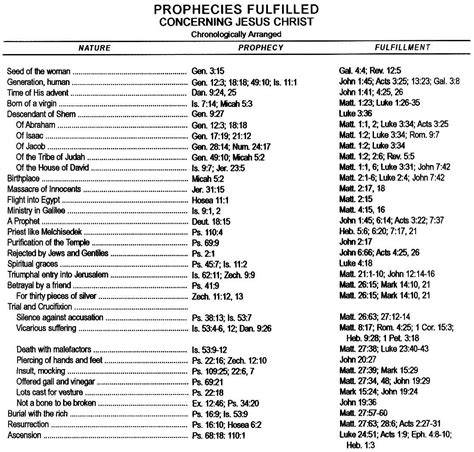
All the prophets throughout the Old Testament, from Genesis to Malachi, foretold vital information about the coming Messiah, Christ Jesus. Old Testament prophecies pointed forward to the Savior.
When He came to earth, exactly as foretold, He then openly and candidly revealed to His followers, friends, and even enemies what had been written of Him. It is mathematically impossible that one man could have fulfilled even a few of the specific prophecies, much less more than three hundred. Only on this one Person, in all of history, is the exact fulfillment of all these prophecies.
| Prophetic theme | Old Testament passage | New Testament fulfillment |
|---|---|---|
| Seed of a woman and virgin birth | Gen. 3:15; Isa. 7:14 | Luke 1:35; Matt. 1:18-23 |
| Descendant of Abraham, Isaac, Judah, and David | Gen. 12:3; 17:19; 49:10; 2 Sam. 7:12 | Matt. 1:1; Luke 3:33; Gal. 3:16 |
| A prophet like Moses | Deut. 18:15-19 | John 6:14; John 12:49 |
| A priest after Melchizedek | Gen. 14:18; Ps. 110:4 | Heb. 6:20; Heb. 7:2 |
| Ministry in Galilee | Isa. 9:1-2 | Matt. 4:12-17 |
| Miraculous ministry | Isa. 35:5 | Matt. 11:4-6 |
| Forerunner before the Messiah | Isa. 40:3-4 | John 1:23 |
| Suffering Servant and sin-bearer | Isa. 52:13-53:12 | Matt. 27:26-31; 1 Pet. 2:24 |
| Rejection and false accusations | Ps. 35:11; Isa. 53:3 | Matt. 26:59; Matt. 27:21-23 |
| Crucifixion, pierced hands and feet | Ps. 22:16; Zech. 12:10 | John 19:34, 37; John 20:27 |
| Gambling for His garments | Ps. 22:18 | John 19:23-24 |
| Vinegar offered in thirst | Ps. 69:21 | Matt. 27:34 |
| No bones broken | Exod. 12:46; Num. 9:12; Ps. 34:20 | John 19:31-36 |
| Death for the sins of others | Isa. 53:4-6 | 1 Pet. 2:24; Gal. 1:4 |
| Resurrection | Ps. 16:9-11; Ps. 22:22; Ps. 118:17-18 | Luke 24:5-7; John 20:9; Acts 2:31 |
| Ascension | Ps. 24:7-10; Ps. 68:18 | Luke 24:51; Acts 1:8-11 |
| Exaltation at God’s right hand | Ps. 110:1 | Mark 16:19; Heb. 1:8 |
The Messiah’s Birth and Lineage
The promised Messiah was to come through the line of Abraham, Isaac, Judah, and David. The prophecies identify Him as a royal descendant and as the Son of God.
Jesus is presented as the seed of Abraham, the seed of Isaac, the descendant of Judah, and the son of David. The promises concerning David’s house, throne, and enduring kingdom are applied to Jesus in the New Testament.
The prophecy of a virgin birth is associated with Isaiah 7:14 and is applied to the birth of Jesus in Matthew 1:18-23 and Luke 1:35. Isaiah also describes the coming child as “Wonderful,” “Counselor,” “Mighty God,” “Everlasting Father,” and “Prince of Peace,” while the New Testament presents Jesus as the Son given and the ruler whose kingdom will have no end.
The Messiah’s Ministry
Isaiah foretold that the Messiah’s ministry would begin in Galilee, that He would bring light, that He would teach with wisdom, and that He would minister to the needy. The Gospel accounts describe Jesus teaching, healing, showing compassion, proclaiming the good news, and extending salvation beyond Israel to the Gentiles.
He would have a ministry of miracles, open blind eyes, bring hope for the hopeless, and act as a compassionate Shepherd. These themes appear throughout the Gospel accounts of Jesus’ earthly ministry.
Jesus was also identified as the Prophet promised through Moses. When Jesus entered Jerusalem, the whole city was stirred and asked, “Who is this?” The crowds answered, “This is Jesus, the prophet…” (Matthew 21:10-11)
The Messiah’s Rejection, Suffering, and Death
Isaiah 53 describes a Servant who would be despised, rejected, oppressed, afflicted, silent before His accusers, wounded for transgressions, and punished so that others could have peace with God. The New Testament applies these descriptions to the suffering and death of Jesus.
Psalm 22 describes abandonment, mockery, darkness, thirst, pierced hands and feet, divided garments, and trust in God amid suffering. These details correspond closely to the Gospel accounts of the crucifixion.
Jesus lived his entire life in the Shadow of the Cross. He came to die on that cross for the sins of Israel and for the sins of the entire world.
First, “the Messiah will be cut off and have nothing.” This is one of the prophecies in the Bible of the death of Jesus Christ. “Cut off” describes his death. Isaiah 53:8 describes Jesus as “cut off from the land of the living.”
The Resurrection and Ascension
The Old Testament also contains prophecies concerning the Messiah’s resurrection and exaltation. Psalm 16 says that God’s Holy One would not see corruption, and Psalm 118 declares, “I shall not die, but live.” The New Testament presents the resurrection of Jesus as the fulfillment of these promises.
Jesus’ bodily ascension is likewise associated with prophetic passages describing the Messiah’s exaltation and enthronement. He ascended into heaven and was exalted at the right hand of the Father.
Jesus’ Prophecy of Jerusalem’s Destruction
You probably know that Jesus predicted the destruction of Jerusalem and the Temple, but what you may not know is that Jesus painted a very detailed picture of when, where, and how that destruction would unfold. He was not vague.
In fact, Jesus made no less than 40 predictions in connection with that event - that’s 40 signposts even Blind Freddy could see. Yet we don’t see the signposts because they are obscured by the mists of time.
Jesus said that when the temple fell, “the sun will be darkened, and the moon will not give its light” (Matt. 24:29). Jesus was describing a political event using the same language adopted by Old Testament prophets such as Isaiah (13:10) and Ezekiel (32:7). He was saying the lights were about to go out on Jerusalem and the old temple system.
“The People of the Ruler who will come” refers to the Romans who destroyed Jerusalem and the Temple in 70 A.D. More than three million Jews were killed. Masada occurred.
Within 40 years, every one of the Lord’s 40 prophecies had been fulfilled. Those who heeded them lived; those who didn’t died brutal deaths.
These prophecies seem mysterious to us, but those who heard them and saw them fulfilled knew exactly what was going on. The prophecies of Jesus were as plain as day and those who heeded them were saved by them.
Even as he bore the cross to Calvary he stopped to prophesy about the tragedy he saw coming (see Luke 23:28-29). These ancient prophecies leave us in awe of a good Savior who cares enough to speak into our lives.
Daniel’s Prophecies and Their Fulfillment
The book of Daniel provides an overview of world events from the days of King Nebuchadnezzar of Babylon all the way to Christ's crucifixion, resurrection and subsequent millennial reign. Daniel forms the framework for the book of Revelation and for the understanding of biblical prophecy.
Daniel's 70 "sevens" prophecy encompasses the chronological framework for the history of the Jews from now until eternity. Again, the book of Revelation fits into this framework. It's really impossible to understand what's going on in Revelation without understanding the book of Daniel.
Nebuchadnezzar’s Dream and the Sequence of Empires
Nebuchadnezzar dreamed of a huge multi-metallic man with a golden head, chest and arms of bronze, belly and thighs of brass, and feet and toes made out of iron mixed with clay.
Daniel explained to Nebuchadnezzar that the different metals represented different kingdoms. Babylon was gold; Media-Persia was silver; Greece was bronze; and Rome was iron.
The iron mixed with clay represented a future conglomeration of loosely federated governments united around one man whom Daniel identifies as the antichrist. The mountain which destroyed the multi-metallic man is a picture of the resurrected Jesus Christ at His Second Coming destroying the wickedness of the Gentile nations on earth.
The 10 toes represent 10 nations, occupying the area of the old Roman Empire. These nations will come together in the last days in an attempt to destroy Israel and take over the world.
The Seventy “Sevens”
God sent the angel Gabriel to give Daniel an answer to his prayer concerning what God had planned for Israel. Gabriel shared that God had another program for Israel when the 70 years were concluded. This plan was for 490 years.
Seventy "sevens" are decreed for your people and your holy city to finish the transgression, to put an end to sin, to atone for wickedness, to bring in everlasting righteousness, to seal up vision and prophecy and to anoint the Most Holy Place.
From the time the word goes out to restore and rebuild Jerusalem until the Anointed One, the ruler, comes, there will be seven ‘sevens,’ and sixty-two ‘sevens.’ It will be rebuilt with streets and a trench, but in times of trouble.
After the sixty-two ‘sevens,’ the Anointed One will be put to death and will have nothing. The people of the ruler who will come will destroy the city and the sanctuary.
The first sixty-nine "sevens" (483 years) began at the issuing of a decree to restore and rebuild Jerusalem. Historically, the "20th year of Artaxerxes" was 444 B.C.
This passage looks 560 years into the future to predict the very day when Jesus Christ entered Jerusalem on Palm Sunday, April 6, 30 A.D.
The Destruction of Jerusalem and the Prophetic Gap
“The People of the Ruler who will come” refers to the Romans who destroyed Jerusalem and the Temple in 70 A.D. “The Ruler who is to come” is the Antichrist. He's the little horn of Daniel 7:8 and the Beast of Revelation l3.
A time gap occurs after the end of the sixty-ninth "seven" and before the beginning of the seventieth "seven". At the Triumphal Entry of Christ into Jerusalem on Palm Sunday, 30 A.D., God's prophetic time clock stopped.
Today we are in the gap, waiting for the last seven years to commence, but in His Word, God has revealed much information concerning his plan for this "seven," so that we can understand the times in which we live.
Prophecies About the Last Days
Revelation 4:1 introduces a section of Scripture that details “things which must be hereafter.” What follows are prophecies of the “end times.” We have not yet reached the tribulation, the revelation of the Antichrist, or other “end-time” events.
What we do see is a “preparation” for those events. Jesus said that the last days would be preceded by several things: many false Christs would come, deceiving many; we would “hear of wars and rumors of wars”; and there would be an increase in “famines, and pestilences, and earthquakes, in diverse places. All these are the beginning of sorrows” (Matthew 24:5-8).
War, Famine, Disease, and Earthquakes
The Bible foretold many things that together would be “the sign” to identify the last days. (Luke 21:7) Consider some examples:
- Jesus foretold: “Nation will rise against nation and kingdom against kingdom.” (Matthew 24:7)
- Jesus foretold: “There will be food shortages.” (Matthew 24:7)
- Jesus said that there would be “earthquakes in one place after another.” (Matthew 24:7; Luke 21:11)
- According to Jesus, there would be pestilences, or epidemics of “terrible diseases.”-Luke 21:11, Contemporary English Version.
- Jesus foretold that in the last days, there would be an “increasing of lawlessness.”-Matthew 24:12.
Today’s news is full of false religions, warfare, and natural disasters. We know that events of the tribulation period will include all that Jesus predicted (Revelation 6:1-8); current events seem to be a build-up for greater trouble ahead.
There have been food shortages, pandemics and earthquakes many times throughout human history. But Christ’s specific mention of them in the context of end-time events shows that they will become a much more notable, frequent phenomenon.
The Ability to Destroy All Life
“And unless those days were shortened, no flesh would be saved” (Matthew 24:22).
The capacity for humans to destroy all life on the planet did not exist until after 1945, with the advent of the atomic era. Since then, the proliferation of nuclear weapons has made human annihilation possible-multiple times over.
Matthew 24:22 shows us that if Jesus Christ does not intervene in world affairs, the human race will be faced with extinction.
This prophecy could not be fulfilled until man had the potential for self-extinction through weapons of mass destruction. Again, only in the last 50 years has this become possible.
Increased Travel and Knowledge
“Many shall run to and fro” (Daniel 12:4): This prophetic trend comes to mind whenever we’re on a crowded road or in a busy airport. There are now over a billion cars around the world, and millions of passengers fly rapidly through the skies every day.
“Knowledge shall increase” (Daniel 12:4): The last few years have witnessed an explosion of knowledge, manifested in technologies such as artificial intelligence (AI), augmented reality (AR), self-driving vehicles, wearable technology, cloud computing, 3D printing, quantum computing, instantaneous language translation, advanced robotics and many other jaw-dropping developments.
The book of Daniel foretold that in “the time of the end,” many would gain increased knowledge of Bible truth, including accurate understanding of these prophecies.-Daniel 12:4, footnote.
Worldwide Communication
Revelation 11:3-11 reveals that shortly before Christ returns, His “two witnesses”-who will testify to the world from Jerusalem for 42 months (3½ years)-will be killed.
“Then those from the peoples, tribes, tongues and nations will see their dead bodies three-and-a-half days” (verse 9). For people all around the world to view this, the technology will need to already exist.
Not only is this now possible, most of us now see images from other nations daily via satellites and Internet networks.
The Possibility of a 200-Million-Man Army
Revelation 9:13-19 describes another event near the end of the 3½ years, during the sixth trumpet. Verse 16 shows that an enormous army will be fielded at that time: “The number of cavalry troops was 200,000,000. I heard how many there were” (International Standard Version).
The ability to field such an exceptionally large army was not possible until recent times, when the populations of some nations or groups of nations grew so dramatically.
Moral Decline and Religious Apostasy
Paul warned that the last days would bring a marked increase in false teaching. “In later times, some will abandon the faith, and follow deceiving spirits and things taught by demons” (1 Timothy 4:1).
The last days are described as “perilous times” because of the increasingly evil character of man and because of people who actively “oppose the truth” (2 Timothy 3:1-9; also see 2 Thessalonians 2:3).
The list of things people will be in the last days-lovers of themselves, lovers of money, boastful, proud, abusive, disobedient to their parents, ungrateful, unholy, without love, unforgiving, slanderous, without self-control, brutal, not lovers of the good, treacherous, rash, conceited, lovers of pleasure rather than lovers of God, having a form of godliness but denying its power-(2 Timothy 3:1-5) seems to fit our modern age exactly.
Can there be any doubt that the prophecies concerning apostasy are being fulfilled? Our 21st-century world has embraced moral relativism, a philosophy which is tainting even the church.
The Bible has become subordinate to the modern church’s quest for a more appealing “truth.” These are indeed “perilous times” spiritually.
Attitudes in the Last Days
- The Bible foretold that people in general would be “unthankful, disloyal, . not open to any agreement, slanderers, without self-control, fierce, without love of goodness, betrayers, headstrong, puffed up with pride.”
- The Bible foretold that many people would have “no natural affection” for their family and that children would be “disobedient to parents.”
- Jesus foretold: “The love of the greater number will grow cold.”
- Jesus foretold that people would appear to worship God but would not truly live by His standards.
- Jesus foretold that people in general would ignore the overwhelming evidence of the approaching end.
- 2 Peter 3:3, 4 foretold that some would ridicule the evidence, dismissing it completely.
These attitudes would reach such extremes that the era could rightly be described as “critical times hard to deal with.”
Israel, Jerusalem, and End-Time Prophecy
In 1948, Israel was recognized as a sovereign state, and this, too, has ramifications for the student of Scripture. God promised Abram that his posterity would have Canaan as “an everlasting possession” (Genesis 17:8), and Ezekiel prophesied a physical and spiritual resuscitation of Israel (Ezekiel 37).
Having Israel as a nation in its own land is important in light of end-time prophecy, because of Israel’s prominence in eschatology (Daniel 10:14; 11:41; Revelation 11:8).
Geopolitically, the central focus of end-time events is Jerusalem and its environs, what many people refer to as the Holy Land.
Jerusalem in ancient times had been fought over countless times, but for four centuries from 1517 the city had been at peace within the boundaries of the Ottoman Empire. Jews lived there as a minority under Turkish rule.
After rebelling against the Romans in A.D. 66 and again in 132, Judea was crushed and most of the remaining Jews were dispersed throughout the Roman Empire and beyond. No Jewish homeland existed again until 1948 when the modern nation of Israel was established.
It was to be another 30 years before the dream was realized in 1948. Yet since then tiny Israel has had to fight wars for survival in 1948, 1967 and 1973 and has suffered countless terrorist attacks and threats of annihilation from hostile neighbors determined to eliminate the Jewish state.
Jerusalem Surrounded by Armies
“But when you see Jerusalem surrounded by armies, then know that its desolation is near” (Luke 21:20). Verse 24 adds that Jerusalem will then come under gentile (non-Israelite) control.
Matthew’s account adds the detail that the “abomination of desolation” (connected with the ending of sacrifices) will be part of this takeover of Jerusalem (Matthew 24:15).
In Zechariah 12:3, which also refers to Jerusalem in the end times, God says, “And it shall happen in that day that I will make Jerusalem a very heavy stone for all peoples; all who would heave it away will surely be cut in pieces, though all nations of the earth are gathered against it.”
If there’s any city on earth that’s in the news almost daily-as a focus of conflict, division, bloodshed and controversy-it’s Jerusalem. It is easy to see how military activity could quickly begin and escalate there at any time.
Jerusalem and the Future Temple
Daniel 12 points specifically to events at the end of this age (verses 4 and 9). Verse 1 calls it the worst time of trouble in human history, which coincides with Christ’s words in Matthew 24:21.
Verse 11 gives even more details: “And from the time that the daily sacrifice is taken away, and the abomination of desolation is set up, there shall be one thousand two hundred and ninety [1,290] days.”
In order for sacrifices to be taken away just before the final 3½ years, they will first need to be started again. At this time, a number of Jews are advocating and preparing for a restoration of the sacrificial system in Jerusalem.
Thus far, those efforts have been stymied by both political and civil opposition. However, Bible prophecy makes it clear the day is coming when animal sacrifices will be instituted and then taken away.
The European Union and the Revived Roman Empire
The formation of the European Union-and the fact that we have a reunified Germany-is very interesting in light of biblical prophecy. The “ten toes” of Daniel 2:42 and the ten-horned beasts of Daniel 7:20 and Revelation 13:1 are references to a “revived” Roman Empire which will hold power before Christ returns.
Although the precise political structure has yet to be formed, the pieces can be seen as falling into place.
In Daniel 2 and 7 we see prophecies about four great gentile empires that would arise in the period between the time of Daniel and the coming establishment of the Kingdom of God (Daniel 2:44).
After Greece came the Roman Empire, "dreadful and terrible, exceedingly strong." This empire was to have "ten horns" and would continue in some form until the establishment of God's Kingdom at Christ's return (Daniel 7:7-9).
The end-time revival of the Roman Empire, which has always been centered in Europe, will be a union of 10 “kings” or kingdoms or states who agree to come under the authority of the “beast” spoken of in Revelation 17.
“And the ten horns which you saw are ten kings who have received no kingdom as yet, but they receive authority for one hour as kings with the beast. These are of one mind, and they will give their power and authority to the beast” (Revelation 17:12-13).
These 10 “kings” will not be perfectly unified, but will cooperate to accomplish their mutual goals. This reality is pictured by the 10 toes of the image shown in Daniel 2:42-44.
Today, multiple voices are encouraging Europe to stand on its own two feet and greatly increase its own military might. And eyes are now turning to Germany, expecting it to take on a greater leadership role.
History and prophecy indicate Germany will have a leading role in this future European power.
The Kings of the North and South
In Daniel 11 we find an amazing prophecy about two leaders, the kings of the North and South, the heads of regions that were geographically north and south of the Holy Land.
Daniel 11 is a long and detailed prophecy about the dynastic conflicts between these two powers, their respective leaders being referred to as "the king of the North" and "the king of the South."
Of great significance is that whenever they went to battle against each other, the Jews got trampled on. This was to continue from the time of Alexander until the middle of the second century B.C., a period of almost two centuries.
Then, suddenly, the prophecy jumps down to the end time. “At the time of the end the king of the South shall attack him; and the king of the North shall come against him like a whirlwind, with chariots, horsemen, and with many ships; and he shall enter the countries, overwhelm them and pass through. He shall also enter the Glorious Land, and many countries shall be overthrown” (Daniel 11:40-41).
The latter part of Daniel's prophecy of the North-South conflict describes a clash of civilizations between the leader of a soon-coming European superpower-a revived Roman Empire-and a leader who is the successor to the Ptolemaic rule of Egypt, which is now part of the Islamic world.
We now see geopolitical conditions lining up for this inevitable clash. Here is yet another prophesied circumstance for which the stage has now been set within our lifetime.
What Remains Unfulfilled?
Since a number of specific events prophesied to occur during the Great Tribulation have not yet happened, we know we are not yet in that final 3½-year period.
After revealing a sequence of major end-time signs, Christ said, “For then there will be great tribulation, such as has not been since the beginning of the world” (Matthew 24:21).
This “great tribulation” is a major prophetic end-time event and is mentioned in many other prophecies throughout the Bible. In brief, they reveal that the Great Tribulation will last 3½ years, culminating with the return of Jesus Christ.
The Final Seven Years
The Seventieth "Seven" (Daniel 9:27) begins when the antichrist makes a peace treaty with the nation of Israel for seven years.
“He will confirm a covenant with many for one ‘seven. In the middle of the ‘seven’ he will put an end to sacrifice and offering. And at the temple he will set up an abomination that causes desolation, until the end that is decreed is poured out on him.”
In the middle of the 70th "seven," Satan falls from Heaven and indwells the Antichrist. Then, the Antichrist breaks the peace treaty and forbids the offering of sacrifices in the Temple.
He sets up the Abomination of Desolation on the altar in the Holy Place in the Temple. The Abomination of Desolation is a resurrected image of the Antichrist that the Antichrist forces people to worship as God or face death.
The Great Tribulation
Jesus said that this is a sign for the godly to flee. The Antichrist will then launch the greatest wave of Anti-Semitism that the world has ever seen.
Daniel 12:7 answers that it will be “for a time, times and half a time.” This expression, also mentioned in other prophecies, equates with the final 3½ years, or 1,260 days, before Christ returns.
Revelation 11:3-11 describes the two witnesses who will testify to the world from Jerusalem for 42 months, or 3½ years. Revelation 9 describes an enormous army of 200,000,000 near the end of that period.
Why Current Events Must Be Interpreted Carefully
While there is no biblical proof that the things mentioned above are prophecy fulfilled, we can see how many of these events are similar to what the Bible describes.
Previous generations have thought that Jesus Christ would return in their lifetimes, but they were proven wrong. Many people alive today think that Christ's return is imminent.
Throughout the nearly 2,000 years since Christ gave His prophecy, many have thought that theirs was the time of His return-and turned out to be wrong, of course.
People hijack or misinterpret Christ’s prophecies because they don’t know history. Their ignorance of the past leads them to make wrong predictions about the future.
Those who force-fit contemporary events to scriptures meant for another generation are wrong 100% of the time. Yet the market for bad predictions thrives because people love this sensational stuff.
Last year several prominent ministries predicted that “something big” would happen in September 2017. Few actually said Jesus would return or that we would be raptured, but those are the sorts of things implied by “something big.” Yet September came and nothing happened. Jesus did not return. There was no rapture, no antichrist, no Armageddon.
It is not my intent to badmouth anyone, but if we spent as much time studying the prophecies of Jesus as we did listening to end times’ doomsayers, we wouldn’t listen to end times’ doomsayers.
Can We Know How Close We Are?
Christ makes it clear we can-and should-have a good idea of our proximity to the end of this age. He said, “Now learn this parable from the fig tree: When its branch has already become tender and puts forth leaves, you know that summer is near. So you also, when you see all these things, know that it is near-at the doors!” (Matthew 24:32-33).
At the same time, Jesus said we cannot pinpoint the exact timing of His return. “But of that day and hour no one knows, not even the angels in heaven, nor the Son, but only the Father” (Mark 13:32).
We are to be watching for prophecy fulfilled because Jesus told us that the day of the Lord-His return for His own-would come like a thief in the night (2 Peter 3:10), unexpected and unannounced.
What Should Christians Do?
Most people pay no attention to the Bible and assume that life as we know it will continue securely for many years. Because of this, the Great Tribulation-which Christ said will be the worst time of trouble in man’s history-will catch many completely off guard.
“For as in the days before the flood, they were eating and drinking, marrying and giving in marriage, until the day that Noah entered the ark, and did not know until the flood came and took them all away, so also will the coming of the Son of Man be” (Matthew 24:38-39).
Therefore what does Jesus Christ tell us-His disciples-to do? “But take heed to yourselves, lest your hearts be weighed down with carousing, drunkenness, and cares of this life, and that Day come on you unexpectedly.”
“For it will come as a snare on all those who dwell on the face of the whole earth. Watch therefore, and pray always that you may be counted worthy to escape all these things that will come to pass, and to stand before the Son of Man” (Luke 21:34-36).
In any case, we are to be watching for prophecy fulfilled because Jesus told us that the day of the Lord-His return for His own-would come like a thief in the night, unexpected and unannounced.
“Be always on the watch, and pray that you may be able to escape all that is about to happen, and that you may be able to stand before the Son of Man” (Luke 21:36).
The good news is that following the storm, Christ will return to establish God’s Kingdom-a time of unprecedented tranquility and utopian conditions.
The Complete Timeline of Israel in Bible Prophecy
tags: #biblical #end #time #prophecies #fulfilled