In James 5:17, the ESV says, “Elijah was a man with a nature like ours,” meaning that Elijah shared the same human limitations, weaknesses, emotions, and struggles that ordinary believers experience. He was not a superhuman figure whose prayers were powerful because he possessed a different kind of nature.
James uses Elijah to show that effective prayer depends not on belonging to a spiritual elite, but on trusting God, seeking fellowship with Him, and praying according to His will. Elijah was an ordinary human who offered extraordinary prayers in faith.
The ESV wording and the meaning of “a nature like ours”
The phrase “nature like ours” is a translation of the Greek adjective homoiopathēs, which means “of like nature, similar in experience or feelings.” It conveys the idea of sharing the same human limitations and frailties.
James emphasizes that Elijah was not made of any superhuman substance. He had no extraordinary or larger-than-life qualities that might elevate his potential for prayer. He was made of flesh and blood, just like everyone else.
Elijah was a very godly man, but fundamentally, he was just an everyday person with desires, struggles, and imperfections. God used him in tremendous ways, but “Elijah was as human as we are” (James 5:17, NLT).
He experienced human challenges like hunger, tiredness, fear, anxiety, depression, and loneliness. He faced criticism and the same temptations and burdens we all encounter.
The immediate context: James 5:13-18
James urges believers to take everything to God in prayer in every season of life. He reminds them that prayer is a high honor and a holy privilege (James 5:13-18).
James writes, “The prayer of a righteous man is powerful and effective. Elijah was a man just like us. He prayed earnestly that it would not rain, and it did not rain on the land for three and a half years. Again he prayed, and the heavens gave rain, and the earth produced its crops” (James 5:16-18).
He highlights the prophet Elijah as a “righteous person” (James 5:16) whose prayers were powerful and effective: “Elijah was a man with a nature like ours, and he prayed fervently that it might not rain, and for three years and six months it did not rain on the earth. Then he prayed again, and heaven gave rain, and the earth bore its fruit” (James 5:17-18, ESV).
The brother of Jesus is giving his readers a tutorial on the subject of prayer. James points to the famous drought story, then makes a staggering connection - you are no different than Elijah.
That’s his purpose in using the phrase, “Elijah was a man just like us.” James is trying to disarm that religious posture that so often poisons the value of biblical stories: Well, sure, that was so-and-so [in this case Elijah] and they were different than us. Nope. Not the case. Actually, James makes it very clear: Elijah was a human being just like you.
Why James chooses Elijah as an example
James does not primarily call believers to imitate Elijah’s public miracles. Importantly, James is not calling us to imitate Elijah’s miraculous works. Few people experience the kind of dramatic ministry that Elijah experienced.
But all believers can strive to emulate his prayer life. Elijah was a representative human with a nature like ours. His example challenges us to pray boldly.
What set Elijah apart in prayer-what gave him the ability to pray and get results-was not from having a nature different from us; it was his faith and trust in God.
Elijah’s prayers flowed from a place of communion and reliance on God, giving him confidence to pray in accordance with the Lord’s will. For this reason, Elijah’s prayers were powerful and produced outstanding results (1 John 5:14-15; John 15:7; Matthew 21:22).
The historical setting: Israel under Ahab and Jezebel
The background of James’ example of Elijah is in 1 Kings 17-18. The passage recounts a time of great spiritual crisis in Israel’s history, when evil King Ahab and his queen, Jezebel, led the nation astray by worshipping the false god Baal (1 Kings 16:30-31).
These are days of political turmoil, economic uncertainty, natural disasters, moral confusion, social unrest, and spiritual lethargy. “It’s never been like this before!” Actually, it has.
The historical books of the Bible are a tremendous reminder of the wicked times of previous generations and the men and women who stood faithfully for truth in the midst of them.
Ahab and Jezebel ruled the land and sin ruled the culture. Yet in spite of this spiritual opposition, God used him to make a difference in his nation.
It wasn’t easy to be a believer in Elijah’s day-but it never is! There is a price tag attached to walking with God.
In America, Christians tend to blend into the culture rather than distinguish themselves from it. Even in Elijah’s day there was a group of 7000 prophets who were hiding in caves rather than challenging the cultural rot.
Elijah’s prayer for drought
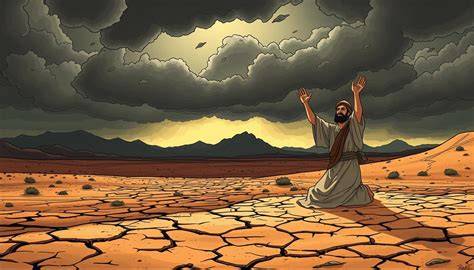
Elijah arrives on the scene, pronouncing God’s judgment on Ahab and His people in the form of a great drought that would end only when Elijah gave the word (1 Kings 17:1).
Elijah boldly stands up and proclaims what God has already said. God’s people were to trust God alone for rain. If they turned to another god, then God would withhold rain.
This specific judgment is fitting since Baal was supposed to give rain. Not only will it not rain, but also there will not even be dew.
No one could claim “bad luck” or a “bad break.” No rain and no dew clearly demonstrated God’s judgment.
James says that Elijah prayed fervently that it would not rain for three-and-a-half years. Although 1 Kings 17 never says Elijah prayed for a drought, we do find Elijah praying in 1 Kings 18:42 for the drought to end.
Other examples of his intense prayer life exist in the Kings narrative, but James focuses on the famine. It is a legitimate inference to think that he prayed for its onset as well.
I think the prayers of Elijah preceded his proclamation to Ahab. Elijah had been before God in the prayer closet prior to being before Ahab in the palace.
Elijah prayed according to God’s Word
What do we learn from Elijah’s prayer for this drought? Surely there are many lessons about faithfulness, persistence, and passion, but I would like to underline one important lesson.
Elijah teaches us to pray according to God’s Word. Elijah is simply claiming the promise of God’s word.
Why a drought? It was because this came directly from Scripture. Elijah knew his Bible. He knew the punishment for idolatry was famine.
Elijah’s prayers were not rooted in his own imagination. He wasn’t asking God to perform neat tricks. He was boldly asking God to act on His own word.
Some think since God has promised something, we shouldn’t ask Him. No, the promise should inspire us to pray.
It’s as if the promise awaits a prayer. An example of praying the promises is found in Daniel 9:1-19. The prophet Daniel was reading Jeremiah concerning the end of the exile after 70 years, and he realized it was near.
He didn’t go dancing into the streets; instead we read, “So I turned my attention to the Lord God” (Dan 9:3).
Here is one of the first ways Elijah schools us in prayer: pray Scripture. How do you pray for 45 minutes (and more!)? Read, pray. Read, pray. Fill your prayers with the Word of God.
James says in his epistle, “You have not, because you ask not” (Jas 4:2 KJV). Jesus said, “If you remain in Me and My words remain in you, ask whatever you want and it will be done for you” (John 15:7).
As you abide in the Word, ask and keep on asking your Father to act on His Word. Ask Him for provision and the Spirit’s power, for wisdom, boldness, and illumination-these things and more are in line with His Word.
Let’s not fall into prayerlessness or unbelief, but let us cry out to God with passion and understanding of His Word, believing He hears the prayers of His children and loves to answer.
Elijah’s obedience shows that he believed God
Because Elijah believes what God has said, he obeys it. The word of the Lord came to Elijah and he submitted to it: “So he did what the Lord commanded” (1 Kgs 17:5).
“So Elijah got up and went to Zarephath” (17:10). “So Elijah went to present himself to Ahab” (18:2).
His life was consumed with obedience to God’s word, even though it called for radical actions like “drink from a brook and let the ravens feed you.”
It sounds simple, but his sensitivity to God’s word sets him apart from his culture. He lived by God’s word in a culture that rejected it.
Elijah followed God step-by-step, never hesitating, never asking questions. Elijah is like us; let’s be like him.
Elijah teaches us to believe what God has said. God is the living God, and we must be a people who speak, pray, and obey His living Word because we believe it.
Elijah’s private walk with God
Elijah’s courage is linked to his private walk with God. All of us need to get away from distractions, from skeptics, from the demands of work, and get alone with God.
God is not impressed with our busyness. He is only impressed with who you are and who you are becoming.
Oftentimes, there is a lot of activity in our lives, but not a lot of accomplishment; we are great doers in public, but deficient in our private devotional life (John 4:23-24).
Elijah obeyed God’s command to “hide himself” (v. 3). His courage in public was connected to his communion with God in private.
Elijah believed that the God of Israel is alive. Elijah believed he was God’s representative. Elijah believed in God’s power.
Elijah was unimpressed with Ahab’s palace; he was a representative of the living God-the King of the Universe.
Nothing honors God more than to say, “God, you say this, and I believe it. And with your help, I am going to order my life according to it.”
God provides for Elijah during the drought
Ravens at the Cherith Ravine
Like Moses, Elijah flees to the East after an initial confrontation since he needs protection from Ahab. He goes to this inhospitable area east of the Jordan.
While he may be spared from Ahab, it looks like he cannot be spared from death, for there is no food. However, Elijah drinks from the brook and gets fed by a raven.
First, God controls not only the rain but also the whole natural order. He even controls the ravens, ceremonially unclean creatures now used for God’s purposes of sustaining the prophet’s life.
We know God provides for the birds of the air, and here He uses the birds of the air to provide for His prophet.
Elijah is looking ultimately to the God who reigns over nature for daily food and water, not to the raven or the brook.
Second, the bread and meat are brought in every morning and evening, thus Elijah has a replay of the wilderness meal plan.
God provides “daily bread” (cf. Matt 6:11) and actually provides it more abundantly than in the wilderness, for Elijah eats both bread and meat twice a day (cf. Exod 16:8,12-13).
All of this should encourage us. God controls the natural order. Jesus reminds us to “look at the birds of the sky” and consider how God provides for them; He asks, “Aren’t you worth more than they?” (Matt 6:26).
He teaches us not to worry about “what [we] will eat or what [we] will drink” (Matt 6:25). You can trust in God to provide for your daily needs.
He may not supply you with the finest of meats every day, and He may not provide in such a miraculous way as He did with Elijah, but God provides.
No doubt the false prophets of Jezebel ate better than Elijah during this period, but God still provided for him.
That too is a good lesson. Even the prophet is suffering from this famine; he isn’t immune to suffering. But he has the presence of God and the provision of God, and that is enough.
We who receive such daily bread should be grateful and content. Paul reminds us: “But if we have food and clothing, we will be content with these” (1 Tim 6:8).
Remember, too, the prayer which I quoted just now-“Give us this day our daily bread.” Not, “our weekly bread,” not, “our monthly bread,” not “our annual stores”-but, “give us our daily bread.”
God is pleased to give some of His servants in the bulk, but there are many others who only “live from hand to mouth”-and perhaps though not best for the flesh, it is best for faith, for we are apt, when mercies come regularly, to forget from whence they flow!
Let’s praise God from whom our daily bread flows!
< h3> The widow of ZarephathWhen the brook dries up, God’s provision for Elijah gets more dramatic. He now goes to a little Phoenician town of Zarephath, which is Baal’s territory and Jezebel’s stomping grounds.
Here, God promises to use an unnamed widow to provide for Elijah. Not only can Baal not stop the drought, but Yahweh’s provision also extends right into Baal’s home turf.
God has prepared a table for Elijah in the presence of his enemies. Elijah goes to “stay there” (v. 9) and experience God’s power and grace.
It seems that each experience prepared Elijah for the next challenge. We see this in the life of David, who killed a lion with his bare hands and then boldly faced Goliath.
We also see this in the life of Jesus, who endured the wilderness test and then faced a more difficult challenge in the garden. Every trial and test prepares us for what is next.
Widows were poor and vulnerable during this period. When Elijah approaches this particular lady, he first asks her for some water.
After her favorable response he also asks her for “a piece of bread” (v. 11). Even though she isn’t an Israelite, she answers in the name of Elijah’s God-“As the Lord your God lives”-and then tells him that all she has is a handful of flour and a little jug of oil, which she planned on using for the last meal before she and her son die (v. 12).
Not exactly the best time to show up for dinner!
Elijah tests her faith and asks her to provide for him first, then for herself and her son. He assures her that there will be enough for her and her son and that her flour and oil will last through the drought.
She trusts in this promise, acts accordingly, and God provides. Elijah’s word is confirmed through this miracle.
Can you imagine this scene? Every day the widow goes over to her barrel of flour and jar of oil and had just enough bread to bake for one more day.
Elijah could have testified with the psalmist, “You who are His holy ones, fear Yahweh, for those who fear Him lack nothing” (Ps 34:9).
God’s providence, sovereignty, and compassion
This passage teaches us some important lessons about the nature of God. It teaches us about God’s extraordinary providence.
It highlights God’s exclusivity, for only the true and living God could provide.
Observe also God’s sovereignty. God chooses this one, unnamed widow to provide for Elijah.
God tells Elijah, “I have commanded a woman who is a widow to provide for you there” (v. 9). But we don’t read that God ever speaks to her.
Even though she has no prophet to tell her this news, God can ordain it to be so because He is the only sovereign.
Proverbs tells us, “A king’s heart is like streams of water in the Lord’s hand: He directs it wherever He chooses” (21:1), but here we see that God also works sovereignly in the lives of the least of these.
Additionally, we should marvel at God’s compassion. God shows amazing concern for this weak widow and her son.
We know that God is a “father of the fatherless and a champion of widows” (Ps 68:5). Here is just one example of such mercy and care.
God’s grace reaches outsiders
We should also underline God’s saving grace to outsiders. When she says, “As the Lord your God lives,” this doesn’t seem to be her confession of faith yet.
She calls God “your God” but not yet “my God.” But here Elijah is an example of a messenger taking the good news to the nations, and later she believes (1 Kgs 17:24).
Jesus refers to this widow in Luke’s Gospel, a Gospel that has numerous allusions to Elijah:
He also said, “I assure you: No prophet is accepted in his hometown. But I say to you, there were certainly many widows in Israel in Elijah’s days, when the sky was shut up for three years and six months while a great famine came over all the land. Yet Elijah was not sent to any of them-but to a widow at Zarephath in Sidon. (Luke 4:24-26)
After Jesus expounds Isaiah, claiming that His ministry is about bringing good news to the poor and proclaiming liberty to the captives (Luke 4:18), His hometown rejects Him (4:22,28-30).
In response Jesus uses this story of the widow of Zarephath, an outsider, to warn them. While there were many poor widows during the three-and-a-half-year drought in Elijah’s day, he wasn’t sent inside Israel but outside Israel to this widow.
A foreign lady, by faith, accepted the word of Elijah and trusted in Elijah’s God (1 Kgs 17:24).
Jesus is saying that while not everyone in His hometown will accept Him, other outsiders will. He compares those in Nazareth to the apostates in Ahab’s day.
As for the widow, salvation will open up to all kinds of people.
Jesus then tells how God uses Elisha to heal an Aramean Gentile leper, Naaman (Luke 4:27). God again worked outside of Israel.
God isn’t a tribal deity. He is the God of the nations (cf. Acts 10:45). He will have a people from every tribe and tongue.
Let us remember this and rejoice that we have received His grace, and let us proclaim the good news to everyone. The most unexpected people may find saving faith in the most unexpected places.
God graciously provides daily bread to satisfy our physical hunger, and He has provided the bread of life in Jesus, who satisfies our spiritual hunger.
Let us, as His beggars, tell other beggars where to find bread.
Elijah and the God who raises the dead
So far the threat of death has been removed by these two miracles, but now a third and more dramatic miracle takes place. The widow’s son becomes ill and dies.
In response the widow blames Elijah for the tragedy. Elijah, however, takes the boy in his arms and cries out to God, “My Lord God, have You also brought tragedy on the widow I am staying with by killing her son?” (v. 20).
Both attribute this event to the Lord, but the difference is that the woman apparently thinks this is the end of the matter, while Elijah will not let it rest.
Notice in passing another lesson on prayer: the prayer of a righteous person doesn’t mean always having the right answers or always understanding God’s purposes.
Elijah took his anxieties and concerns to God in prayer. He prays in faith and desperation (Heb 11:35).
Once again he gives us an inspiring example for prayer. Pour out your heart to the living God in faith.
The writer says, “Then he stretched himself out over the boy three times. He cried out to the Lord and said, ‘My Lord God, please let this boy’s life return to him!’” (v. 21).
Elijah prays fervently and desperately. As a result we read, “So the Lord listened to Elijah’s voice, and the boy’s life returned to him, and he lived” (v. 22).
Remember Baal wasn’t the only god worshiped. Mot, the god of death, was also recognized.
Elijah isn’t only in Baal’s territory, but he’s also in Mot’s territory. Does Yahweh have to submit to Mot like Baal does? Of course not-God alone reigns over life and death!
You can have a dynamic prayer life because our God is the true and living God.
After the boy is raised, Elijah took the child and “gave him to his mother” and said, “Look, your son is alive” (v. 23).
The woman then confesses that she believes that the word of God is in Elijah’s mouth. At last she believes in the living God.
Elijah’s humanity is especially visible in 1 Kings 19
Most people see the crowning moment of Elijah’s life as coming in 1 Kings 18, in the showdown on Mount Carmel. Elijah faced off against the false prophets of Baal with all of the Israelites looking on.
By the time the curtain fell, the people who were watching it all take place, the people who had wavered between serving God and serving the false god, Baal, were heard crying out, “The LORD, He is God! The LORD, He is God!”
What an incredible scene it must have been. It hadn’t rained in the land for three and one half years, but Elijah prayed.
Nothing happened, not a cloud in the sky, but Elijah prayed and prayed and prayed until eventually, when he sent his servant back to check for the seventh time, he saw a cloud the size of a man’s hand rising over the sea.
What an amazing picture of the faithfulness of Elijah, the persistence of Elijah in prayer, and the steadfastness of Elijah in trusting in and following God.
James wrote, “Elijah was a man just like us…” Elijah was just like us in that he needed to be persistent in prayer and faithful and obedient in following God’s lead, regardless of the risk and regardless of the cost.
With that said, I’m almost certain many of your left worship thinking, “I’m nothing like Elijah. Look how God used Elijah. Look at the miracles God did through Elijah. Look at the courage of Elijah. I’m nothing like Elijah!”
It is almost unimaginable that immediately following 1 Kings 18 and the great victory of God over the false prophets of Baal, we find Elijah, in the very next chapter, 1 Kings 19, sitting under a broom tree and praying.
“I have had enough, LORD. Take my life; I am no better than my ancestors.”
How could Elijah have found himself in the depths of despair so quickly after he had experienced the greatest moment of his life? How could God’s faithful servant be tangled so tightly in the clutches of exasperation and hopelessness?
How could a man who loved God with his whole heart have experienced such deep despair?
Many of God’s people, people we read about in God’s Word, have felt exactly as Elijah felt and they were willing to share their feelings with God.
Moses, Job, Jonah, and Elijah
Moses
Let’s start with someone most everyone here this morning will recognize, Moses, the great deliverer used by God to free the Hebrews from 400 years of slavery in Egypt.
A man of faith? An obedient servant of God? You better believe it, yet there was a time, while he was leading those freed slaves through the wilderness that he had had enough.
Moses was at his wits end. The burden was too much. The people’s complaining had worn him slick and all he wanted at that point was to die.
Job
Or, how about Job, let’s take a look at Job’s life just for a moment. It’s one thing when people praise you, but it’s an altogether different deal when God points you out in a crowd, as He did Job to Satan.
God described Job as His servant. God said, “There is no one on earth like him.” God said, “He is blameless.” God said, “He is upright.” God said, “He is a man who fears God and shuns evil.”
And yet, you know what Job went through. He lost all of his kids, his hired-hands, his livestock, his health. He even lost his will to live.
Is this the same man God described with such glowing terms? An “upright and blameless man?” A man unlike any man on the face of the planet who fears God and shuns evil? You got it! It’s the same man.
Jonah
Job and Moses were faithful, willing servants of God, but Jonah on the other hand, was one of the most reluctant, unwilling servants of God we find in the Bible.
Jonah hated the Ninevites and yet he went and preached the shortest sermon found anywhere in the Bible to the people of Nineveh.
The shortest sermon ever and yet the people of Nineveh heard the voice of God through the words of Jonah and they repented.
You would think Jonah would have been overwhelmed. After all, Jesus said, “I tell you that in the same way there will be more rejoicing in heaven over one sinner who repents than over ninety-nine righteous persons who do not need to repent” (Luke 15:7).
Jonah wasn’t excited at all. As a matter of fact, Jonah was furious! He was so upset that he walked out of the city and begged God to take his life.
Jonah began and ended in the same place, “It would be better for me to die than to live.”
What these accounts have in common
Do you see any commonalities taking place in the lives of Moses, Job, and Jonah that drove them to the depths of despair and caused them to just want to close their eyes and never wake up?
I see something they all had in common and that was their circumstances, their experience of the painful predicament of life.
To Jonah, seeing the Ninevites repent was the most painful of all possible experiences because Jonah knew the Ninevites, he knew how they had tortured and brutalized others.
What’s interesting is that archaeologists have discovered reliefs, carvings in stone, in Nineveh, of the Assyrians torturing people by impaling, decapitation, flaying them with knives, and pulling out their tongues.
The Ninevites were some vicious people and Jonah wanted them to suffer in the same way they had made others suffer.
Watching God’s grace soften the hearts of the Ninevites drove Jonah to despair.
Elijah’s fear and exhaustion
So it was their circumstances, the experiences of life, that drove Moses, Job, and Jonah to want to die, but what about Elijah, the man who was just like us?
At the end of 1 Kings 18 we learn that after the defeat of the false prophets, Elijah ran all the way back to Jezreel, the capital of the Northern Kingdom, the very home of Jezebel and Ahab.
He must have been so overjoyed to see the hearts of the people turned back to God that he thought revival would break out all over the land.
Elijah must have thought, “Surely when Ahab gets home and tells Jezebel, even she will be convinced that the LORD is God!”
That’s not how it worked out did it? Jezebel said, “I’m going to kill you by this time tomorrow!”
The very next verse tells us, “Elijah was afraid and ran for his life.”
Elijah ran south, as far south as you can get, until he arrived in Beersheba. He left his servant and went a day’s journey further into the desert.
Elijah sat down under a broom tree and said, “I have had enough LORD. Take my life; I am no better than my ancestors.”
That’s it. No more. Please Lord, if this is the way it’s going to be just let me die.
Have you ever been there? Have you ever felt totally depleted by life? Exhausted and exasperated by the troubles that seem relentless when they are beating against your heart and your mind?
God’s response to Elijah’s despair
I want you to notice how God responded to His servant Elijah because it is so very different from the way many people respond to those who are struggling with God and with life.
After Elijah said, “I have had enough LORD. Take my life;” he laid down and fell asleep.
Then he lay down under the tree and fell asleep. All at once an angel touched him and said, “Get up and eat.” He looked around, and there by his head was a cake of bread baked over hot coals, and a jar of water. He ate and drank and then lay down again.
God’s response does not erase Elijah’s humanity. Instead, the account shows that a faithful servant can become exhausted, frightened, and discouraged without becoming a different species of believer.
Elijah, like Moses, Job, and Jonah, was affected by his circumstances. His faithfulness did not make him immune to suffering, fatigue, fear, or despair.
What “like us” means for believers
In saying, “Elijah was a man with a nature like ours,” James wants all believers to understand that we have an equal ability to pray powerfully and effectively.
We have the same possibilities available to us in prayer as Elijah did. God’s promises of answered prayer extend to all His children, not only to those considered among the spiritual elite.
Elijah was an ordinary human who offered extraordinary prayers in faith. He knew God’s heart and trusted Him to do what He had promised.
Through Elijah’s prayers, God did miraculous things-first stopping the rain for three and a half years and then providing rain again when Elijah prayed.
All believers can access the spiritual power in prayer that Elijah did by pursuing a close walk with God, so that we can know and follow His will.
Elijah was a man like us in times like ours. Most of all, he served the same God we serve - the God who never changes.
Truth is not “old” and it is not “new.” It is eternal, and it is for us.
The central lesson of the passage
The point of James 5:17 is not that Elijah possessed a special spiritual nature unavailable to other believers. The point is that God answered the earnest prayer of a human being who trusted Him and prayed in accordance with His Word.
Elijah’s example challenges believers to pursue close fellowship with God, to pray boldly, to persevere when no immediate answer appears, and to obey what God has said.
James wrote, “Elijah was a man just like us…” Elijah was just like us in that he needed to be persistent in prayer and faithful and obedient in following God’s lead, regardless of the risk and regardless of the cost.
Elijah is like us; let’s be like him.