In Isaiah 9:6, “Everlasting Father” does not mean that Jesus is the same Person as God the Father. Scripture teaches that God is one in essence and exists as three distinct Persons: God the Father, God the Son, and God the Holy Spirit. The title describes Jesus’ divine nature, eternal kingdom, and fatherly care for the people He came to save.
The Hebrew phrase translated “Everlasting Father” could be translated literally “Father of Eternity.” In the Hebrew construction of the phrase, father is the primary noun, and everlasting is the term that describes His fatherhood. He is Father forever, the King who protects, provides for, teaches, restores, and gives life to His people without end.
Isaiah 9:6 and the Names of the Messiah
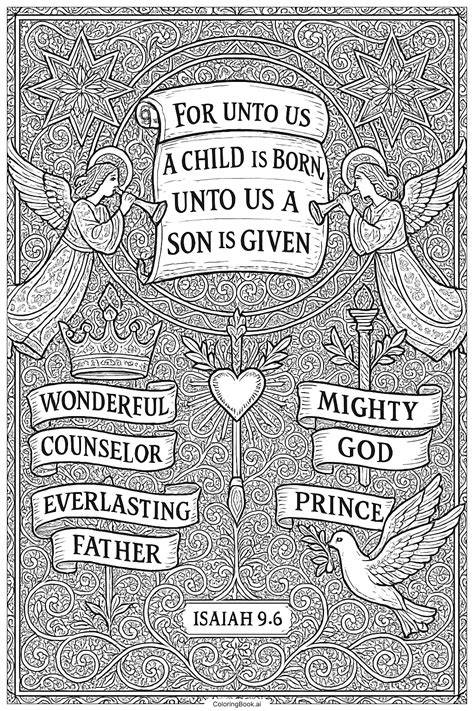
“For to us a child is born, to us a son is given; and the government shall be upon his shoulder, and his name shall be called Wonderful Counselor, Mighty God, Everlasting Father, Prince of Peace” (Isaiah 9:6, ESV).
This messianic prophecy announces the birth of a child and the giving of a son who will reign as King. Isaiah declares that Jesus would carry four titles that would be a reflection of His character: Wonderful Counselor, Mighty God, Everlasting Father, and Prince of Peace.
These names spoken by Isaiah the prophet describe the character and mission of the coming Messiah: Wonderful Counselor, Mighty God, Everlasting Father. Isaiah culminates all these names with the capstone of them all: the Prince of Peace.
The opening of the verse tells us Jesus is literally “a son” (both a human son, and Jesus the Son, the Second Person of the Trinity); the second part of the verse then gives us four characteristics about the Son.
| Title | What it reveals |
|---|---|
| Wonderful Counselor | His perfect wisdom and guidance |
| Mighty God | His divine power and nature |
| Everlasting Father | His eternal fatherhood, kingship, protection, and provision |
| Prince of Peace | His work of reconciliation, wholeness, and lasting peace |
How Can Jesus Be “Father” If He Is the Son?
One of the first questions that many of us have when it comes to Jesus carrying the title Everlasting Father is this, “If Jesus is the Son of God, then how can Isaiah call Him Everlasting Father?”
This question stems from God's existence as a Trinity. God exists as three distinct Persons but is of one essence. There is God The Father, God The Son, and God The Holy Spirit. He is three in one. He is one God who exists as three Persons.
So, the first thing we need to realize is that Isaiah isn’t teaching us that God the Son is the same person as God the Father. Scripture teaches that even though they are all of one essence, God the Father, God the Son, and God the Holy Spirit are three distinct Persons.
Isaiah is not saying that Jesus, the Son of God is the same Person as God the Father. He is not talking about Jesus’ role in the Trinity.
The title does not teach Modalism
In 200 A.D. a man named Sabellius began teaching what became referred to as Modalism. He said that God only existed as one person, but that he would operate in these different modes of The Father, Son, and Holy Spirit.
The early church denounced this as heresy because it didn’t line up with Scripture. Those that teach God is a single Person “wearing different hats” or “manifesting Himself in various roles” must ignore or explain away an endless list of Scriptures starting in Genesis 1 and continuing through the last chapter of Revelation.
So we immediately can rule out that this verse is somehow saying that Jesus is literally one and the same as “God the Father” (not to be confused with being co-equal and co-eternal) which would destroy the very plain teaching of Scripture concerning the Trinity.
Since Jesus is called “son” and “father” in the same verse, we know this cannot be literal since it would represent an obvious and juvenile contradiction.
Jesus reveals the Father without being the Father
Jesus is a reflection of the Father and conduit of His nature and knowledge… in the same way we as human children are an IMPERFECT reflection of our parents image, Jesus was the PERFECT reflection of the God the Father.
Even there, Jesus says, John 14:9, “Whoever has seen me has seen the Father.” The man, Jesus, who came at Christmas, died on Good Friday, and now sits on heaven’s throne, he is “the radiance of the glory of God and the exact imprint of his nature.” If you see him, you see the Father.
To see Jesus live, speak and obey was to witness exactly what the Father would do. So in essence and nature, Jesus was a living representation of the Everlasting Father while here on the earth, and of course is that same representation spiritually for all eternity.
“Everlasting Father” connects God the Son with God the Father… there is no disconnecting or untethering Jesus from His Father. When we place our trust in Jesus, we have our security in God the Father.
The Hebrew Meaning of “Everlasting Father”
In Hebrew, “Everlasting Father” is Abi’ad. “Ab” means father, and “ad” means eternal. This phrase can be translated literally as “Father of Eternity,” so Isaiah could be saying that the coming Messiah is the Creator of everything, the One who brought it into being, and the One who initiated it.
The Hebrew phrase translated “Everlasting Father” could be translated literally “Father of Eternity.” For this reason, some have suggested that the title means that this coming Messiah is also the creator of everything: He is the father of time and eternity, the “architect of the ages.”
While we know this to be true from the New Testament (John 1:1-3, Colossians 1:16-17), that is not the emphasis in Isaiah.
Father of eternity
Eternity owes its existence to Jesus, and it is His power that sustains it. This could be what Isaiah is trying to get across with the title, Everlasting Father.
In Colossians 1, the apostle Paul writes one of the most Christological passages in all of the Bible, declaring the supremacy of Christ.
“The Son is the image of the invisible God, the firstborn over all creation. For in him all things were created: things in heaven and on earth, visible and invisible, whether thrones or powers or rulers or authorities; all things have been created through him and for him. He is before all things, and in him all things hold together. And he is the head of the body, the church; he is the beginning and the firstborn from among the dead, so that in everything he might have the supremacy” (Colossians 1:15-18).
The title highlights Jesus’ equal status in the Godhead and His divine nature. It exclaims His eternal nature, His equality with God the Father and God the Spirit, His “everlasting nature” as Alpha and Omega.
It declares Jesus’ timelessness, proclaiming 700 years before His birth that Jesus is eternally past and eternally future.
Father forever
However, some note that in the Hebrew construction of the phrase, “father” is the primary noun, and “everlasting” is the term that describes His fatherhood. In other words, as the Everlasting Father, Jesus is a father, and His fatherhood will be without end.
In the Hebrew construction of the phrase, father is the primary noun, and everlasting (ESV, NIV, KJV) or eternal (NASB) is the term that describes His fatherhood. He is Father forever.
The Hebrew word translated “everlasting” has the idea of “in perpetuity” or “without end.” Indeed, the next verse says of the Messiah, “Of the greatness of his government and peace there will be no end” (Isaiah 9:7).
The emphasis is forward looking, so “everlasting” is probably a better translation than “eternal,” which not only indicates “without end” but also “without beginning.”
So, as the Everlasting Father, the Messiah will be a father, and His fatherhood will be without end.
Everlasting Father and the Kingship Context
In context, this verse is proclaiming the redemption of Israel and the activities, titles, and blessings of the Messiah who is to rule the earth and usher in a reign of blessing and peace that will have no end.
Most commentators rightly examine the context and argue the title “Father” is related to kingship in the ancient Near East (ANE), given the other titles and the kingship themes in the chapter.
Based on the passage’s immediate context and the ANE background, I believe that “Everlasting Father” deliberately evokes covenantal kingship language from the ANE. In doing so, the announcement of the Son’s birth declares he’s the King of kings and his kingdom has no end.
The broader context of Isaiah 7-9
In Isaiah 7:1-9, Rezin (king of Syria) and Pekah (king of Israel) joined forces against Ahaz (king of Judah). The purpose of this attack was to set a ruler of their choosing over Judah.
The prospect of fighting two kings was terrifying to Ahaz, but the prophet Isaiah emphasized the importance of trusting in the Lord despite the threat (vv. 4-9).
To bolster the king’s faith, God invites Ahaz to request a sign “deep as Sheol or high as heaven” (vv. 10-11). When Ahaz refuses, Isaiah rebukes him, and the prophet announces the sign: A virgin will conceive and bear a son whose name will be called “Immanuel” (vv. 12-14).
While Ahaz is told that Rezin and Pekah will soon no longer be a threat (vv. 15-16), he’s also warned of the devastation that Assyria will bring on Judah (vv. 17-25).
Isaiah 8:1-4 returns to the theme of children and the downfall of Syria and Israel before describing the Assyrian threat (vv. 5-15).
The chapter concludes with an expression of Isaiah’s trust in YHWH and with Isaiah’s children as signs that stand in stark contrast to Ahaz’s lack of trust (vv. 16-22).
Ahaz and the wrong covenantal father
As seen in 2 Kings 16, Ahaz fails to trust the Lord. Instead, he appeals to Tiglath-pileser, king of Assyria, declaring him to be master and father-a suzerain king over Judah and over himself.
A suzerain was a king of one nation that had some measure of control and authority over another king and his kingdom. This meant Ahaz was ceding authority over his kingdom to the foreign power of Assyria.
Rather than trusting in YHWH, Ahaz trusted in princes. It’s important, therefore, to consider the nature of the covenant Ahaz made with Tiglath-pileser.
When Ahaz says “your servant and your son” (v. 7) to refer to himself, he’s declaring fealty to Tiglath-pileser and recognizing him as master and father. This declaration is further underscored by the tribute Ahaz offers, alongside his plea for deliverance from Syria and Israel.
Ancient Near Eastern covenant language
Covenants in their broader historical and cultural context intersect with treaties, laws, and royal grants, and often involve rituals, oaths, and other aspects of ANE society.
In the broadest terms, covenants may be divided into those between parties of equal status and those hierarchical in nature.
Parity treaties are well attested in the ANE. Unlike treaties between parties of unequal status, parity treaties refer to the parties as “brothers.” Old Testament examples include the covenants between Jonathan and David (1 Sam. 20) and Hiram and Solomon (1 Kings 5).
Hierarchical treaties, by contrast, use terms such as “father and son” or “master and slave” to formalize the superiority of one king over another.
The historical situation in 2 Kings 16 lies in the background of Isaiah 7, which in turn sets the context for the declaration of Isaiah 9.
The point is that Ahaz placed his trust in the wrong covenantal father. Isaiah 9 returns to the theme of kingship and the birth of a child.
By calling the son in verse 6 “Everlasting Father,” the prophet deliberately evokes ANE covenantal language in which greater kings are called “father” over lesser kings.
While Tiglath-pileser’s kingdom would rise and fall, the eternal Son’s kingdom will have no end. The title challenges you to ask, Where will you place your trust? Will you declare fealty to the princes of this world, or will you hope in the eternal Son alone?
Jesus as the Everlasting Father
Even though Jesus is the King of Kings and will reign on David’s throne forever (Isaiah 9:7), He treats His people not like subjects but rather as children. He treats us as a loving father would treat his own kids.
The title “Father” therefore communicates more than authority. It describes the way the Messiah exercises His authority: with commitment, protection, provision, correction, compassion, restoration, and enduring love.
A loving Father teaches His children
Good fathers teach their children. They teach them the truth about the world and how things work so that they will be aware and understand and know how to navigate through this world.
This is what Jesus as the Everlasting Father does.
“Jesus went throughout Galilee, teaching in their synagogues, proclaiming the good news of the kingdom…” (Matthew 4:23).
Jesus taught people truth. John even teaches us that Jesus was born into this world full of grace and full of truth (John 1:14), and Jesus Himself in John 14:6 says, “I am the way, the truth, and the life.”
In His earthly ministry, Jesus (as the Everlasting Father) taught people the truth about God, this world, their lives, and how to be reconciled to God by grace through faith. He continues to do the same thing today.
A loving Father meets the needs of His children
Good fathers meet the needs of their kids. They don’t always give them what they want, but they know what they need and they provide for those needs.
This is exactly what we see Jesus doing in His earthly ministry.
“Jesus went throughout Galilee, teaching in their synagogues, proclaiming the good news of the kingdom, and healing every disease and sickness among the people. News about him spread all over Syria, and people brought to him all who were ill with various diseases, those suffering severe pain, the demon-possessed, those having seizures, and the paralyzed; and he healed them” (Matthew 4:23-24).
Jesus, as the Everlasting Father, met the needs of people, and He meets the needs of people today. He meets your needs, and He cares and provides for you.
A loving Father emotionally connects with His children
Good fathers connect with their kids. They relate to them. They rejoice when they rejoice. They mourn when they mourn.
When Jesus was talking to Mary and Martha about their brother Lazarus dying and they showed Him his grave, John tells us this: “Jesus wept.” Then the Jews said, “See how he loved him!” (John 11:35-36).
Jesus showed emotion, and He demonstrated His love for people.
He even tells the parable of the Prodigal Son that when the son comes back, the Father (who is God in the story) goes running to him, throws His arms around him, and kisses him over and over.
Jesus as the Everlasting Father, loves you and expresses that love to you with an intimacy that is like no other.
A loving Father protects His children
Good fathers protect their kids.
In John 10, Jesus talks about being the Great Shepherd, and He says this: “My sheep hear my voice, and I know them, and they follow me. I give them eternal life, and they will never perish, and no one will snatch them out of my hand” (John 10:27-28).
First of all, verse 27 captures the intimacy of Jesus as a Father: “my sheep hear my voice” (they know me and I know them).
However, verse 28 also captures the fierceness of a Father. He will fight you tooth and nail if you come after one of His kids (“…no one will snatch them out of My hand.”).
Jesus, as the Everlasting Father, protects His children, and He fights for you and protects you from the enemy even today.
A loving Father forgives and restores
A good father will forgive his kids when they mess up and restore their relationship. This is what Jesus ultimately came to do.
He came to take the sins of all of humanity upon Himself and pay the penalty for them so that we could be forgiven and reconciled to God (1 Peter 1:24-25).
We even see Jesus forgive and restore Peter after he had denied Him three times (John 21:15-19).
Jesus (the Everlasting Father) through the cross and His resurrection, forgives and restores us to God as we receive His free give of salvation by faith.
A loving Father imparts life
A good Father imparts life to his kids. He infuses them with life, meaning, and purpose.
Look at what Jesus says in John 10:10: “The thief comes only to steal and kill and destroy. I came that they may have life and have it abundantly.”
The reason Jesus came was to bring us life, and He is the Source of that life (John 11:25).
The moment we put our faith and trust in Him for salvation, we have life (1 John 5:12). In Him, we have meaning, purpose, significance, and fulfillment.
As the Everlasting Father, Jesus imparts life to his children, and He is your Source of life today.
A loving Father is present and consistent
A good father is there for his children. He is present and consistently involved in their lives.
When Jesus was meeting with His disciples for the last time before His ascension, He gives them the Great Commission and says this: “And surely I am with you always, to the very end of the age” (Matthew 28:20).
Jesus tells His disciples that He will always be with them, but the reality is that He will always be with you too.
If you’ve trusted in Jesus for salvation, you are spiritually united to Him, and He will be with you forever. He will never leave you nor forsake you (Hebrews 13:5).
Everlasting Father and the Prince of Peace
Peace is something we all long for. It is one of humanity’s greatest needs and desires. We struggle with fear of the future, conflicts in relationships, financial stress, health problems and so much more.
In this day and age when anxiety is at an all time high, peace can seem like an impossible dream.
The title “Prince of Peace” encapsulates Jesus' identity as the divine ruler who brings about reconciliation, harmony, and spiritual wholeness.
The prophecy in Isaiah 9:6 was written during a time of great uncertainty and darkness for the nation of Israel. It was a time of political upheaval, when the people were yearning for a leader who would bring stability, peace, and divine guidance.
Peace with God
Sin had created a chasm between humanity and God, disrupting the peace that was intended in the original design of creation.
Jesus, as the Prince of Peace, restores this broken relationship by offering the way of salvation through His sacrificial death and resurrection. He reconciles humanity with God, ushering in a peace that surpasses all understanding.
Having a restored relationship with God is the foundation for peace with all of creation. So God sent Jesus to restore our relationship with Him.
The biblical meaning of peace
When we usually think of the word “peace”, we think of the lack of conflict or hostility or we picture someone being free from internal and external strife.
The Biblical concept of peace is much fuller than that. The Hebrew word for peace, šālôm, or the Greek word, eirēnē, means a sense of totality or completeness, success, fulfillment, wholeness, harmony, security and well being.
Shalom signifies completeness, wholeness, and prosperity in every dimension of life-spiritual, emotional, physical, and relational.
It is God’s perfect peace-His complete, lacking nothing type of wholeness and harmony. It is what we might experience when we say, “it is well with my soul.”
Peace in the midst of turmoil
The peace that Jesus offers extends beyond external circumstances. It encompasses inner peace-the tranquility of the soul that comes from knowing Christ and experiencing His transformative love.
In a world marked by turmoil, division, and conflict, Jesus brings a different kind of peace-the peace that reigns in the hearts of His followers.
This peace is not merely the absence of conflict but the presence of God's shalom, a holistic well-being that touches every aspect of life.
Jesus' words in John 14:27 reveal His unique gift of peace-a peace that is distinct from the world's fleeting tranquility. His peace transcends circumstances and extends to the depths of our hearts, guarding against fear and turmoil.
Jesus came as our Prince of Peace to bring us wholeness, perfect unity between us and God, harmony among creation and a victorious sense of well-being.
Jesus Christ is the only reason we can truly live peacefully with God and others.
The peace that remains to be completed
The peace Jesus brings is one that is beyond comprehension. It is a peace that comes from knowing that God has everything well in hand, even when it doesn’t look like it.
It is a sense of well-being, knowing you are perfectly safe in the middle of the storm because you have something beyond what is visible to anchor you.
It is knowing that you are part of the an unshakable Kingdom where you are safe, loved and abounding with grace. This peace comes from knowing your identity is secure in Christ and your destiny is sure.
While this world has yet to fully experience all that the Prince of Peace came to bring, His light is breaking into the darkness of this world and already making all things new.
The Kingdom of God is here, bringing peace.
Jesus introduced a Kingdom of peace and love when He came down to earth so many years ago. Because of that, we have hope!
We, as sons and daughters in the Kingdom of God, are called to continue this legacy of peace. (Matthew 5:9).
Let us continue His work by reflecting God’s peace and restoration to a world in desperate need of that kind of hope.
With the peace of God reigning over our lives, we will see glimpses of the Kingdom as we expectantly wait for the Prince of Peace to return and complete what He has started.
Why the Title Matters for Christian Faith
“Everlasting Father” fills the other titles with personal meaning. The all-wise counselor and all-powerful God who we meet in Jesus is also a spiritual Father.
This name fills all of that wisdom (Wonderful Counselor) and all that power (Mighty God) with love. It makes the Wonderful Counselor and Mighty God family.
An all-wise, all-powerful Messiah wouldn’t be good news for us if he wasn’t for us - if he didn’t exercise all of that wisdom and power for our good.
Jesus is that kind of Savior - he’s a father to those he came to save.
And not just any father, but an everlasting Father.
The strength and safety of his love will never wax or wane or end. He can get you through December, and January, and February, and every month and season until you’re home.
As the Everlasting Father, Jesus is the eternal King whose kingdom has no end, the perfect revelation of the Father, the Creator and Sustainer of all things, and the compassionate Father who eternally teaches, protects, provides for, forgives, restores, and gives life to His people.
tags: #everlasting #father #prince #of #peace