The Last Supper was the final meal that, in the Gospel accounts, Jesus shared with his apostles in Jerusalem before his crucifixion. The twelve men shown with Jesus were his disciples, or followers, and the meal became the setting for predictions about betrayal and Peter’s denial, as well as the institution of the Eucharist.
Leonardo da Vinci’s The Last Supper, painted between 1495 and 1498, places Jesus at the center of a table surrounded by the twelve apostles. Leonardo arranged the apostles into four groups of three, giving each figure a distinct psychological reaction to Christ’s announcement: “One of you will betray me.”
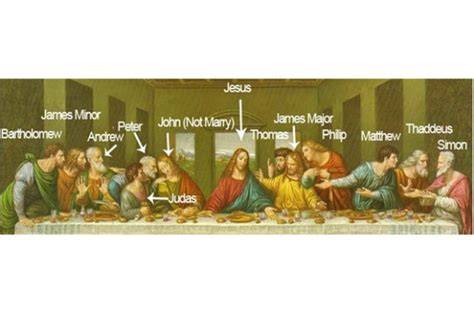
Who Were the Twelve Disciples at the Last Supper?
The apostles are identified from a mid-16th-century inscribed copy, reading left to right as the viewer faces the painting. Their order in Leonardo’s composition is Bartholomew, James the Lesser, Andrew, Judas Iscariot, Peter, John, Thomas, James the Greater, Philip, Matthew, Jude Thaddeus, and Simon the Zealot.
| Position | Disciple | Distinctive feature in Leonardo’s composition |
|---|---|---|
| 1 | Bartholomew | Leans forward with both hands pressed flat on the table |
| 2 | James the Lesser | Reaches toward Peter and places his other hand on Andrew’s shoulder |
| 3 | Andrew | Raises both palms in shocked denial |
| 4 | Judas Iscariot | Clutches his money bag and recoils from Christ |
| 5 | Peter | Leans toward John while gripping a knife |
| 6 | John | Swoons in sorrow with lowered eyes and clasped hands |
| 7 | Thomas | Raises his index finger |
| 8 | James the Greater | Spreads his arms in expansive disbelief |
| 9 | Philip | Places both hands on his chest in a pleading gesture |
| 10 | Matthew | Turns toward Thaddeus and Simon while gesturing toward Christ |
| 11 | Jude Thaddeus | Turns between Matthew and Simon in bewildered consultation |
| 12 | Simon the Zealot | Sits at the far right with open hands in questioning reception |
The Four Groups of Three Apostles
Leonardo organized the twelve apostles into four groups of three - a compositional revolution that replaced the static, frieze-like arrangement of every previous cenacolo. Each figure responds to Christ's announcement "One of you will betray me" with an individualized psychological reaction that Leonardo called moti dell'anima - movements of the soul.
Group One: Bartholomew, James the Lesser, and Andrew
Bartholomew has risen to his feet in startled tension, leaning forward with both hands pressed flat on the table. He is the farthest figure from Christ, yet his body language shows he has been electrified by the announcement. His heavy, frowning face with pursed lips is documented in a surviving red chalk study at Windsor (RCIN 912548).
Bartholomew was the son of Talmai. He lived in Cana of Galilee. He was known as a missionary in Armenia. Scripture shares that Jesus called him a man with no deceit.
Bartholomew was introduced to Jesus Christ through Saint Philip and is also known as "Nathaniel of Cana in Galilee," notably in John's Gospel. Many believe that Bartholomew may have also been referred to as Nathanael. That’s because the Gospel of John is the only one to mention a man named Nathanael (John 1:43-51).
Saint Bartholomew is credited with many miracles related to the weight of objects. We don’t know for sure how Bartholomew died, but based on paintings of him, many believe he was skinned alive.
James reaches his left hand back toward Peter in a gesture of seeking confirmation - Did he really say that? His body bridges the gap between the far-left trio and the explosive second group, creating a physical link across the composition. He simultaneously places his other hand on Andrew's shoulder in a gesture of shared bewilderment.
James the Lesser, also known as James the Just, was called "the Lesser" to distinguish him from James, son of Zebedee. He was also called the brother of Jesus.
James the Lesser was one of the pillars of the early Church and was present for significant events such as the feeding of the five thousand. He is referred to in Mark 15:40 as “James the less,” which likely means he was younger or shorter than the other James.
James and Matthew may have been brothers. In Mark 2:14, Matthew, referred to as Levi, is called “son of Alphaeus.” The only other person we see called the son of Alphaeus is James (Matthew 10:3).
Andrew holds both palms up in the universal gesture of shocked denial - Surely not! His open hands contrast dramatically with Judas's clenched fist in the adjacent group. This is the gesture of innocence asserting itself.
Andrew was the first apostle Jesus called and the first apostle to claim Jesus was the Messiah. Andrew was Peter’s brother, and the two were found by Jesus together (Matthew 4:18-22).
Like Peter, Andrew was also a fisherman by trade. He is often mentioned after Peter, which likely means he was his younger brother.
While Peter was the first to tell Jesus he believed he was the Messiah, Andrew may have been the first person ever to call Jesus the Messiah, period (John 1:41). In the account of Jesus feeding thousands of people with five loaves of bread and two fish, Andrew is the one who found the boy with the loaves and fishes (John 6:8-9).
Despite his seemingly important role as an early follower of Christ, Andrew is only mentioned 12 times in the entire New Testament-and four of those times are simply lists of the 12 apostles. He comes onto the scene early in the gospels, but only plays a minor role.
However, his prominence in the lists of disciples and the few glimpses we get of him seem to suggest he was one of the main apostles-even if he wasn’t one of the “pillars of the church”.
Group Two: Judas Iscariot, Peter, and John
This is the most psychologically intense group in the painting - containing the betrayer, the future denier, and the beloved disciple.
Judas Iscariot
Leonardo's most revolutionary decision: Judas sits among the other apostles, not isolated on the near side of the table as in every previous cenacolo. He is identifiable only through a constellation of signals: his face is uniquely shrouded in shadow, his head is the lowest in the entire composition, and he clutches his money bag with one hand while recoiling from Christ's announcement.
His hand reaches toward the same dish as Christ - evoking Matthew 26:23, "He that dippeth his hand with me in the dish, the same shall betray me." He alone wears conflicting colors - red, blue, and green - suggesting internal moral chaos.
An overturned salt cellar near him references both ancient Roman superstition and the Near Eastern expression "to betray the salt." A red chalk preparatory study at Windsor (RCIN 912547) shows his hooked nose, close-set lips, and strongly modeled muscular neck.
Judas Iscariot is notorious for betraying Jesus. Judas’s surname is more probably a corruption of the Latin sicarius (“murderer” or “assassin”) than an indication of family origin, suggesting that he would have belonged to the Sicarii, the most radical Jewish group, some of whom were terrorists.
Other than his apostleship, his betrayal, and his death, little else is revealed about Judas in the Gospels. Always the last on the list of the Apostles, he was their treasurer.
John 12:6 introduces Judas’s thievery by saying, “as he had the money box he used to take what was put into it.” Judas is most well-known for betraying Jesus for thirty pieces of silver (Matthew 26:14-16).
He ultimately regretted it, throwing the money away and hanging himself after finding out that Jesus was sentenced to death (Matthew 27:3-5).
Peter
Peter grips a knife in his right hand - foreshadowing his violent act in Gethsemane when he will cut off the ear of the high priest's servant. He leans urgently toward John, his body twisted with intensity.
In the Gospel of John, it is Peter who signals John to ask Christ who the betrayer is. A surviving Windsor drawing (RCIN 912546) studies the arm holding the knife. Peter's anger is palpable: he is already ready to fight.
Peter, also known as Peter the Apostle, Simon Peter, Simon, or Cephas, was one of the first leaders of the early Christian Church. He appears repeatedly and prominently in all four New Testament gospels as well as the Acts of the Apostles.
Peter was one of the first people to become a disciple of Jesus. He and his brother Andrew were discovered by Jesus while they were fishing, and Jesus invited them to come follow him and become “fishers of men” (Matthew 4:18-22).
Peter’s given name was Simon. Jesus gave him the nickname Peter, after the Greek word petros, which means “rock” (Matthew 16:16-18). We often see him referred to in the Bible as Simon, Peter, and Simon Peter.
Peter was married, and one of the first of Jesus’ miracles he witnessed was the healing of his mother-in-law (Mark 1:29-31). Peter was the first of the disciples to call Jesus the Messiah (Matthew 16:16).
Catholic tradition accredits Peter as the first bishop of Rome - or pope - and also as the first bishop of Antioch.
John
John swoons in sorrow, his eyes lowered, his hands clasped before him. His androgynous, beardless features are consistent with Leonardo's characteristic rendering of idealized youth and follow standard Renaissance iconographic convention - though Dan Brown's Da Vinci Code notoriously proposed the figure was Mary Magdalene, an identification unanimously rejected by art historians.
In previous cenacoli, John was always depicted asleep on Christ's chest; Leonardo replaced passive slumber with conscious grief. X-ray analysis revealed that Christ and John have no underdrawing - Leonardo painted these two critical faces entirely freehand.
John was the brother of James and the son of Zebedee, and came from a family of fisherman. He was one of Jesus' closest confidants, along with Peter and James, and was present at many important events in Jesus' ministry.
John was James’s brother (Matthew 10:2-4), and the two were fishermen together (Luke 5:9-10). Like Peter and Andrew, James was a fisherman along with his brother, John. The two of them actually worked with Peter (Luke 5:9-10).
John wrote five books in the Bible: John, 1 John, 2 John, 3 John, and Revelation. He is traditionally believed to be the author of several New Testament works, including the Gospel of John, the three Letters of John, and the Revelation to John.
He is also known as John the Divine and St. John. Jesus asked John to take care of his mother, Mary, right before he died on the cross (John 19:26-27).
John is believed to be the only disciple who died of natural causes - the rest were killed because of their faith in Jesus.
Jesus Christ at the Center
Christ's body forms an equilateral triangle - the prime geometric symbol of the Trinity. He sits in calm isolation amid the surrounding turmoil, his arms open in a gesture that Leo Steinberg interpreted as simultaneously reaching toward bread (left hand) and wine (right hand), linking the betrayal announcement with the institution of the Eucharist.
The vanishing point of the entire perspective construction falls precisely at his right temple, identified by Renaissance brain theory as the sensus communis - the center of perception. Three windows behind him substitute for the eliminated halo, bathing him in natural light.
His garments carry layered color symbolism: red for his impending Passion and sacrifice, blue (ultramarine from lapis lazuli) for divinity and heaven. Christ's red garment required five separate coats of vermilion over a carbon-black primer.
Like John, his face has no underdrawing - Leonardo painted it entirely freehand. The Pinacoteca di Brera holds a contested chalk-and-pastel Head of Christ (40 × 32 cm), though it is heavily reworked.
Group Three: Thomas, James the Greater, and Philip
Thomas
Thomas raises his index finger - a gesture that prefigures his famous doubt after the Resurrection, when he will demand to place his finger in Christ's wounds. Leonardo collapses future and present into a single gesture, embedding prophecy into psychology.
Copies of lost Leonardo drawings for Thomas's hands survive at Windsor (RCIN 912544, attributed to Cesare da Sesto). The Google Arts & Culture gigapixel scan of the Giampietrino copy revealed Thomas's raised finger in detail no longer visible in the damaged original.
Thomas, also known as Didymus, meaning "twin" in Greek and Hebrew. He was a missionary from Galilee, Roman Empire (modern-day Israel).
Thomas is mentioned in the listings of the apostles in the Synoptic Gospels. In the Gospel of John, Thomas plays a particularly distinctive part, and is often condemned for his lack of belief, but was equally courageous and relentlessly sought the Truth.
Thomas may have been a twin. He is often referred to as “Didymus,” which comes from the Greek word for twin (John 11:16).
It’s Thomas who asks the question (John 14:5) that prompts Jesus to make a well-known declaration in John 14:6: “I am the way, the truth, and the life. No one comes to the father except through me.” Thomas famously doubted Jesus’ resurrection in John 20:25, earning him the nickname “Doubting Thomas.”
James the Greater
James spreads his arms wide in expansive disbelief, his mouth open. His is the most physically dramatic gesture in the painting - a full-body expression of stunned incomprehension.
A red chalk and pen-and-ink study at Windsor (RCIN 912552, 25.2 × 17.2 cm) is described as Leonardo's "only surviving Last Supper study drawn from the life," with rapid architectural sketches confirming its status as a working study made on-site.
James the Greater was the brother of St. John the Evangelist. James and John, along with the Apostle Peter, were part of Jesus’ “inner circle,” witnessing key events that the other apostles did not witness.
Jesus gave James and his brother John the nickname “Sons of Thunder” (Mark 3:17). Of the twelve disciples, James was among a select few who were very close to Jesus.
When Jesus went into the Garden of Gethsemane to pray the night before he was crucified, only James, Peter, and John were brought with him (Matthew 26:36-46). James was the first disciple to die for being a follower of Jesus (Acts 12:1-2).
After James was martyred, legend places his remains in Spain, where they are supposedly enshrined in a cathedral known as the Cathedral of Santiago de Compostela. Since the Middle Ages, people have walked from certain starting points across Europe to his tomb along pilgrimage routes that have become known as the Way of St. James.
Philip
Philip places both hands on his chest, his face turned toward Christ in a pleading expression: "Lord, is it I?" He requests explanation, his gesture one of wounded innocence.
A carefully elaborated black chalk study at Windsor (RCIN 912551) shows Leonardo idealizing a life drawing, taking the figure "one step out of the real world and into the divine."
Philip, the Apostle, is one of four people named Philip in the Bible, and he’s often confused with Philip the Evangelist, who plays a minor role in Acts. The other two Philips are both sons of King Herod the Great.
Like Peter and Andrew, Philip was born in Bethsaida (John 1:44). However, Philip is a Greek name - so it’s possible Philip had Greek heritage and could likely speak Greek.
Church tradition identifies Philip as the missionary to Greece, Syria, and Phrygia, but even early on, Philip the Apostle was frequently confused with Philip the Evangelist, also known as Philip the Deacon, which makes it hard to distinguish which details describe which Philip.
Add to that the legendary accounts from the Acts of Philip and Letter from Peter to Philip, and it becomes difficult to separate fact from fiction, too.
Group Four: Matthew, Jude Thaddeus, and Simon the Zealot
Matthew
Matthew turns toward Thaddeus and Simon, his arms extended toward Christ as if saying "Did you hear what he just said?" His body faces away from Christ but his gesture points back, creating a visual tension between retreat and reference.
Matthew, also known Levi, is traditionally regarded as the author of the Gospel of Matthew. When Jesus called Matthew to follow him, he was a tax collector, or “publican” - one of the most reviled professions in ancient Judaism.
Matthew was a tax collector (Matthew 9:9). Tax collectors had a bad reputation because many were known for lying about how much people owed and keeping the difference for themselves.
Jesus lumped Matthew and other tax collectors in with other sinners, making a powerful point that no one is too far gone for him to redeem (Matthew 9:12).
Matthew was referred to as Levi in Mark 2:14 and Luke 2:5-27. This may have been because he was from the tribe of Levi, or it may have been the Greek name he went by.
Matthew is a surprisingly obscure New Testament figure. And despite the fact that the church has long considered him the author of the Gospel of Matthew, little else is known about him.
While Matthew is honored as a martyr, no one knows for sure where or how he died. Various accounts say he was beheaded, stoned, burned, or stabbed - one even suggests he died of natural causes like John.
Jude Thaddeus
Thaddeus receives Matthew's urgent communication while turning toward Simon, creating a chain of reaction that binds the three figures into a unit of bewildered consultation. The group functions as a kind of internal committee, attempting to process the announcement collectively.
Jude is the reputed author of the canonical Letter of Jude that warns against the licentious and blasphemous heretics. The devotion to him as patron saint of desperate causes began in France and Germany in the late 18th century.
St. Jude is distinguished in John 14:22 as Judas but “not Iscariot” to avoid identification with the betrayer of Jesus. Indeed, the tradition of calling him “Jude” rather than the Scriptural “Judas” likely started to avoid such confusion.
He is listed in Luke 6:16 and Acts 1:13 as “Judas of James,” and, depending on the Bible consulted, he is probably the son or brother of St. James the Less, son of Alphaeus.
Jude is more probably identified with Thaddaeus, or Lebbaeus, in Mark 3:18 and Matthew 10:3 and less probably with Jesus’ “brother” Judas (Mark 6:3, Matthew 13:55).
Jude, also called Judas, was occasionally referred to as Thaddeus (Mark 3:16-19, Matthew 10:2-4) - probably so he didn’t get confused with the other Judas in the group.
Simon the Zealot
Simon sits at the far right, his hands open in a gesture of questioning reception. He mirrors Bartholomew at the far left as a bookend figure - both are at the extremes of the table, both straining to comprehend.
Copies after lost Leonardo originals for Simon survive at Windsor (RCIN 912549, 912550).
Simon, also called the Zealot, is mentioned in the lists of apostles provided in the Gospels of Matthew, Mark, and Luke, as well as in the Book of Acts. His epithet, "the Zealot," distinguishes him from Simon Peter, another of the twelve apostles.
The term "Zealot" refers to a political movement among Judeans that existed during the 1st century, which advocated for the violent overthrow of Roman rule in Judea. However, it is not definitively established whether Simon was actually a member of this movement.
The label "Zealot" could indicate his zealous nature or fervent devotion to the Jewish faith and cause rather than membership in a specific political group.
Simon the Zealot is often considered to have preached the Gospel in different regions, including Egypt and Persia, where he is sometimes said to have been martyred.
Simon is called “Simon the Zealot” when he is mentioned in the Bible. The Zealots were a violent group, and it’s possible Simon may have been associated with them before becoming a follower of Jesus.
The Biblical Setting of the Last Supper
The Last Supper is the final meal that, in the Gospel accounts, Jesus shared with his apostles in Jerusalem before his crucifixion. The Last Supper is commemorated by Christians especially on Holy Thursday.
The Last Supper provides the scriptural basis for the Eucharist, also known as "Holy Communion" or "The Lord's Supper". Jesus having a final meal with his disciples is almost beyond dispute among scholars, and belongs to the framework of the narrative of Jesus' life.
The New Testament mentions the Last Supper in five of its books. The First Epistle to the Corinthians (1 Corinthians 11:23-25) contains the earliest known mention.
The four canonical gospels state that the Last Supper took place in the week of Passover, days after Jesus's triumphal entry into Jerusalem, and before Jesus was crucified on Good Friday (Matthew 26:17-29; Mark 14:12-25; Luke 22:7-38).
The overall narrative that is shared in all Gospel accounts that leads to the Last Supper is that after the triumphal entry into Jerusalem early in the week, and encounters with various people and the Jewish elders, Jesus and his disciples share a meal towards the end of the week.
After the meal, Jesus is betrayed, arrested, tried, and then crucified. Key events in the meal are the preparation of the disciples for the departure of Jesus, the predictions about the impending betrayal of Jesus, and the foretelling of the upcoming denial of Jesus by Apostle Peter.
Jesus Predicts Judas’s Betrayal
In Matthew 26:24-25, Mark 14:18-21, Luke 22:21-23 and John 13:21-30, during the meal, Jesus predicted that one of the apostles present would betray him.
Jesus is described as reiterating, despite each apostle's assertion that he would not betray Jesus, that the betrayer would be one of those who were present, and saying that there would be "woe to the man who betrays the Son of man! It would be better for him if he had not been born."
In Matthew 26:23-25 and John 13:26-27, Judas is specifically identified as the traitor. In the Gospel of John, when asked about the traitor, Jesus states: "It is the one to whom I will give this piece of bread when I have dipped it in the dish."
Then, dipping the piece of bread, he gave it to Judas, the son of Simon Iscariot. As soon as Judas took the bread, Satan entered into him.
The Institution of the Eucharist
The three Synoptic Gospel accounts describe the Last Supper as a Passover meal. In chapter 26 of the Gospel of Matthew, Jesus prays thanks for the bread, divides it, and hands the pieces of bread to his disciples, saying "Take, eat, this is my body."
Later in the meal Jesus takes a cup of wine, offers another prayer, and gives it to those present, saying "Drink from it, all of you; for this is my blood of the covenant, which is poured out for many for the forgiveness of sins."
He continues, "I tell you, I will never again drink of this fruit of the vine until that day when I drink it new with you in my Father's kingdom."
In chapter 22 of the Gospel of Luke, the wine is blessed and distributed before the bread, followed by the bread, then by a second, larger cup of wine. According to Paul and Luke, he tells the disciples "do this in remembrance of me."
This event has been regarded by most denominations as the institution of the Eucharist. There is recorded celebration of the Eucharist by the early Christians in Jerusalem.
Jesus' actions in sharing the bread and wine have been linked with Isaiah 53:12, which refers to a blood sacrifice that, as recounted in Exodus 24:8, Moses offered in order to seal a covenant with God.
Some scholars interpret the description of Jesus' action as asking his disciples to consider themselves part of a sacrifice, where Jesus is the one due to physically undergo it.
Although the Gospel of John does not include a description of the bread and wine ritual during the Last Supper, most scholars agree that John 6:58-59, the Bread of Life Discourse, has a Eucharistic nature and resonates with the "words of institution" used in the Synoptic Gospels and the Pauline writings on the Last Supper.
Jesus Predicts Peter’s Denial
In Matthew 26:33-35, Mark 14:29-31, Luke 22:33-34 and John 13:36-38, Jesus predicts that Peter will deny knowledge of him, stating that Peter will disown him three times before the rooster crows the next morning.
The Synoptic Gospels mention that after the arrest of Jesus, Peter denied knowing him three times, but after the third denial, heard the rooster crow and recalled the prediction as Jesus turned to look at him. Peter then began to cry bitterly.
John’s Account: Foot Washing and the Farewell Discourse
John 13 includes the account of the washing the feet of the Apostles by Jesus before the meal. In this episode, Apostle Peter objects and does not want to allow Jesus to wash his feet, but Jesus answers him, "Unless I wash you, you have no part with me", after which Peter agrees.
In the Gospel of John, after the departure of Judas from the Last Supper, Jesus tells his remaining disciples that he will be with them for only a short time, then gives them a New Commandment.
"A new command I give you: Love one another. As I have loved you, so you must love one another. By this everyone will know that you are my disciples if you love one another."
Two similar statements also appear later in John 15:12: "My command is this: Love each other as I have loved you", and John 15:17: "This is my command: Love each other."
At the Last Supper in the Gospel of John, Jesus gives an extended sermon to his disciples. This discourse resembles farewell speeches called testaments, in which a father or religious leader, often on the deathbed, leaves instructions for his children or followers.
This sermon is referred to as the Farewell Discourse of Jesus, and has historically been considered a source of Christian doctrine, particularly on the subject of Christology.
John 17:1-26 is generally known as the Farewell Prayer or the High Priestly Prayer, given that it is an intercession for the coming Church. The prayer begins with Jesus's petition for his glorification by the Father, given that completion of his work and continues to an intercession for the success of the works of his disciples and the community of his followers.
Terminology: Last Supper, Lord’s Supper, and Mystical Supper
The term "Last Supper" does not appear in the New Testament, but traditionally many Christians refer to such an event. The term "Lord's Supper" refers both to the biblical event and the act of "Holy Communion" and Eucharistic, or "thanksgiving," celebration within their liturgy.
Evangelical Protestants also use the term "Lord's Supper", but most do not use the terms "Eucharist" or the word "Holy" with the name "Communion".
The Eastern Orthodox use the term "Mystical Supper", which refers both to the biblical event and the act of Eucharistic celebration within liturgy. The Russian Orthodox also use the term "Secret Supper", or Church Slavonic: "Тайная вечеря", Taynaya vecherya.
Time and Place of the Last Supper
The Date
Historians estimate that the date of the crucifixion fell in the range AD 30-36. Isaac Newton and Colin Humphreys have ruled out the years 31, 32, 35, and 36 on astronomical grounds, leaving 7 April AD 30 and 3 April AD 33 as possible crucifixion dates.
The Maundy Thursday church tradition assumes that the Last Supper was held on the evening before the crucifixion day, although, strictly speaking, in no Gospel is it unequivocally said that this meal took place on the night before Jesus died.
Historically, various attempts to reconcile the three synoptic accounts with John have been made. Annie Jaubert argued that there were two Passover feast dates, while Humphreys argued that the Last Supper took place on the evening of Wednesday, 1 April AD 33.
The date remains connected to the question of how the Gospel accounts relate the Passover chronology to the timing of Jesus’ crucifixion.
The Location
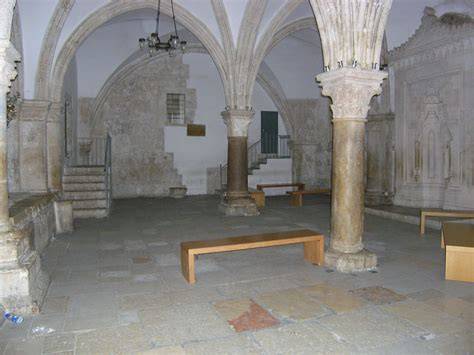
According to later tradition, the Last Supper took place in what is today called The Room of the Last Supper on Mount Zion, just outside the walls of the Old City of Jerusalem, and is traditionally known as The Upper Room.
This is based on the account in the Synoptic Gospels that states that Jesus had instructed two disciples - Luke 22:8 specifies that Jesus sent Peter and John - to go to "the city" to meet "a man carrying a jar of water".
The man would lead them to a house, where they would find "a large upper room furnished and ready". In this upper room they "prepare the Passover."
Leonardo’s Psychological Arrangement of the Apostles
Each figure responds to Christ’s statement with a separate movement, expression, and relationship to the surrounding apostles. Leonardo’s arrangement makes the announcement visible as a wave of shock that travels from one group to the next.
Leonardo's notebook passage reveals his method: he pre-scripted each figure's psychological action as a writer might draft stage directions, then translated narrative description into visual gesture.
“One who was drinking and has left the glass in its position and turned his head towards the speaker. Another, twisting the fingers of his hands together turns with stern brows to his companion.”
The four groups of three apostles encode layered numerological significance: three for the Trinity, four for the Gospels, their product twelve for the apostles.
This mathematical pattern proliferates throughout the painting: four sets of tapestries with three spaces between them on each side wall; three windows behind Christ framed by four structural supports; six rows of ceiling coffers, 3+3, hovering over twelve apostles.
Nothing in this composition is accidental.
The Disciples’ Contrasting Backgrounds
The group around Jesus included fishermen, a tax collector, figures connected with different Jewish traditions, and men whose later identities were shaped by missionary work, martyrdom, and Christian tradition.
Only Jesus could have brought together people with such diverse ideologies and backgrounds and equipped them all to share his story and message with others.
- Fishermen: Peter, Andrew, James the Greater, and John are associated with fishing and worked within overlapping family or professional networks.
- A tax collector: Matthew, also called Levi, belonged to a profession widely viewed with suspicion in ancient Judaism.
- A possible political radical: Simon was called the Zealot, although it is not definitively established whether he belonged to the Zealot movement.
- The betrayer and treasurer: Judas Iscariot was responsible for the group’s money and later betrayed Jesus.
- Missionaries and traditional authors: Several apostles are associated with missionary activity or New Testament writings, although some identifications remain uncertain.
While we know more about some of Jesus’ disciples than we do about others, one thing is for certain: Jesus makes a challenging point just by the group he brings around him, as if he’s saying “You may have your pre-conditions for what makes someone worthy of taking a seat at the table - but not me.”