Our Lady of Perpetual Help is associated with a long Catholic tradition centered on devotion to the icon of the Mother of Perpetual Help. The documented history of this wonder-working icon begins in 1495, when the image was highly reverenced in a church on the island of Crete.
The title is connected with the Redemptorists, who became custodians of the original icon and promoted devotion to Our Lady of Perpetual Help throughout the world. The icon was transferred to Rome in 1866 and remains enthroned in the Church of St. Alphonsus.
The origin and meaning of the icon
Our Lady of Perpetual Help, founded in 1890, is one of the oldest and most beautiful churches in the Tampa Bay area. Following is the history of this famous icon.
The original sacred picture of “Our Mother of Perpetual Help” is fittingly venerated in a church named after the Marian Doctor of the church St. Alphonsus Liguori. It was he who wrote that great spiritual classic, The Glories of Mary.
It is his sons, the Redemptorists, who are the custodians of the shrine and picture. They are forever associated with this miraculous image through their apostolic zeal in fostering reverence and devotion to our Lady of Perpetual Help throughout the world.
The story of this Icon is one of the most unusual and involved stories of the many Marian shrines and miraculous images throughout the world. At that time it was already considered of great age, with some writers placing its origin at either the thirteenth or fourteenth century.
It was afforded every measure of devotion because of the number of favors granted to those who prayed before it. Most writers agree that the painting came into the possession of a wealthy merchant in the late fifteenth century.
From Crete to Rome
Some writers claim that the merchant stole the painting. One claims that he obtained it through honest means, while still another reports that the merchant and others fled Crete with the painting when Crete was threatened by the Turks.
Whatever the reason, it is known that the merchant carried the painting with him to Rome, and that he became seriously ill. Before he died he requested that the painting be placed in a church as soon as possible.
Contrary to his request, the painting remained in private hands until 1499, when it was escorted in a solemn procession to the Church of St. Matthew on the Esquiline Hill.
A tablet which hung for many years beside the portrait told of this procession and noted that, “In this manner, the picture of the most glorious Virgin Mary was enshrined in the church of St. Matthew the Apostle, on the 27th of March, 1499, in the seventh year of the Pontificate of our most Holy Father and Lord in Christ, the Lord Pope Alexander VI.”
Our Blessed Lady seemed eager to make known the virtues of her image by way of a miracle that was performed during this procession. A man who had been paralyzed for some time was immediately cured when the image passed in procession near the house in which he lay.
The image at St. Matthew’s Church
For the next 300 years the image hung in St. Matthew’s church, where innumerable favors were granted to the people who prayed in its chapel. With members of the Augustinian Order as its guardian, the image was known by various names: Our Lady of St. Matthew, Our Lady of Never-failing Help, Our Lady of Ever-enduring Succor, and finally, Our Mother of Perpetual Help.
The title “Our Mother of Perpetual Help” therefore emerged from a long history of popular devotion. The changing names reflected the continuing reverence shown to the image and the belief that those who prayed before it received spiritual and physical favors.
Napoleon’s invasion and the disappearance of the icon
In 1798 Marshal Berthier, under orders from Napoleon Bonaparte, invaded Rome and forced Pope Pius VI into exile in France. One writer reports that Berthier’s successor, Massena, destroyed almost 30 churches, including the Church of St. Matthew.
Thankfully the priests had had time to remove the miracle-working image of Our Lady. For several years it found refuge in the Church of St. Eusebius.
It was then placed in the Church of St. Mary of Posterula, where it was hung in a side chapel and was all but forgotten for almost 40 years.
The image had at least one devoted admirer, an elderly lay-brother, Augustine Orsini, who was particularly devoted to it and often told its history to whomever would listen.
One of those who was keenly interested was a young altar boy, Michael Marchi. His later recollections would prove essential to the rediscovery of the icon.
The Redemptorists recover the image
When Pope Pius IX in 1853 requested that the Redemptorists establish a house in Rome, they chose a property on the Via Merula, which was located between the Lateran and St. Mary Major.
While the church was being built, one of the priests, Fr. Edward Schwindenhammer, mentioned that he had found a reference which revealed that their new church was being erected adjacent to the site where once had stood a church which enshrined a miraculous image of the Blessed Mother.
One of the priests replied that he knew the history of the image and the exact location where it could be found. The priest was the former altar boy, Michael Marchi.
On learning of the portrait’s whereabouts, the Redemptorist General, Fr. Nicholas Mauron, gained a private audience with the Pope. The Holy Father listened to his plan to have the portrait returned to the site where it had been enthroned for almost three centuries.
Pope Pius IX then recalled that as a small boy he had once prayed before the miraculous image while it was in the Church of St. Matthew. In compliance with the wishes of the Pope, the image was given by the Augustinians to the Redemptorist Church of St. Alphonsus.
Return to the Church of St. Alphonsus
Our Lady’s triumphal return to her chosen site took place on April 26, 1866. During this translation two noteworthy cures took place: one was the healing of a boy who was seriously ill with meningitis; the other miracle involved a young girl who received the use of her paralyzed leg.
Never has a portrait of the Mother of God been given as much papal attention as this image received from Pope Pius IX. Not only did he pray before the image as a boy, but he also approved its translation.
His approbation of the image was acknowledged on June 23, 1867, when the icon was crowned by the Vatican Chapter. The ceremony was conducted by the Latin Patriarch of Constantinople, whose presiding was indicative of the icon’s popularity among Easter Rite Christians.
Pope Pius IX also fixed the feast of the image for the Sunday before the feast of the Nativity of St. John the Baptist, and by a decree dated May, 1876, he approved a special office and Mass for the Congregation of the Most Holy Redeemer (the Redemptorists).
When confraternities were erected throughout Europe, the Pope combined them in 1876 into one Archconfraternity of Our Lady of Perpetual Help and St. Alphonsus.
The Pope’s name was the first in the register of the archconfraternity, and he was among the first to visit the portrait in its new home.
Spread of devotion in the United States
Devotion to this wonder-working icon spread rapidly to the United States. In 1870, when the Redemptorists were asked to establish a mission church in Roxbury, not far from Boston, they dedicated their small church to the Mother of Perpetual Help.
They received from Rome the first copy of the portrait, which had been touched to the original. Since then more than 2,300 copies that had been similarly touched to the original have been sent to other houses of the Order.
The United States also takes credit for inaugurating the Tuesday night devotions to the Mother of Perpetual Help.
Devotions that first took place at St. Alphonsus (Rock) Church in St. Louis, Missouri, on Tuesday nights, were quickly adopted by churches of the Order and by other churches, and took the form of a perpetual novena, a practice that is now observed worldwide.
Artistic features of the icon
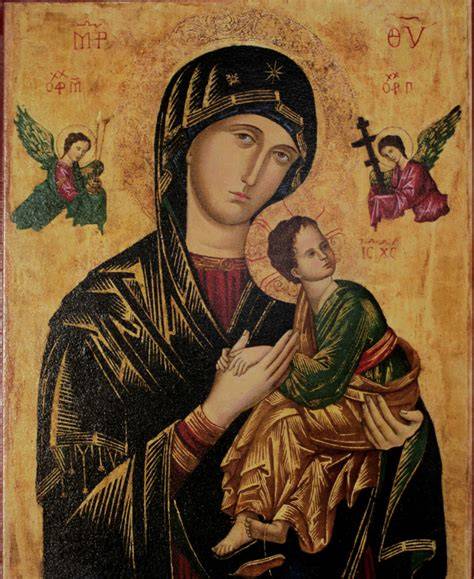
A study of the portrait is necessary to understand its historical and artistic qualities. Although its origin is uncertain, it is estimated that the portrait was painted sometime during the thirteenth or fourteenth century.
It is painted in a flat style characteristic of icons and has a primitive quality. All the letters are Greek.
The initials beside the Mother’s crown identify her as “Mother of God.” Those beside the child, “ICXC,” are abbreviations meaning “Jesus Christ.”
The smaller letters identify the angel on the left as “St. Michael the Archangel.” He is depicted holding the lance and spear with the vessel of vinegar and gall of Christ’s Passion.
The Angel on the right is identified as “St. Gabriel the Archangel.” He holds the cross and the nails.
When this portrait was painted, halos were not commonly depicted. For this reason the artist rounded the head and veil of the Mother to indicate her holiness.
The golden halos and crowns were added much later. The Madonna in this portrait is out of proportion to the size of her Son since it was Mary whom the artist wished to emphasize.
The charms of the portrait are many, from the naivete of the artist, who wished to make certain the identity of each subject was known, to the sandal that dangles from the foot of the Child.
The expression of the Child Jesus is haunting as He grips the hand of His Mother while gazing sideward at the instruments of torture held by the Angels.
Above all, the expression of the Madonna evokes a sadness on the part of the viewer. With her head gently touching that of her Son, and while surrounded with the instruments of her Son’s sufferings, she seems to gaze plaintively-as though seeking compassion from those who look upon her.
The icon today
Countless miracles attributed to the image extend from the time of its documented history in 1495 through the years until the present day. These seem to give ample testimony and proof of the portrait’s favor with the Mother of God.
The miraculous portrait is till enthroned on an altar in the Church of St. Alphonsus in Rome. The ruins of the Church of St. Matthew, where the image was reverenced for almost 300 years, are found on the grounds of the Redemptorist monastery.
Our Lady of Perpetual Help Parish in Morton
In response to a need for a Catholic Church in the then rural area of Morton, Pennsylvania, Archbishop Edmond F. Prendergast founded the new parish of Our Lady of Perpetual Help on December 1, 1907, with Rev. James J. Wilson as pastor.
Many of the parishioners were farmers and summer residents from Philadelphia. Ground for the new church was broken in June 1908, at the corner of Kedron and Franklin Avenues on land that was donated by the Faraday Improvement Company.
Construction was completed in November 1908. The Sisters of Saint Francis traveled from Glen Riddle each Sunday, starting in 1918, to give religious education to the children.
Development of the parish school
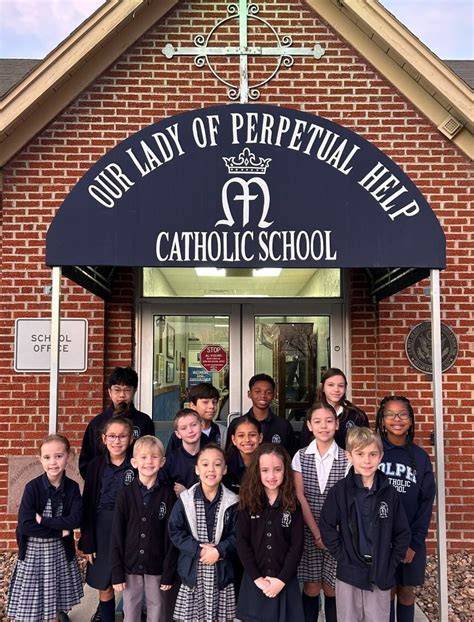
Mr. Bernard O’Connell sold his homestead on Amosland Road to the parish and the OLPH School was opened in September 1936, in his former residence.
On October 15 1949, the new school building was opened leaving only the convent to occupy the O’Connell house. The house, which was built in 1751, eventually needed to be replaced.
In January 1968, the Sisters of Saint Francis, who were teaching in our school, moved into their new, modern convent.
As the parish continued to grow, new classrooms were added to the school building and new organizations were begun.
New church and parish facilities
The increase in the number of families necessitated the construction of a new church building, and on May 30, 1981, the new church was dedicated.
The original OLPH church building was officially closed in December 1989. One month later, the structure and attached rectory were destroyed by fire.
To continue to meet the needs of this flourishing parish, a new rectory, daily chapel, and parish center were constructed and completed in 1990.
In 2000, six new classrooms and administrative offices were constructed, connecting the parish center and the old school.
With those additions, all OLPH parish buildings were situated on the same property, uniting the parish physically as well as spiritually.
Transition to regional Catholic education
Due to lower enrollment in the Catholic schools of the Archdiocese a process of merging schools ensued in January, 2012.
On June 16, 2012, Our Lady of Perpetual Help officially closed as a parish school. With the closure of Our Lady of Fatima parish school at the same time, both merged into a new regional Catholic school for the area.
On September 5, 2012, the school located on the campus of Our Lady of Perpetual Help Parish opened with the new name of Our Lady of Angels Regional Catholic School.
The initial student body numbered 510.