The tomb in which they buried Jesus of Nazareth was empty that first Easter morning. On this point the ancient eyewitnesses agree.1 The most historically and archaeologically credible location associated with Jesus’ burial is the Church of the Holy Sepulchre, although absolute proof of the tomb’s location remains beyond reach.
There are three tombs in Jerusalem people point to as the place Jesus of Nazareth was originally laid to rest in. Which one is the real one? Is there archaeological and historical evidence that can provide an answer to this question? Let’s analyze the claims of each tomb to see which site is the best candidate for being the actual place where Jesus was buried.
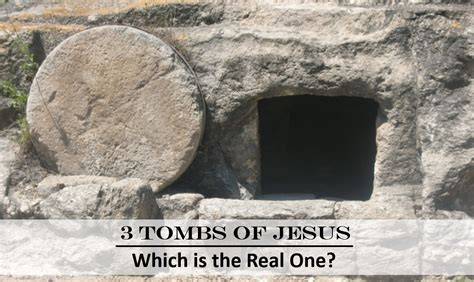
The Talpiot Family Tomb
Located about 5km south of the Old City of Jerusalem is the Talpiot Family Tomb. It was originally discovered in 1980, but rose to fame with the 2007 Discovery Channel documentary, “The Lost Tomb of Jesus,” which was produced by James Cameron and directed by Simcha Jacobovici.
The Talpiot Family Tomb was discovered in 1980 and likely belonged to a middle class family in the first century. Ten ossuaries were discovered within the Tapiot tomb bearing names such as Jesus, Mary and Joseph. The filmmakers identified one of the ossuaries bearing the inscription “Mariamene” as belonging to Mary Magdalene, suggesting she was married to Jesus.3
Only two of the ossuaries contained a patronym helpful in identification: “Jude, son of Jesus” and “Jesus, son of Joseph.” This has led some to conclude Jesus of Nazareth and Mary Magdalene had a son named Judah. However, scholars have pointed out that the presence of names such as Jesus, Joseph and Mary is not as compelling an argument as the filmmakers made it out to be. Simply put, they were among the most popular Hebrew names in the first century A.D.; Cameron and Jacobovici have read more into these names than is warranted.4
The Mariamene inscription and DNA evidence
Supporters of the Talpiot tomb also point to DNA testing, which demonstrated that Jesus and Mariamene were not maternally related. In the Discovery Channel documentary, the filmmakers use this as evidence to suggest they were married. Critics have pointed out, however, that they could have been paternally related (ie. father and daughter, or grandfather and granddaughter).
The James ossuary claim
Scholar James Tabor contends that that the famous “James, brother of Jesus” ossuary came from the Talpiot tomb, suggesting it was the family tomb of Jesus of Nazareth. Chemical testing that was financed by filmmaker, Simcha Jacobvici, is often cited as evidence that the James ossuary came from the Talpiot tomb.
A “chemical fingerprint” is said to have been found on both, with similar trace amounts of phosphorus, chrome and nickel, components in the clay of East Jerusalem soil. As impressive as this sounds, however, a very small sample size was used, calling into question the results.
Moreover, the James ossuary may have come from another tomb in East Jerusalem; the tests do not prove it came from the Talpiot tomb. Also, the physical appearance of the James ossuary, with its pitted and worn surface is unlike the smooth limestone surfaces of the ossuaries from the Talpiot tomb.
Archaeologist, Shimon Gibson, who was one of the original excavators of the Talpiot tomb has stated, “I don’t think the James ossuary has anything to do with Talpiot.”5
Problems with identifying Talpiot as Jesus’ tomb
It is interesting to note that, of the scholars interviewed for the documentary, all but James Tabor (who believes it is the family tomb of Jesus) have since objected to the way their statements were used and misrepresented.6 This, in and of itself, should give people pause in accepting the conclusions of the filmmakers.
Finally, the supporters of the Talpiot family tomb have failed to adequately explain the most obvious flaw in their theory: since Jesus’ family was from Galilee, why would they have a family tomb in Jerusalem?
Archaeologist, Jodi Magness, has pointed out that, at the time of Jesus, only wealthy families buried their families in rock-cut tombs and used the secondary burial practice of later interring the bones in ossuaries. A poor family from Galilee would have used an ordinary grave.
Furthermore, Magness asserts that the names on the ossuaries from the Talpiot tomb indicates that the tomb belonged to a family from Judea, where people were known by their first name and father’s name, whereas Galileans would have used their first name and hometown.7
Assessment of the Talpiot Family Tomb
Amos Kloner, one of the original excavators of the Talpiot family tomb, sums it up best: “It makes a great story for a TV film. But it’s completely impossible. It’s nonsense. There is no likelihood that Jesus and his relatives had a family tomb. They were a Galilee family with no ties in Jerusalem. The Talpiot tomb belonged to a middle class family from the 1st century CE.”8
The Talpiot Family Tomb therefore has several features that have attracted public attention, including inscriptions containing common names, DNA results and the disputed connection with the James ossuary. However, these details do not establish that the tomb belonged to Jesus of Nazareth.
The Garden Tomb, or Gordon’s Tomb
Another possible location for the tomb of Jesus is the Garden Tomb, popularized in 1883 by Charles Gordon (hence its alternate name - Gordon’s Tomb). Its serene setting in a garden makes it a popular tourist destination, particularly with evangelical Christians, who come to see the spot where Jesus was buried.
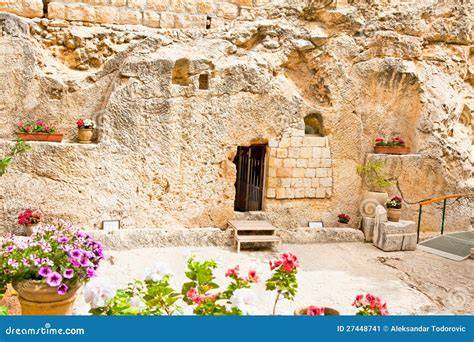
The Garden Tomb, as it appeared in the 1920’s, was only identified as a possible site for the tomb of Jesus in the 19th century.
How the Garden Tomb was identified
The history of the Garden tomb is littered with questionable identification tactics, such as Gordon’s belief that Jerusalem represented the shape of a skeleton with Skull Hill being the head9, and outright fraud, like Ron Wyatt’s claim to have found the Ark of the Covenant nearby.10
More importantly, no Second-Temple-era tombs have been found anywhere in the vicinity.11 Archaeologist, Gabriel Barkay, who has studied the tomb complex in which the Garden Tomb is located has concluded that it is an Iron Age tomb, dating to the 7th or 8th centuries B.C.
Its typology clearly resembles the other First-Temple era tombs in the area, particularly those on the property of the nearby Basilica of St. Stephen.12 The Garden Tomb was not a “new tomb in which no one had yet been laid” (John 19:41); it was already over 600 years old by the time of Jesus.
Assessment of the Garden Tomb
While there is perhaps value in having a tomb in the peaceful setting of a garden which reminds people of what the original tomb setting may have been like, this is not the actual tomb of Jesus.
The Garden Tomb’s peaceful landscape and visual resemblance to traditional depictions of Jesus’ burial make it meaningful to many visitors. Its archaeological date, however, places it centuries before the time of Jesus and makes it an unlikely candidate for his tomb.
The Church of the Holy Sepulchre
While it doesn’t look much like a tomb anymore, this edicule surrounds the remains of purported tomb of Jesus within the Church of the Holy Sepulchre.
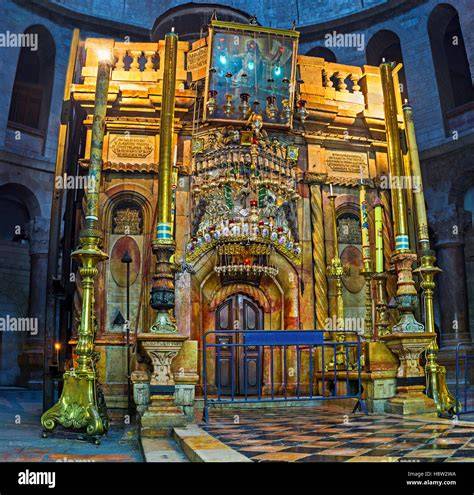
The site with the oldest attestation to being the resting place of Jesus of Nazareth lies within the Church of the Holy Sepulchre. In his work, Life of Constantine, early Christian writer Eusebius described how the emperor ordered the removal of the pagan temple that Hadrian had built and the discovery of the tomb beneath.
He also wrote about Constantine’s order to construct a church to honor the site.13 Archaeological research has demonstrated that this was the site of a Jewish cemetery in an ancient limestone quarry outside the walls of Jerusalem at the time of Jesus’s death.14
Historical testimony and archaeological setting
Today a shrine called the edicule surrounds the remains of the ancient tomb. The location is consistent with the burial setting described in the Gospels: a Jewish cemetery in a limestone quarry outside the city walls.
The site’s historical identification is also earlier than the identification of the Garden Tomb. The Church of the Holy Sepulchre is associated with the fourth-century building program of Constantine, while the Garden Tomb was identified as a possible site only in the nineteenth century.
The 2016 restoration and scientific testing
As part of restorations in 2016 to clean and structurally improve the edicule, experts removed the limestone slab that covered the burial bed of the tomb for the first time in almost 500 years.
During the unsealing of the tomb, mortar samples from different locations in the structure which confirmed the construction date of the mid-4th century and the rebuilt crusader chapel from the middle ages.
The mortar was dated using a technique known as optically stimulated luminescence (OSL) that calculates the last time the quartz sediment was exposed to light. The tests were conducted independently at two separate labs.15
These tests affirmed the ancient written history of the site.
Assessment of the Church of the Holy Sepulchre
Archaeologist John McRay sums it up best: “Although absolute proof of the location of Jesus’ tomb remains beyond our reach, the archaeological and early literary evidence argues strongly for those who associate it with the Church of the Holy Sepulchre.”
| Site | Evidence associated with the site | Assessment |
|---|---|---|
| Talpiot Family Tomb | First-century ossuaries bearing names such as Jesus, Mary and Joseph; disputed DNA and James ossuary claims | Belonged to a middle-class family from the first century CE, but there is no convincing evidence that it was Jesus’ family tomb |
| Garden Tomb | Peaceful garden setting and nineteenth-century identification | An Iron Age tomb dating to the 7th or 8th centuries B.C.; not the tomb of Jesus |
| Church of the Holy Sepulchre | Oldest attestation, fourth-century historical testimony, Jewish cemetery and limestone quarry setting, and archaeological confirmation | The strongest candidate, although absolute proof remains beyond reach |
What the tomb may have looked like
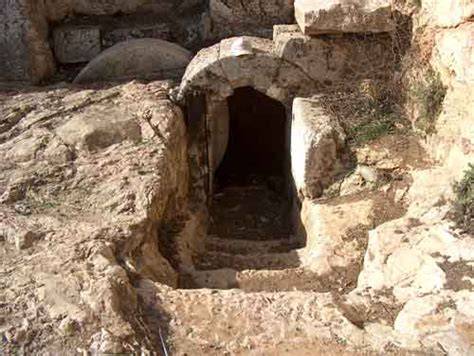
This is not one of the purported tombs of Jesus. This tomb is located on a road in Galilee from Mount Carmel to Megiddo near the Jezreel Valley.
It is one of the best examples of a first-century rolling stone tomb in all of Israel. It’s likely similar to the one in which Jesus was buried as the gospels record that the tomb in which Jesus was buried was sealed by a rolling stone (Matthew 27.60; Mark 15.46; Luke 24.2).
The empty tomb in the earliest testimony
The tomb in which they buried Jesus of Nazareth was empty that first Easter morning. On this point the ancient eyewitnesses agree.1 Matthew and John were disciples of Jesus who affirmed the empty tomb. (Matthew 28:1-10; John 20:1-10).
Eusebius records that Mark wrote the memories of Peter in the gospel he wrote, which testifies to the empty tomb (Mark 16:1-8). Luke claims to have written an orderly account based on the testimonies of eyewitnesses (Luke 1:2-3) and he also records the empty tomb (Luke 24:1-12).
Furthermore, both those guarding the tomb and the Chief Priests who pushed for Jesus’s crucifixion acknowledged this fact and concocted a tale about the disciples stealing the body to explain the empty tomb (Matthew 28:11-15).
It is telling that the earliest witnesses to tomb being empty and to having met the risen Jesus were women, a class that was sadly discounted as unreliable in the first century.
The vast majority of modern scholars - critical or otherwise - also agree.2 The testimony of the earliest disciples is that they had witnessed Jesus of Nazareth alive after his death and burial.
They spent time with him, ate with him, touched him and listened to him teach. For them, the empty tomb and their experience with their risen Lord formed the foundation of their belief in who Jesus was (God - John 20:28) and what he had done (died to pay the penalty for the sins of the world - 1 John 2:2).
The resurrection of Jesus was at the very heart of the gospel they preached (Acts 2:32-38) and remains the central teaching of Christianity 2000 years later.