The Mystery of the Cathedrals is a cryptic study by the mysterious French alchemist Fulcanelli, who interprets the sculptures, architectural forms, inscriptions, and religious images of Gothic cathedrals as symbolic descriptions of alchemical processes. The book focuses especially on Notre-Dame de Paris, with shorter discussions of the cathedrals of Amiens, Bourges, and Hendaye.
It is not simply a history of architecture or a conventional work of religious interpretation. Fulcanelli presents the Gothic cathedral as a “hermetic textbook in living stone,” a vast symbolic structure in which the stages, instruments, substances, and aims of the Great Work are concealed beneath Christian imagery and Gothic ornament. The book is fascinating, demanding, and highly controversial: it can be approached as an important document of twentieth-century esotericism, but its interpretations require a critical and historically informed reading.
Fulcanelli and the enigma of authorship
Fulcanelli, who lived in the first half of the twentieth century, has left almost no reliable trace behind him except rumors and astonishing feats attributed to a master alchemist. The identity of Fulcanelli remains unresolved, and this uncertainty is an essential part of the book’s mythology.
In 1926 the fabled alchemist Fulcanelli left his remarkable manuscript concerning the Hermetic Study of Gothic Cathedral Construction with a student. He then disappeared. One of the few details sometimes treated as certain is that he passed through and resided in Seville at the beginning of the twentieth century, in the district of Heliopolis.
The dedication of the book is addressed “To the brothers of Heliopolis.” This detail has contributed to the continuing fascination surrounding the author, although the available information about his biography is mixed with rumor, legend, and later speculation.
The mysterious Fulcanelli, who lived in the first half of the 20th century, has not left almost any trace behind him. except rumors and astonishing feats- of a Master alchemist.
Publication and place in twentieth-century alchemy
The Mystery of the Cathedrals was published in 1926, followed by its companion volume Dwellings of the Philosophers in 1929. Together, the two books became central texts of modern Fulcanellian and occult literature.
The most important Hermetic book of the Twentieth Century.
Seminal work by the mysterious master French alchemist Fulcanelli. Companion to his other book “The Dwellings of the Philosophers.”
For many readers, the book is an absolute must for anyone interested in alchemy. It is not a book to read once and put aside, but a book to study repeatedly. A reader who finds it completely impenetrable at one stage may understand more of it years later, after gaining familiarity with alchemical language, Gothic art, and Hermetic symbolism.
This is not a book to read, but a book to study, over and over and over again.
The cathedral as a hermetic textbook
Fulcanelli argues that the Gothic cathedral should not be regarded solely as a monument dedicated to Christian worship. Instead, it should be understood as a complete symbolic construction containing religious, philosophical, social, scientific, and popular ideas.
“The gothic cathedral, that sanctuary of Tradition, Science and Art, should not be regarded as a work dedicated solely to the glory of Christianity, but rather as a vast concretion of ideas, of tendencies, of popular beliefs; a perfect whole, to which we can refer without fear, whenever we would penetrate the religious, secular, philosophic or social thoughts of our ancestors.”
The book decodes the symbology found upon and within the Gothic Cathedrals of Europe which have openly displayed the secrets of alchemy for 700 years.
Most people probably view the hermetic symbols as the flourishes of Gothic architecture. However, for students of chemical or spiritual alchemy, there is much to learn from those symbols as well as from The Mystery of the Cathedrals and its sequel Dwellings of the Philosophers.
In Fulcanelli’s interpretation, stone, sculpture, stained glass, architectural geometry, inscriptions, animals, plants, biblical figures, saints, mythological characters, and liturgical objects can all carry several layers of meaning. A Christian image may simultaneously function as an allegory of a substance, a vessel, a stage of transformation, or an operation in the alchemical work.
The cathedrals examined in the book
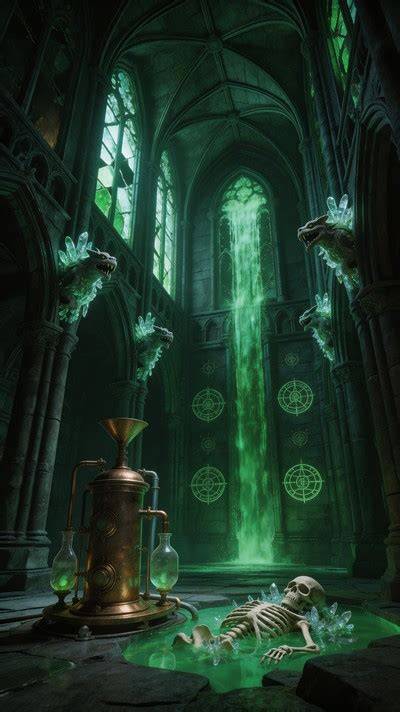
Fulcanelli’s discussion is organized primarily around Notre-Dame de Paris, with shorter visits to Amiens, Bourges, and Hendaye. These buildings provide the visual and symbolic framework for most of the book’s arguments.
In The Mystery of the Cathedrals Fulcanelli makes a survey-questionable for some readers-of the alchemical iconography of Notre-Dame de Paris, with briefer visits to Amiens, Bourges, and Hendaye. These visits structure the bulk of the book and its arguments.
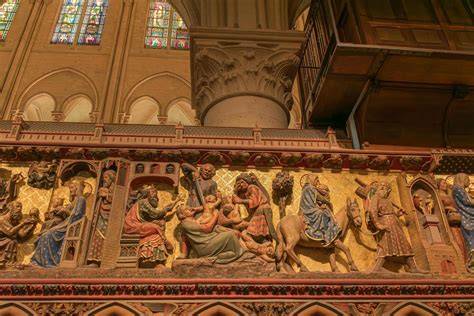
The analysis is especially concerned with bas-reliefs and other sculptural details. Fulcanelli treats these works not as random decorative additions but as deliberate images preserving a body of knowledge in a durable material form.
He explores in depth secrets contained within the Gothic cathedrals of France. He reveals a number of secrets, providing crucial clues into the occult work of the alchemists, contained in these massive repositories of knowledge preserved in stone.
Notre-Dame de Paris and the language of stone
Notre-Dame de Paris occupies a privileged position in the book. Its sculptures and architectural elements become a symbolic vocabulary through which Fulcanelli discusses the stages and principles of Hermetic practice.
The cathedral has long been described in superlative terms by tourists, Catholics and other Christians, mystics of many faiths, architects, and especially the French nation. Yet, in the Hermetic reading offered by Fulcanelli, the church is more than a beautiful or historically important religious monument.
It is, as the pseudonymous author Fulcanelli wrote in the original version of The Mystery of the Cathedrals, a veritable hermetic textbook in living stone to the alchemical process.
Victor Hugo’s description of Notre-Dame provides an important literary parallel to the book’s concern with preservation, mutilation, and the historical meanings embedded in architecture: “The church of Notre-Dame de Paris is still no doubt, a majestic and sublime edifice. But, beautiful as it has been preserved in growing old, it is difficult not to sigh, not to wax indignant, before the numberless degradations and mutilations which time and men have both caused the venerable monument to suffer, without respect for Charlemagne, who laid its first stone, or for Philip Augustus, who laid the last.”
Hermeticism beneath Christian imagery
Fulcanelli’s central interpretive claim is that Christian imagery and alchemical symbolism can coexist within the same work of art. The cathedral may openly glorify Christianity while also presenting, according to his reading, a coded account of the Great Work.
The author deciphers the messages of several bas-relief sculptures of Notre-Dame and two other Gothic cathedrals through the lens of Hermeticism. Specifically, he presents the images as metaphorical descriptions of the alchemical processes involved in the Great Work.
Many of the sculptures ostensibly glorify Christianity, yet their forms can appear, through Fulcanelli’s method, to reflect the stages, materials, and instruments of alchemical practice. At other times, the connection seems farfetched, especially in the sculptures associated with the cathedrals of Amiens and Bourges.
The book’s method therefore depends on a double reading. The first reading follows the visible religious and artistic subject; the second searches for an encoded Hermetic meaning beneath it. This method is the source of both the book’s power and its greatest weaknesses.
The Great Work and the Philosopher’s Stone
The Great Work was the process of creating a substance-the Philosopher’s Stone-that could transmute base metals into silver or gold.
Fulcanelli uses cathedral imagery to discuss the materials, stages, vessels, colors, operations, and transformations associated with this work. The book presents these elements through metaphors rather than through a clear laboratory manual.
The language of the alchemist is cloaked in mystery through the excessive use of metaphor. The processes themselves, as well as the minerals and instruments, are cloaked in metaphor.
For instance, the vessel for heating the ingredients is known as the “philosopher’s egg,” while “John’s Blackbird” signifies a stage of the process where the “compost” becomes pitch black.
Fulcanelli turns to many esteemed practitioners of the art to assist him in describing many, though incomplete, processes involved in the Great Work. These descriptions are often presented alongside interpretations of Gothic bas-reliefs that appear to reflect them metaphorically.
Symbols and subjects explored by Fulcanelli
The book treats an extraordinary number of subjects. Its range is one reason the reading can feel overwhelming: religious iconography, alchemical operations, mythology, architecture, language, color symbolism, sacred geometry, popular festivals, and philosophical concepts are brought together into one interpretive system.
- The Gothic cathedrals
- The Feast of Fools
- The Feast of the Ass
- The cross and the apse
- The ansate cross
- The crucible
- Black, white, and red
- Labyrinths
- The rota or wheel
- The magical seal of Solomon
- Isis, Ceres, and Demeter
- Rhea, Cybele, and the Black Virgins
- Offerus and Christopher
- Gothic art and argot
- The Moon and the Virgin Mary
- The Sun and God the Father
- Sacred wells
- The crow
- The green lion and the red lion
- Philosophical mercury
- The illuminating power of analogy
- The oak
- The athanor
- The four putrefactions
- The combat of the two elements
- Mercury and gold
- The universal solvent
- Recrudescence
- The death and rejuvenation of the King
- The Vessel
- The Work
- The Art
- The Philosopher’s Stone
- Solve et coagula
These subjects do not appear as isolated entries in a straightforward reference work. Fulcanelli links them through analogy, wordplay, mythological association, visual symbolism, and alchemical terminology.
Color, transformation, and putrefaction
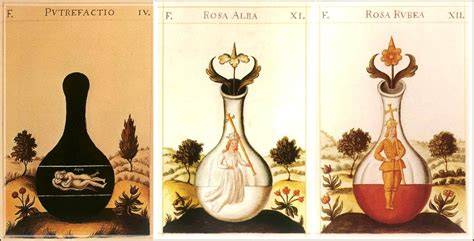
Black, white, and red are among the most important colors in the symbolic system of the book. They are connected with stages of transformation and with the changing condition of the material undergoing the Great Work.
The four putrefactions, the combat of the two elements, mercury and gold, the universal solvent, and recrudescence are all part of the book’s attempt to explain transformation through symbolic images.
The black phase is associated with putrefaction and dissolution, while the white and red phases belong to later stages of transformation in the traditional alchemical sequence. These associations are not always presented in a simple or consistent manner, because Fulcanelli’s explanations move between laboratory processes, mythological narratives, religious symbols, and linguistic correspondences.
The green lion and the red lion, the philosophical mercury, the crucible, and the athanor belong to the recurring vocabulary through which the book describes matter and the instruments of the Work.
Religious figures as alchemical symbols
One of the most striking features of Fulcanelli’s method is his reinterpretation of religious figures. The Virgin Mary, the Christ figure, saints, and biblical scenes can be treated not only as theological subjects but also as symbolic representations of materials and processes.
Isis, Ceres, and Demeter, together with Rhea and Cybele, are associated with the symbolism of the Black Virgins. The Moon may be connected with the Virgin Mary, while the Sun may represent God the Father.
Offerus and Christopher appear in discussions of the figure who carries or transports something across a threshold. The image may be read simultaneously through its Christian narrative and through an alchemical interpretation of matter, transformation, and passage.
These readings can be evocative, but they can also seem forced. A woman holding a lamb, for example, may be read by a Christian viewer as the Virgin Mary with the Christ child, while Fulcanelli’s system may reinterpret the image as a conjunction of sulfur and mercury.
This difference illustrates the basic tension in the book: Fulcanelli invites the reader to look beyond the most immediate interpretation, but the alternative interpretation is not always supported by evidence that would persuade a skeptical reader.
Argot, cabala, and wordplay
Fulcanelli gives considerable importance to language. Gothic art becomes “argotic” art, and names, inscriptions, puns, sounds, and double meanings are treated as possible carriers of Hermetic information.
The books are written in a cryptic and erudite manner, replete with Latin and Greek puns, alchemical symbolism, double entendres, and lectures on and in Argot and Cant, all of which serve to keep casual readers ignorant.
The so-called phonetic cabala is one of the weakest and hazier parts of the book for some readers. The wordplay can appear ingenious in one passage and arbitrary in another, particularly when similar sounds are used to connect ideas that have no obvious historical or linguistic relationship.
Fulcanelli repeatedly appeals to analogies between words, images, numbers, myths, and architectural details. The power of analogy is one of the book’s central themes, but the same method can produce interpretations that seem excessively elastic.
Sacred geometry, labyrinths, and architectural form
The book considers the cathedral as an organized structure in which geometry and symbolism work together. Crosses, apses, wheels, labyrinths, wells, towers, and other architectural forms can be understood as more than functional or decorative features.
Sacred geometry is embedded in the architecture, and Fulcanelli presents the forms of the cathedrals as part of a symbolic language connecting art, science, and spirituality.
The labyrinth is particularly important as an image of difficulty, initiation, and the gradual movement toward knowledge. The wheel or rota similarly suggests rotation, cyclical transformation, and the turning of the Work.
The seal of Solomon, the ansate cross, the oak, the sacred well, and the vessel form a network of symbols that can be approached historically, religiously, mythologically, or alchemically.
The Gothic cathedral is therefore presented as a unified organism rather than as a collection of isolated carvings. Its sculptures, plan, orientation, inscriptions, and internal spaces are treated as mutually reinforcing parts of a larger symbolic design.
The cathedral, tradition, and the preservation of knowledge
For Fulcanelli, stone offers a durable medium for the transmission of knowledge. Cathedrals have the advantage of being made of stone and diligently maintained, while other sources of symbols-and therefore information that was considered important enough to be recorded-may have become irretrievable through time and decay.
Cathedrals have the blessing of being made of stone and diligently maintained. Other sources of symbols, and therefore information that was viewed as important enough to be recorded, may be irretrievable due to time and decay.
This idea explains why the cathedral is so important to the book’s imagination. Written texts can be lost, altered, or misunderstood, whereas monumental architecture may preserve symbolic forms for centuries. The building becomes an archive in which images survive even when their original interpreters have disappeared.
The cathedral is thus both a religious monument and a repository of knowledge. Its meaning is not exhausted by the intentions of modern visitors, and its stone surfaces invite repeated acts of interpretation.
Alchemy as physical and spiritual transformation
The book is often understood as a work of practical or chemical alchemy, but it can also be approached through the modern idea of psychological and spiritual alchemy.
Modern-day students will find a great deal of help in the work of Carl Jung and others who view alchemy as more than trying to turn lead into gold but as a spiritual and psychological means of becoming wholly one’s divine self.
Some readers approach the book as a record of laboratory procedures involving minerals, metals, vessels, heat, dissolution, and recombination. Others read the same symbols as representations of inner transformation, psychological integration, death and renewal, or the movement toward spiritual wholeness.
The book itself does not always separate these approaches clearly. Its language moves between physical matter and spiritual meaning, allowing the same image to function as a description of a substance, an operation, a state of consciousness, or a stage in an initiatory process.
This is one reason the text continues to attract readers beyond the history of occult chemistry. It can be studied as an artifact of esoteric culture, a symbolic interpretation of medieval art, a literary work, or a manual of Hermetic philosophy.
Why the book is difficult to understand
The Mystery of the Cathedrals is famous for its obscurity. It is easy to read at the level of sentences, but difficult to understand as a complete system.
It is a fascinating but genuinely cryptic book, with passages that are often decipherable-or digestible-only by “adepts of the Hermetic Science,” that is, by students of alchemy.
It is a book of easy reading but difficult comprehension.
The language is dense because Fulcanelli assumes that the reader will recognize a large body of alchemical, biblical, mythological, architectural, linguistic, and philosophical references. Without this background, many of the allusions seem disconnected or obscure.
The author also relies on terminology that is intentionally indirect. Materials, instruments, and procedures are described through animals, colors, biblical characters, legendary objects, and coded names. A reader unfamiliar with the vocabulary of alchemy may not know whether a passage is discussing a physical substance, an allegorical figure, or a stage of the Work.
The book is not a work for the uninitiated or for those unfamiliar with alchemy. In order to understand it, one must have at least some knowledge of Gothic art and architecture as well as an understanding of the rudiments of alchemy.
A book for rereading and study
Many readers describe the experience of approaching the book at different ages or stages of knowledge. What seems completely impenetrable at first may become somewhat clearer after studying alchemy, Gothic art, Hermetic philosophy, or the history of religious symbolism.
I read this book when I was 12 years old to pass the time at my aunt’s house. Didn’t understand a single word of it. I remember it being particularly obscure and dense, but strangely fascinating.
Thirty years ago it was totally impenetrable to me, now less so. Perhaps in the future it will be even clearer, who knows?
Another reader had been studying the book since the 1971 English edition and still felt able to grasp only a fraction of it. This is not necessarily a defect from the perspective of its admirers: the repeated return to the text is part of its intended experience.
It is one of the books to return to repeatedly. A reader may find that the work yields different meanings after learning new terminology or encountering the sculptures and architectural details in person.
The importance of illustrations
The visual material is essential because the book’s arguments depend heavily on specific sculptures, reliefs, inscriptions, and architectural forms. A reader cannot fully evaluate an interpretation without being able to see the object being discussed.
In one edition, the illustrations of the Gothic sculptures that are so important for study were poorly rendered. The ink was too light to make out the details.
The placement of illustrations can also make the reading more difficult. When an image appears many pages before or after the passage that discusses it, the reader must interrupt the argument in order to locate the relevant visual evidence.
This problem is especially serious in a book that repeatedly asks the reader to compare a verbal interpretation with a precise visual detail. The effectiveness of the argument depends not only on the prose but also on the quality, scale, and placement of the images.
Literary qualities and evocative prose
Despite its density, the book contains passages of considerable literary power. Fulcanelli’s prose can be evocative, dramatic, and memorable, particularly when he describes the cathedral as a living repository of tradition and hidden knowledge.
Here and there, the prose reaches unsurpassed heights.
Fulcanelli possesses clear literary qualities, manifested in passages that are genuinely evocative.
The sense of mystery is created not only by the subject matter but also by the rhythm of the writing, the accumulation of analogies, and the suggestion that the visible world contains an order that ordinary perception fails to recognize.
The book’s literary force helps explain why it has remained influential even among readers who reject many of its specific conclusions. Its atmosphere, vocabulary, and vision of the cathedral can be more persuasive as imaginative literature than as demonstrated historical analysis.
Critical problems in Fulcanelli’s method
The interpretations in the book are not equally convincing. Some connections between a sculpture and an alchemical process may appear suggestive, while others seem to depend on arbitrary associations, excessive wordplay, or the rejection of more immediate explanations.
At times, Fulcanelli’s analyses seem farfetched, especially in those sculptures associated with the cathedrals of Amiens and Bourges.
The book contains digressions that can become verbose and fail to return clearly to the original argument. It includes non sequiturs, interpretations that appear convenient rather than reasonable, and associations that are difficult to verify.
Its most skeptical readers object to the tendency to treat every shell as a sign of Santiago de Compostela, regardless of its context, or to derive elaborate meanings from small differences in letters and sounds. Such readings can obscure the historical and artistic context of the image being interpreted.
Another problem arises when symbolic readings are treated as though they were factual explanations. The deterioration of pigments, for example, may be interpreted as evidence of deliberate concealment when ordinary material decay offers a more plausible explanation.
These difficulties do not make the book useless, but they make critical reading essential. The most productive approach is neither complete credulity nor immediate dismissal, but a willingness to distinguish between historical evidence, symbolic speculation, literary effect, and personal interpretation.
Fulcanelli’s appeal to independent judgment
One of the book’s most interesting qualities is its repeated appeal to the reader’s own judgment. Fulcanelli does not simply ask for an act of faith; he asks the reader to observe, compare, reflect, and test interpretations against the visible world.
Again and again he appeals to the reader’s own criteria and judgment. He does not ask for an act of faith; he asks for an act of will.
The Hermetic student, in this view, should not accept a theory merely because it appears in a famous book or comes from a respected author. Observation, logic, patience, and independent thought are treated as necessary conditions of serious study.
“The Mysterious Science requires great precision, exactness and perspicacity in the observation of facts; a sound, logical and balanced mind; a lively imagination without exaltation; a passionate and pure heart. It also requires great simplicity and absolute indifference towards theories, systems and hypotheses which, relying on books or the reputation of their authors, are usually accepted without verification. It wants its aspirants to learn to think more with their own brains and less with those of others. Finally, it asks them to seek the truth of its principles, the knowledge of its doctrine and the practice of its works in Nature, our common mother. Through the constant exercise of the faculties of observation and reasoning, through meditation, the neophyte will climb the steps leading to KNOWLEDGE.”
The importance of skepticism
A critical approach is particularly important because Fulcanelli’s reputation can make the reader reluctant to question him. He is often treated as an untouchable or cult figure, and the mystery surrounding his identity can encourage readers to interpret obscurity as proof of profundity.
The book is fascinating, but it contains passages that are genuinely obscure, and some of its interpretations appear questionable. The author’s unknown identity makes it difficult to separate his statements from later legends about him.
Some readers are more interested in the legends surrounding Fulcanelli-his identity, alleged unnatural lifespan, disappearance, and ominous prophecies-than in the book itself.
These legends may be historically interesting, but they should not be confused with evidence for the truth of the interpretations. The mystery of the author and the mystery of the cathedrals reinforce each other, yet they are separate questions.
Alchemy, architecture, and the history of interpretation
The book occupies an unusual position between art history, religious studies, occult philosophy, literary symbolism, and the history of alchemy. It does not follow the standards of modern academic scholarship, but it has had a lasting influence on the way many readers imagine the relationship between medieval architecture and esoteric knowledge.
Its central image-the cathedral as a repository of coded wisdom-has proved especially influential. The idea that medieval builders concealed a second message beneath Christian forms has appeared in later esoteric writing, popular history, fiction, documentaries, and discussions of sacred architecture.
At the same time, the book’s method can lead readers to overlook the many non-alchemical meanings of Gothic art. Medieval sculpture was shaped by theology, liturgy, patronage, local traditions, workshop practice, political ideas, popular beliefs, and the practical requirements of architectural decoration.
A careful reader can therefore study Fulcanelli without accepting that every image was designed to encode an alchemical procedure. The book is valuable both as an interpretation and as evidence of the modern desire to find hidden systems within historic monuments.
Physical and psychological readings of the symbols
The symbols of the book support different levels of interpretation. A blackened substance may refer to a physical stage of putrefaction, to spiritual darkness, or to a psychological encounter with what has been hidden. The death and rejuvenation of the King may describe an alchemical transformation, a mythological cycle, or a process of inner renewal.
The combination of physical and spiritual language is one of the reasons the book can appeal to readers with very different interests. Chemical alchemists may focus on minerals, metals, heat, vessels, and color changes, while students of psychological alchemy may concentrate on transformation, integration, and the formation of a unified self.
Yet the text does not offer a simple psychological reinterpretation that removes the physical dimension. Many readers conclude that Fulcanelli had practical and physical processes in mind, even when later approaches use the symbols in psychological or spiritual ways.
I am not an alchemist, so much of this went over my head. I have read some about psychological alchemy, but it is clear the author has more practical and physical processes in mind.
Reading recommendations and preparation
Readers approaching the book for the first time may benefit from prior familiarity with Gothic art and architecture, basic alchemical terminology, Hermetic symbolism, and the history of esoteric traditions.
It is useful to become familiar with the subject matter before diving headlong into Fulcanelli’s masterpiece. Suggested preparatory reading includes Louis Charpentier’s Mysteries of Chartres Cathedral and Tobias Churton’s The Golden Builders.
An interesting commentary on The Mystery of the Cathedrals is included in Jay Widner and Vincent Bridges’s The Mysteries of the Great Cross of Hendaye: Alchemy and the End of Time.
Readers may also find it helpful to consult visual studies of Notre-Dame, Amiens, Bourges, and Hendaye while reading. Because so much of Fulcanelli’s argument depends on specific reliefs and inscriptions, the book is best studied alongside photographs, architectural plans, and historically grounded discussions of the monuments.
Coming to this book with a background in alchemy would be best. A complete novice can still find it fascinating, but many of its technical and symbolic references will remain difficult to follow.
The book’s lasting fascination
The enduring appeal of The Mystery of the Cathedrals lies in the possibility that familiar monuments contain meanings that have not yet been fully understood. The book makes the reader look again at carved figures, animals, colors, geometric forms, and architectural spaces that might otherwise appear merely decorative.
The descriptions of the underlying symbolic meanings of these religious sites were fascinating. They make one wonder what other hidden symbols lie lost and undiscovered.
The cathedral’s scale and durability intensify this effect. A small object can disappear, decay, or be separated from its original context, while a cathedral preserves hundreds of images within a structure that continues to attract visitors and researchers.
Even when the interpretations appear unconvincing, the book encourages a heightened awareness of visual details. It teaches the reader to ask what a figure represents, why it appears in a particular location, how it relates to neighboring images, and how different traditions may overlap in one monument.
The magic of the cathedrals will grip you tightly.
How to approach The Mystery of the Cathedrals
The most balanced approach is to study the book with a critical yet open mind. Its strongest passages reveal a powerful literary imagination and an ambitious attempt to connect architecture, art, science, religion, mythology, and spiritual transformation.
Its weaker passages expose the risks of a method based on unlimited analogy. Phonetic cabala, arbitrary wordplay, strained symbolism, and historically unsupported conclusions can make the argument hazy or implausible.
The book should therefore be neither accepted as a complete explanation of Gothic architecture nor dismissed as meaningless nonsense. It is a major document of modern Hermetic thought, an influential interpretation of Gothic cathedrals, and a demanding work whose claims must be tested against historical evidence and the actual monuments.
For readers interested in alchemy, Gothic architecture, esotericism, symbolic interpretation, or the history of occult ideas, it remains a fascinating work. Its obscurity is real, its literary atmosphere is powerful, and its conclusions are often debatable. In spite of the difficulties, The Mystery of the Cathedrals is time well spent.
The Mind of Fulcanelli and the mysteries de cathédrales
tags: #the #mystery #of #the #cathedrals