Balaam was a non-Israelite diviner from Pethor in Mesopotamia whom Balak, king of Moab, hired to curse the Israelites. Although Balaam intended to secure a reward from Balak, God compelled him to pronounce blessings instead of curses over Israel.
In Numbers 22-24, Balaam appears as a foreign religious specialist who could receive divine messages and deliver oracles. In Numbers 31 and later biblical references, however, he is condemned for advising Israel’s enemies to entice the Israelites into idolatry and sexual immorality. Balaam is therefore presented as an enigmatic figure: a diviner who spoke genuine prophecies from God but whose greed and disloyalty ultimately brought him judgment.
Balaam’s Place in the Book of Numbers
Balaam’s main narrative is found in Numbers 22-24, within the wider story of ancient Israel’s entrance into the land of Canaan and its subjugation of the lands east of the Jordan River. The latter portion of the book of Numbers recounts that the Israelites, toward the end of their forty years of dwelling in the wilderness, headed north along the eastern side of the Dead Sea before entering the promised land of Canaan.
The Israelites traveled through the eastern Negev, northward on the east side of the Dead Sea, and then encamped in the “plains of Moab,” on the northeast shoulder of the Dead Sea (22:1), until, under Joshua’s direction, they crossed the Jordan River into Canaan, near Jericho (Joshua 1-4). Following the events narrated in Numbers 21, the Israelites journeyed to the “plains of Moab,” the region just northeast of the Dead Sea, on the opposite side of the Jordan River from Jericho (which was in Canaan; see Numbers 22:1).
Balak, king of the Moabites, was alarmed because a vast number of Israelites was now in his region (22:2-4; Moab was located east of the Dead Sea). The Israelites had not attacked the Moabites, but the Israelites’ success in defeating the Amorite kings Sihon and Og (chapter 21) provided Balak ample reason for concern. To counteract this perceived threat, Balak sent messengers to hire Balaam to come curse the Israelites.
Who Was Balaam?
Balaam son of Beor is one of the most enigmatic figures in the Hebrew Bible, and one of the earliest to be referenced outside the biblical text. Variously presented as a diviner or prophet, and as someone who walked the line between enemy and ally, the intriguing figure of Balaam even captured the attention of later Christian and Jewish authors.
Balaam’s name in Hebrew is bilʿam, the etymology of which is uncertain. However, the English vocalization of his name, typically pronounced “BAY-lum,” is based on the Greek form of the name, which occurs in the Septuagint and the New Testament. Balaam was a man from Pethor in Mesopotamia. His Father’s name was Beor.
Numbers 22:5 specifically states that he is from the town of Pethor, generally accepted to be the ancient Aramean city of Pitru, located in what is today northern Syria. Balaam is not a Midianite. Neither is he a Moabite like Balak. Instead, he is an Aramean.
This is stated explicitly in Balaam’s first oracle where he says “Balak has brought me from Aram” (Numbers 23:7). While some scholars dispute Balaam’s Aramean background, the appearance of the name Balamu for an Aramean chieftain in the eighth century B.C.E. favors Balaam’s Aramean heritage.
In the Numbers narrative, Balaam’s designation as an Aramean underscores his position as a foreigner who has no connection to the conflict between the Moabites and the Israelites. Balaam was a Gentile soothsayer from the Euphrates who was hired by King Balak to curse the Hebrew people.
Balaam as Diviner and Prophet
Although the word “prophet” is widely used in English, the ancient world possessed an astonishing array of different “prophetic” figures, many of whom functioned quite differently from the Hebrew prophets we know from the Bible. Balaam’s particular reception of divine information can be divided into two categories: unsolicited omens and solicited omens.
Examples of unsolicited omens can be seen in the three divine messages he receives in Numbers 22. Balaam receives the first two messages at night, without mention of any action on his part to receive them. Similarly, he received a third message when an angel appears to him while he is traveling to Moab on his donkey. These are not unlike the typical omens and divine commandments received by the Hebrew prophets.
However, some of Balaam’s actions designate him as something beyond a typical prophet-a diviner. Divination is about the reading of signs on the organs of a sacrificial animal, to divine the will of the gods. One example of such divinatory practice is found in Numbers 22:7.
Although the Hebrew expression has typically been translated “with the fees for divination in their hand,” a better translation is “with divination in their hands.” This plausibly refers to the practice of making models of a sacrificed animal’s organs to receive the interpretation of a diviner who was not present at the original slaughter.
Although not mentioned often in the Hebrew Bible, the use of this sort of divination was very common in the ancient Near East and is known from Hazor and Megiddo. If Balaam was a diviner, it would be unusual for him to also receive unsolicited omens, but certainly not unheard of.
If Numbers 22:7 is indeed a reference to an omen model brought by the Moabites to Balaam, then it would explain much of the rest of Balaam’s story. The reason for Balak sending the omen model to Balaam would almost certainly have been a desire for a second opinion due to the overwhelmingly bad signs of the omen.
Upon receiving the model, Balaam would have read the signs and known that God had blessed Israel. This contextualizes Balaam’s constant declaration that he cannot go beyond the command of Yahweh. This is not a statement of his devotion to God, but a display of the terms of his business and an acknowledgment that no amount of payment can force the omens to change.
Understanding Balaam as a diviner provides insight into two further actions of Balaam: his journey with Balak to see the different locations where the Israelites are camped, and his consistent sacrificial activities before delivering oracles. First, the placement of the oracles at locations within sight of the Israelite camp follows well the standard divinatory practice, in which it was necessary to either be within eyesight of the object of the requested omen or to have a physical talisman associated with the object.
Thus, Balaam would have needed the Israelite camp to be in view before he could call upon the deities to answer his request. Second, the continued sacrifice of animals would thus be contextualized as a ritual sacrifice intended to bring the favor of the gods. This would have been standard practice, although the offerings were typically not this extravagant.
Balak Hires Balaam to Curse Israel
When the Israelites entered the land of Moab, the king of Moab, Balak, summoned Balaam to curse the Israelites so he could have victory over them in battle. Balak, king of the Moabites, has asked Balaam, a non-Israelite sorcerer, to put a curse on Israel.
Balak, aware that the Children of Israel have been blessed by God, hopes that a curse will allow the Moabites to be victorious in their battle against the Israelites. King Balak wanted to weaken the children of Israel, who on their way to Canaan had moved in on his territory.
Balak sent to Balaam, who lived in Mesopotamia along the Euphrates River (Numbers 22:5), and asked him to curse Israel in exchange for a reward. Balaam was apparently willing to do this but said he needed God’s permission (verse 8).
Balaam, of course, had no power, in himself, to curse Israel, but, if God were willing to curse Israel, Balaam would be rewarded through Balak. Balaam told Balak that he would divine and commune with Yahweh to see if a curse could be laid on the Israelites, but he could only say what the Lord had told him and nothing else.
God told Balaam, “You must not put a curse on those people, because they are blessed” (verse 12). King Balak then sent “other officials, more numerous and more distinguished than the first” (verse 15), promising a handsome reward. This time God said, “Go with them, but do only what I tell you” (verse 20).
After several entreaties from Balak, along with permission from God and a stop along the way with God’s angel, Balaam ends his journey at a mountaintop, where he sees from a distance the Children of Israel encamped.
Balaam and the Talking Donkey
The story of Balaam’s donkey is one of the most memorable episodes in the Bible. The next morning, Balaam saddled his donkey and left for Moab (Numbers 22:21). God sent an angel to oppose Balaam on the way.
The donkey Balaam was riding could see the angel, but Balaam could not, and when the donkey three times moved to avoid the angel, Balaam was angry and beat the animal. “Then the Lord opened the donkey’s mouth” (verse 28), and it rebuked the prophet for the beatings.
When the donkey saw the angel of the standing in the road with a drawn sword in his hand, it turned off the road into a field. Balaam beat it to get it back on the road. Then the angel of the stood in a narrow path through the vineyards, with walls on both sides. It pressed close to the wall, crushing Balaam’s foot against it. So he beat the donkey again.
The angel appeared a third time in a narrow path where there was no space for the donkey to avoid him, so the animal stopped in place and laid on the ground. This time Balaam hit her with his staff. But to show Balaam his foolishness, God opened the mouth of the animal, and she asked Balaam why he continued hitting her.
Seemingly unaware that he was conversing with a donkey, Balaam told her she had made a fool of him, and he wished he had a sword to kill her on the spot. At that moment, the angel of the Lord revealed himself to Balaam and told him the donkey had saved his life three times.
“Then the Lord opened Balaam’s eyes, and he saw the angel of the Lord standing in the road with his sword drawn” (Numbers 22:31). The angel told Balaam that he certainly would have killed Balaam had not the donkey spared his life. Ironically, a dumb beast had more wisdom than God’s prophet.
The angel then repeated to Balaam the instruction that he was only to speak what God told him to speak concerning the Hebrews (Numbers 22:33-35). Balaam immediately repented and confessed his foolishness. The angel instructed him to continue his journey to Moab but to be careful only to speak the words God commanded.
The angel asked him, “Why have you beaten your donkey these three times? I have come here to oppose you because your path is a reckless one before me. The donkey saw me and turned away from me these three times. If it had not turned away, I would certainly have killed you by now, but I would have spared it.”
Balaam said to the angel of the Lord, “I have sinned. I did not realize you were standing in the road to oppose me. Now if you are displeased, I will go back.” The Lord said to Balaam, “Go with the men, but speak only what I tell you.” So Balaam went with Balak’s officials.
Why Was God Angry with Balaam?
The passage can appear confusing because God first tells Balaam not to go, later tells him to go, and then becomes angry when Balaam leaves with the Moabite officials. The text emphasizes that Balaam could go only under God’s command and could speak only God’s words.
Some interpreters understand Balaam’s conduct as revealing a divided heart. God told Balaam, “Go with them, but do only what I tell you” (Numbers 22:20). The next morning, Balaam saddled his donkey and went with the Moabite officials (Numbers 22:21), but God was angry and sent the angel to oppose him.
Balaam’s willingness to go may have reflected his desire for Balak’s reward, even though he knew that Israel could not be cursed against God’s will. The narrative therefore portrays a man who recognizes divine authority but remains attracted to wealth and influence.
Later biblical references make this moral problem explicit. Peter says that Balaam “loved the wages of wickedness” (2 Peter 2:15), and Jude associates Balaam with the selling of one’s soul for financial gain (Jude 1:11).
Balaam Blesses Israel Four Times
In Moab, King Balak took the prophet Balaam up to a high place called Bamoth Baal and told him to curse the Israelites (Numbers 22:41). Balaam first offered fourteen sacrifices on seven altars and met with the Lord (Numbers 23:1-5).
Upon his arrival, Balak takes Balaam to three separate places where they can see the encamped Israelites. Each time, Balak builds seven altars for the gods and sacrifices bulls and rams upon them, to gain the approval of the gods for his request.
Yet, each time, instead of cursing the Israelites, Balaam blesses them, declaring, “How can I curse whom God has not cursed?” (Numbers 23:8). Balaam then gives an unprovoked fourth oracle, after which he departs the scene.
| Oracle | Location or setting | Result |
|---|---|---|
| First | Bamoth Baal | Balaam blesses Israel instead of cursing them. |
| Second | The top of Pisgah | Balaam declares that God has commanded a blessing. |
| Third | The top of Peor | Balaam praises the beauty and strength of Israel. |
| Fourth | After Balak’s anger | Balaam announces further prophecies, including the star and scepter of Israel. |
The First Oracle
He then declared the message God gave him: a blessing on Israel: “How can I curse / those whom God has not cursed? / How can I denounce / those whom the Lord has not denounced?” (Numbers 23:8).
King Balak was upset that Balaam had pronounced a blessing on Israel rather than a curse, but he had him try again, this time from the top of Pisgah (Numbers 23:14). Balaam sacrificed another fourteen animals and met with the Lord.
The Second Oracle
When he faced Israel, Balaam again spoke a blessing: “I have received a command to bless; / he has blessed, and I cannot change it” (Numbers 23:20). King Balak told Balaam that, if he was going to keep blessing Israel, it was better for him to just shut up (Numbers 23:25).
The Third Oracle
But the king decided to try one more time, taking Balaam to the top of Peor, overlooking the wasteland (Numbers 23:28). Again, Balaam offered fourteen animals on seven newly built altars (Numbers 23:29).
Then “the Spirit of God came on him and he spoke his message” (Numbers 24:2-3). The third message was not what the Moabite king wanted to hear: “How beautiful are your tents, Jacob, / your dwelling places, Israel!” (Numbers 24:5).
The Fourth Oracle and the Coming Ruler
After the third attempt, Balak gave up on the idea. Balaam’s three prophecies of blessing on Israel infuriated the king of Moab, who told the prophet to go back home with no reward: “Now leave at once and go home! I said I would reward you handsomely, but the Lord has kept you from being rewarded” (Numbers 24:11).
Before he left, Balaam reminded the king that he had said from the very beginning he could only say what God told him to say. Then he gave the king four more prophecies, gratis.
In the fourth prophecy, Balaam foretold of the Messiah: “A star will come out of Jacob; / a scepter will rise out of Israel. / He will crush the foreheads of Moab, / the skulls of all the people of Sheth” (Numbers 24:17).
After three attempts to curse Israel, Balaam finds God’s speech taking over once again; but this time, Balaam utters a prophecy about some Great King coming to Israel in the distant future: “I see Him, but not now; I behold Him, but not nigh; A Star shall come forth out of Jacob And a Scepter shall rise out Israel” (Numbers 24:17).
What Do Balaam’s Blessings Mean?
The biblical accounting of Balaam’s behavior, without rabbinic interpretation, is rather straightforward. Balak, king of the Moabites, has asked Balaam, a non-Israelite sorcerer, to put a curse on Israel. Balak, aware that the Children of Israel have been blessed by God, hopes that a curse will allow the Moabites to be victorious in their battle against the Israelites.
But unfortunately for Balak and the Moabite elders, the plan backfires. Despite initial reluctance, Balaam eventually goes with the Moabite messengers, with the warning that he can only speak the words that God gives to him.
In Numbers 22-24, Balaam son of Beor is thus presented in a positive light. The Israelites appear to have no awareness of Balaam’s actions or his pronouncement of blessings on them. Balaam’s seven prophecies were seven blessings on God’s people; it was God’s enemies who were cursed.
The account highlights in dramatic fashion the fact that God’s plans for the Israelites would not be thwarted, despite serious human efforts to the contrary. The story of Balaam emphasizes God’s delivering power against the backdrop of the Israelites traversing foreign, and often hostile, territory.
Was Balaam a Prophet or a Sorcerer?
Reading Parashat Balak along with Rashi, the medieval 12th-century French exegete par excellence, one quickly discovers how vilified Balaam is in midrash. But not all biblical commentators side with Rashi.
There’s a fantastic chapter by Nehama Leibowitz in Studies of Bamidbar entitled “Prophet or Sorcerer?” Rabbi Jacob Milgrom, too, has an article on the subject entitled “Balaam: Saint or Sinner?” in his extraordinary JPS Commentary to Numbers.
Rabbi Sampson Raphael Hirsch, on the other hand, in his commentary on the book of Numbers (chapter 24:1-2), writes the following about Balaam: “And when [he] saw that it pleased the Lord to bless Israel, he went not, as at other times to meet with enchantments, but he set his face toward the wilderness. And Balaam lifted up his eyes and he saw Israel abiding tribe by tribe. And the spirit of God came upon him.”
Hirsch writes, “The veil had been lifted from his eyes, as he began to realize that the will of God could not be influenced by means of sorcery. The sentiments he had uttered on the two earlier occasions in Chapter 23, verses 9 and 20, now became his own inner convictions. Now it was not a question of God putting a word into his mouth against his will, in spite of himself, as heretofore, but of the spirit of unconstrained prophecy informing his utterances.”
Leibowitz, in her commentary, points out that “Maimonides, too, asserted in his Guide to the Perplexed that when the Torah reads, ‘And God put a word in Balaam’s mouth,’ the words were, in essence, God’s words, and that God taught Balaam by rote, indicating that Balaam never believed for a moment his own words of blessing.”
Rabbi Yohanan, a 3rd-century sage from the land of Israel, is suspicious of Balaam’s blessings, so that when “God put a word in Balaam’s mouth” (23:5) to bless the Israelites, it was like a “hook” (BT Sanhedrin 105b).
In other words, Rabbi Yohanan believed that these words of blessing caused Balaam great pain, like a fish getting caught. This interpretation suggests that Balaam spoke true words without sharing their spiritual or moral meaning.
Balaam’s Negative Reputation
What seals the deal for Rashi for making Balaam out to be the bad guy is that he is responsible (31:16) for encouraging the Moabite women to seduce the Israelite men at Baal-peor. It’s troubling, but not surprising, that the Torah text blames Balaam, a non-Israelite religious leader, and women for the immoral behavior of the Israelite men.
In Numbers 31, Balaam reappears in a decidedly more negative context. Here, two more snippets of the Balaam narrative appear, interspersed amongst the narrative of Israel’s war with the Midianites.
The first additional note comes in 31:8, where Balaam is said to have been slain alongside five kings of Midian in battle with the Israelites. The second note is found in Numbers 31:16, where Balaam is implicated in the matter of Peor, found in Numbers 25, in which the Moabite women lead the men of Israel into apostasy.
Both instances, however, are thought to be later additions and do not connect directly to the main Balaam narrative of Numbers 22-24. Nevertheless, they became decisive for the later biblical portrait of Balaam.
Balaam’s Advice at Baal-Peor
Later on Balaam figured out a way to get his reward from Balak. Balaam advised the Moabites on how to entice the people of Israel with prostitutes and idolatry (Numbers 31:15-16; Revelation 2:14). He could not curse Israel directly, so he came up with a plan for Israel to bring a curse upon themselves.
Balak followed Balaam’s advice, and Israel fell into sin, worshiping Baal of Peor and committing fornication with Midianite women. For this God plagued them, and 24,000 men died (Numbers 25:1-9; Deuteronomy 23:3-6).
After divining and seeing that the Lord was really with the children of Israel and that they could not be cursed, Balaam still consulted with the Moabite and Midianite kings and gave counsel to them. One such counsel was that they should get the Moabite women to entice the Israelite men so that they would go against Yahweh’s laws and defile themselves.
Yahweh would then curse them by himself and they would be weak and eventually defeated by the Moabites. Balaam’s real issue was not simply that he was a commissioned diviner who was determined to curse the children of Israel. Ultimately, Balaam was a prophet who willingly rejected Yahweh for gain.
Balaam in the New Testament
Balaam’s name and story became infamous, and he is referred to several times in the New Testament. Peter compares false teachers to Balaam, “who loved the wages of wickedness” (2 Peter 2:15).
Jude echoes this sentiment, associating Balaam with the selling of one’s soul for financial gain (Jude 1:11). Finally, Jesus speaks of Balaam when He warns the church in Pergamum of their sin:
“There are some among you who hold to the teaching of Balaam, who taught Balak to entice the Israelites to sin so that they ate food sacrificed to idols and committed sexual immorality” (Revelation 2:14).
Jude 1:11 states: “Woe to them! They have taken the way of Cain; they have rushed for profit into Balaam’s error; they have been destroyed in Korah’s rebellion.”
Revelation 2:14 states: “Nevertheless, I have a few things against you: There are some among you who hold to the teaching of Balaam, who taught Balak to entice the Israelites to sin so that they ate food sacrificed to idols and committed sexual immorality.”
These passages do not deny that Balaam spoke true prophecies. Instead, they condemn his willingness to use his religious knowledge and influence for personal gain and to help lead God’s people into sin.
The Death of Balaam
Balaam was killed when Moses sent an army of 12,000 Israelites to destroy the kingdom of Midian (Numbers 31:8). The text states, “They also killed Balaam son of Beor with the sword.”
The death of Balaam is significant because it contrasts sharply with his earlier words: “Let me die the death of the righteous, and let my last end be like his!” (Numbers 23:10). These words could indicate some kind of an admittance of Balaam’s unrighteous deeds. And despite these declared wishes, he certainly came to an ignominious end.
Balaam and the Deir Alla Inscription
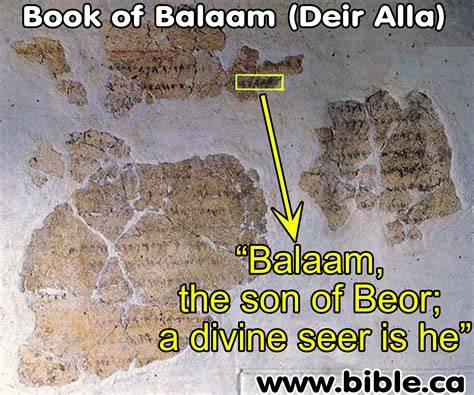
Amazingly, the prophet Balaam is found not only in the Bible, but also in archaeological evidence unearthed at Deir Alla. Deir Alla is a Jordanian town about 8 kilometers east of the Jordan River.
In 1967, within the walls of its ancient settlement site, Dutch excavators discovered a painted script, written in a form of Aramaic/Canaanite language, dating to around 800 B.C.E. The incomplete, somewhat-lengthy script has been deciphered, beginning with the following dramatic introduction: “The misfortunes of the Book of Balaam, son of Beor. A divine seer was he. The gods came to him at night …”
The long script proceeds to describe a vision Balaam witnessed of imminent destruction by the gods. The text repeatedly mentions the name “Balaam, son of Beor,” as well as various gods including Shagar and Ishtar. The names “El” and “Shaddai” are also mentioned, akin to the Hebrew words used for God.
The ancient wall script gives some interesting insight into Balaam. Not only did he play a role large enough to be featured in the biblical Israelite history-he must have also been well-known within the general territory of Jordan, in order for tradition to continue and even be venerated on a wall-piece regarding his visions.
The inscription’s indication of his stature matches with the biblical implication that Balaam was a renowned seer-one quite famous in order for the king of Moab to personally seek out his repeat assistance. The Deir Alla discovery was the first inscription to identify an Old Testament prophet.
Does Deir Alla Contradict the Bible?
Some claim that the Deir Alla Balaam inscription contradicts the Balaam of the Bible. In his book Problems of Genre and Historicity with Palestine’s Inscriptions, the minimalistic biblical scholar and theologian Thomas L. Thompson writes:
“Both stories [Deir Alla and the Bible] have Balaam speak with the voice of God. This determines the fate and destiny of nations. In the Bible’s story, he is a prophet of Yahweh. In the Deir Alla text, he is associated with a god bearing the name Shgr, ‘Shaddai’ gods and goddesses, and with the goddess Ashtar …”
Thompson states that both accounts, contradictory in nature, are fictional and merely demonstrate ancient storytelling techniques. Similarly, Dr. J. Day comments in The Daniel of Ugarit and Ezekiel and the Hero of the Book of Daniel: “… one might cite the example of Balaam, whom the dominant strand of Old Testament tradition regards as a true prophet (Num. xxii-xxiv), but who is revealed by a recently discovered Aramaic text from Deir Alla to have been a polytheist.”
Yet the biblical Balaam was not necessarily a faithful prophet of Israel. Joshua 13:22 states: “Balaam also the son of Beor, the soothsayer, did the children of Israel slay with the sword …” The word soothsayer refers to the use of magic and divinations, and is biblical language used to describe false prophets and magicians.
In 19 out of 20 times the Hebrew word is used in the Bible, it is in a negative context. Further, Numbers 24:1 states: “And when Balaam saw that it pleased the LORD to bless Israel, he went not, as at other times, to seek for enchantments, but he set his face toward the wilderness.”
God specifically forbids His people from using enchantments (Leviticus 19:26), and commanded all those who did be put to death (Deuteronomy 18:10). Only false prophets and pagans of the time used these practices.
Thus it becomes clear that the Balaam of the Bible was a pagan, just like in the Deir Alla inscription. Instead, he was used by God, in his unique situation before the Moabite king, to prophesy blessings on the Israelites.
This example of God using a false prophet is not unique in the Bible-1 Kings 13 tells the story of a false prophet that was inspired by God to prophesy the death of a true prophet he was hosting for a meal (verses 20-22).
Both the Bible and the Deir Alla inscription describe a pagan who used mystical arts and enchantments to commune with the spirit world. The nearly 3,000-year-old inscription from Deir Alla in no way discredits the biblical account, but on the contrary provides a fascinating corroboration of a well-known Near Eastern figure, both hated and revered-the prophet Balaam.
Was Balaam a Friend or an Enemy?
What impact does Balaam’s profession have on the question of whether he was friend or foe? The biblical authors quickly pivoted from presenting Balaam in a favorable light. Much of this shift can be understood in view of Balaam’s position as a foreign diviner and the biblical prohibition against such religious practices (Deuteronomy 18:9-14).
In turn, the positive portrayal of Balaam son of Beor in Numbers is not a depiction of an ally, but simply a reliable spokesperson for the divine who, despite all of Balak’s sacrifices, has chosen to bless the Israelites instead of cursing them.
So who was the real Balaam? Was he a prophet, a sorcerer, a saint, or a sinner? Judaism gives voice to a plurality of opinions, and the fact that we can agree to disagree, whether we’re debating halakhah, the politics of Israel, or the inner motivations of biblical personalities, is non-fundamentalist and democratic.
Balaam was not a straightforward hero or villain. He was a foreign diviner who could receive authentic divine messages, and God used him to bless Israel despite Balak’s demands. At the same time, Balaam’s attraction to reward and his later counsel against Israel revealed his true character.
His story therefore distinguishes between the truth of a prophecy and the moral character of the person who delivers it. Balaam spoke blessings that Israel needed to hear, but he did not become a faithful servant of Israel’s God. His words were true, while his motives and later actions were corrupt.
Why Balaam’s Blessing Still Matters
If it weren’t for Balaam’s words, which I recite each morning, how could I daven? I’d be disoriented. “How fair are your tents, O Jacob, Your dwellings, O Israel!” (Numbers 24:5).
Dr. Ismar Schorsch, in his 2004 JTS Torah commentary on Balak points out that the placement of Balaam’s blessings comes at a critical time when the Israelites-a ragtag bunch, exhausted and rebellious-are in need of spiritual uplift as they near Canaan.
Moses, fed up, would have loved to curse his people, while Balaam, a non-Israelite, the one expected to curse Israel, ends up blessing them at an opportune time. Balaam reminds me that each day is a gift.
All too often, we can forget how the power of 10, a microcosm of sacred communal living, can make such a difference in the world. We need observers-outsiders-reminding us, helping us see that what we are doing has significance.
An outsider may affirm not only who we are, but a blessing from a third party may illuminate what we can become. Observations from third parties help to objectify experiences as a means of seeking truth.
Also, as much as we see ourselves as the insiders to the experience, we are, in fact, all outsiders to the experience. Each time we enter sacred space, we can’t take this experience for granted.
Balaam invites me to “lift my own veil,” as it were, to see more clearly in order to move closer to God and community.