Usha Vance was raised as a practicing Hindu and has stated that her parents’ Hindu faith, which they instilled in her, was “one of the things that made them such good parents, that make them really very good people.” She is Hindu, is not interested in becoming Catholic, and has said that she is not going to convert.
Her husband, JD Vance, converted to Catholicism in 2019, after their 2014 marriage and the birth of their first two children. Their relationship is therefore an interfaith marriage in which Catholic and Hindu traditions remain part of family life.
Usha Vance’s Hindu upbringing
Usha Vance was raised in a Hindu family, and Hindu traditions remain an important part of her religious and cultural background. She has spoken positively about the faith of her parents and about the influence of her grandmother, whom she describes as a devout Hindu.
“My grandmother is a devout Hindu. She prays every day, visit the temple regularly, does her puja. We spend a lot of time with her. We don't mark a lot of holidays at home, but what we do is spend time with my family,” Usha said adding that she would like to throw a Holi party next year at home.
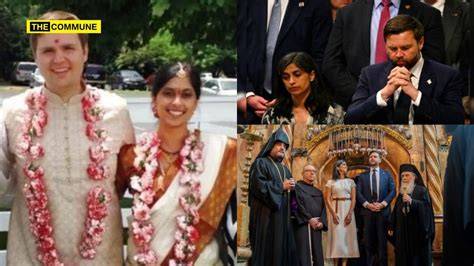
Usha Vance said their children have plenty of access to Hindu traditions through books that they give them, through things that they show them, and events like their recent visit to India. Hindu traditions are a part of their lives though the Vances don't celebrate Hindu festivals at home like Diwali, Holi, but they spend a lot of time with Usha's parents and her grandmother.
Usha Vance’s position on Catholicism
Usha Vance has made clear that she is not Catholic and does not intend to convert. “When you convert to Catholicism it comes with several important obligations, like to raise your child in the faith and all that.”
“We had to have a lot of real conversations about how do you do that, when I'm not Catholic, and I'm not intending to convert or anything like that,” Usha continued.
Although she does not share her husband’s Catholic faith, Usha Vance supported his religious search. JD Vance writes that his wife helped him reconnect with his faith and describes her as the family’s “anchor,” managing the chaos of Sunday mornings as they rush their children to Mass.
How Usha Vance influenced JD Vance’s conversion
JD Vance was raised Christian, but he said that he never had a strong attachment to a particular denomination and was never baptized. After losing interest in Christianity and spending a period as an atheist, he eventually returned to religious belief and converted to Catholicism.
“I became persuaded over time that Catholicism was true. I was raised Christian, but never had a super-strong attachment to any denomination, and was never baptized. When I became more interested in faith, I started out with a clean slate, and looked at the church that appealed most to me intellectually,” Vance said in an interview with The American Conservative.
Vance has said that Usha played a decisive role in this process even though she is not Christian. “That Usha thought church was 'good for me' gave me both permission and inspiration,” Vance writes. “I wanted more than anything to be worthy of this woman. If church helped me, I'd sit my butt in the pew every Sunday.”
“Fundamentally, the book wouldn’t exist without her,” said Vance, speaking by telephone in his first interview to preview the book. “I talk about this in the book. There is a certain irony to it, because she is not herself a Christian. But I certainly, I don’t think, would be a Christian today were it not for my wife.”
Usha Vance, he added, was heavily involved in nearly every facet of shaping “Communion.” She helped “harmonize different chapters” and excise parts that “didn’t add anything of value.”
Marriage and interfaith ceremonies
Usha Vance met JD Vance at Yale Law School, and the couple married in Kentucky in 2014. At the time of their marriage, JD Vance was not Catholic.
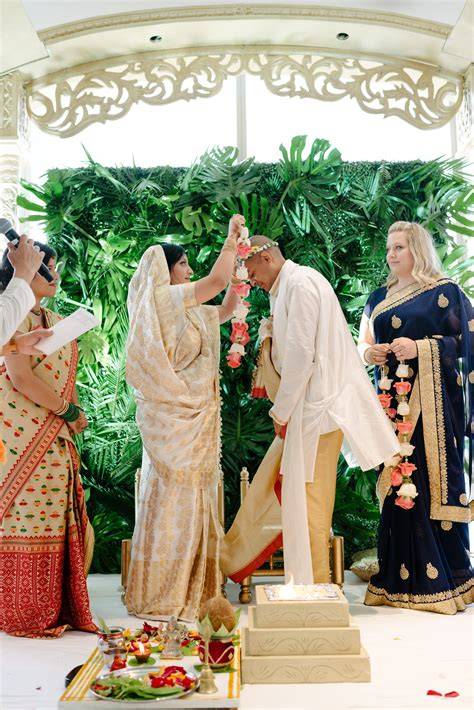
She and J.D. Vance had an interfaith marriage ceremony in 2014. The couple were blessed by a Hindu pundit in a separate ceremony, per The New York Times.
JD Vance converted to Catholicism after their marriage and after the birth of their first child, possibly after the birth of their second child as well. “At the time when I met JD, he wasn't Catholic, and he converted later and when he converted, we had a lot of conversations about that because it was actually after we had our first child, maybe it was after Vivek was born too,” she said.
Raising children in an interfaith household
Usha and JD Vance have three children, Ewan, Vivek and Mirabel. Usha Vance said their children attend Catholic schools but they have plenty access to Hindu traditions.
“So what we've ended up doing is we send our kids to Catholic school, and we have given them each the choice, right? They can choose whether they want to be baptized Catholic and then go through the whole step-by-step process with their classes in school,” she said.
Second Lady Usha Vance said their three children Ewan, Vivek and Mirabel will have a choice to decide whether they want to be baptized Catholics as they grow up. In an interview with Meghan McCain, Usha said their eldest child Ewan has decided to be a baptized Catholic and Vivek is next to choose his religion.
Usha Vance said their children have plenty of access to Hindu traditions through books that they give them, through things that they show them, and events like their recent visit to India.
Vance said their oldest child has done that, and added that they make going to church a "family experience." “The kids know that I'm not Catholic, and they have plenty of access to the Hindu tradition from books that we give them, to things that we show them, to the recent trip to India, and some of the religious elements of that visit,” Vance continued.
Religious choices for the children
The Vances’ approach combines Catholic education and participation in church with access to Hindu traditions within the family. Their children know that Usha Vance is not Catholic, while each child can decide whether to be baptized Catholic and continue through the religious formation offered at school.
“When you convert to Catholicism it comes with several important obligations, like to raise your child in the faith and all that.” Usha said their children attend Catholic schools but they have plenty access to Hindu traditions.
Usha Vance as a Hindu second lady
Usha Vance is the first Indian American and Hindu second lady in the White House. Usha Vance is the first Indian-American second lady.
Her public role has brought attention to the religious character of the Vance family, particularly because the vice president is Catholic while his wife remains Hindu. Their family life illustrates how an interfaith marriage can include regular Catholic practice without requiring both spouses to share the same religious identity.
When Vice President JD Vance told an audience at a Turning Point USA rally Wednesday (Oct. 29) at the University of Mississippi that he hopes his wife, a Hindu, will one day "be moved by the same thing that I was moved by in church," it was more than a peek into their marital relationship.
Asked about the uproar Tuesday, he described his comments as a “pretty simple observation” as a Christian wanting to share his faith with his partner. He also acknowledged that Usha Vance is not likely to convert. “And I’m OK with that,” Vance said.
“What I’d say about Usha is that one of the things I love about her is that she’s brilliant, but she’s also fiercely independent. You know, fundamentally Christianity is a faith where, if you believe in it, you would like other people to believe in it, too, and that’s going to be particularly true for those that you’re closest to and those you love.”
Usha Vance’s understanding of religious difference
Usha Vance’s statements about her family emphasize that Catholic and Hindu traditions can coexist in the same household without requiring her to abandon Hinduism. Her children attend Catholic schools and participate in church as a family, while Hindu traditions remain available to them through relatives, books, religious practices and travel.
Her grandmother’s daily prayers, regular temple visits and puja are among the Hindu practices that remain present in the family’s life. The Vances do not celebrate Hindu festivals at home like Diwali and Holi, but they spend a lot of time with Usha's parents and her grandmother.
“My grandmother is a devout Hindu. She prays every day, visit the temple regularly, does her puja. We spend a lot of time with her. We don't mark a lot of holidays at home, but what we do is spend time with my family,” Usha said adding that she would like to throw a Holi party next year at home.
JD Vance’s Catholic beliefs and their effect on the family
Vance was baptized Catholic and received his first communion in 2019 at St. Gertrude Priory, which is attached to a Dominican parish in Cincinnati. He chose St. Augustine as his patron saint.
In his recent memoir, Vance says he strayed from his Christianity after the 2005 death of his grandmother, Bonnie Blanton Vance, whom he lovingly refers to as Mamaw throughout the book. “With her gone, no one really cared about my faith, and soon I stopped caring, too,” Vance writes.
By the time he returned from Iraq, where he served as a U.S. Marine Corps media relations officer, Vance writes that he was no longer a Christian. However, he adds that his wife, Usha Vance, whom he met at Yale Law School, turned his life around.
Being vice president has definitely strengthened his faith, according to Vance. He said he has seen things that feel like they are “way too unusual to just be coincidences or luck or chance,” including well-timed phone calls or prayers offered to him since he took office.
“These are not like the miracles of turning water to wine,” he added, “but they are these things that make you feel like God is listening to you.”
Catholic principles in public life
Vance has also said that Catholic ideas influence the way he thinks about political decisions. Speaking about the Christian “just war” theory, he said it requires leaders “to ask very difficult questions about whether a war is justified.”
“But at its best,” he said, “it’s forcing you to ask the right questions. So I find myself constantly asking myself: ‘Is this justified? Is this moral? Is this the right thing to do?’ And that does provide a limitation on political leaders, as it should.”
Vance also described Marco Rubio, a fellow Catholic, as someone who has influenced his political thinking. “If you go back to even before I was in the Senate, Marco was making speeches about Catholic approaches to economics, to manufacturing policy, to trade policy, that were very influential to me,” he said.
“So I think it’s quite clear that Marco’s Christianity is constantly influencing how he thinks about his job, how he thinks about the big principles that we’re applying.”
Why Usha Vance’s religious background matters
Usha Vance’s religious background is significant because she combines a Hindu identity with a family structure shaped partly by Catholic practice. She has not described herself as a Catholic or expressed an intention to convert, yet she has encouraged her husband’s religious commitment and participated in a family routine that includes church and Catholic schooling.
The Vances’ family arrangement also places personal choice at the center of their children’s religious upbringing. Their children are introduced to Catholicism through school and church while also receiving access to Hindu traditions through their mother’s family and cultural practices.
Their household demonstrates that an interfaith marriage may involve shared family rituals without complete religious agreement between spouses. In the Vances’ case, Catholicism is central to JD Vance’s beliefs and public identity, while Hinduism remains central to Usha Vance’s personal background and family connections.
JD and Usha Vance on faith and family
Usha Vance was raised as a practicing Hindu, remains Hindu, and has said that she is not planning to convert to Catholicism. Her husband converted to Catholicism in 2019, and she nevertheless encouraged his return to faith. Together, they raise their children with Catholic schooling and church participation alongside access to Hindu traditions, allowing the children to make individual decisions about baptism and religious identity.