Byzantine imagery in the Catholic Church is a sacred visual language designed less to reproduce earthly appearances than to reveal heavenly reality, teach Christian doctrine, and lead the observer toward contemplation of God. Its mosaics, frescoes, panel icons, colors, gestures, halos, symbols, and stylized figures communicate Christology, Mariology, and the lives of the saints through what may be called a “painted homily.”
Although Byzantine art is often recognized by its flat surfaces, elongated figures, frontal faces, solemn expressions, geometric drapery, and golden backgrounds, these features are intentional rather than technically deficient. Byzantine artists make no attempt to copy human figures from a physical point of view. Instead they seek to abstract the forms to express a theological meaning and convey a spiritual reality rather than a physical one.
What Byzantine imagery means in Catholic tradition
Iconography is the original tradition of Christian sacred art and has been an integral part of the worship and mystical life of Christians since apostolic times. Referred to in the Eastern Christian tradition as “windows into heaven,” they have inspired and uplifted millions of the faithful, and have at times been the instruments for demonstrating God’s miraculous intercession in the life of mankind.
In describing the purpose of icons, the early Fathers used the Greek work anagogic, literally meaning “leading one upward.” Photios Kontoglou, the renowned modern iconographer, expressed this perfectly: “Icons raise the soul and mind of the believer who sees the icon to the realm of the spirit, of the incorruptible, of the kingdom of God, as far as this can be achieved with material means.” So to appreciate iconography fully, we must approach it as a liturgical art form whose function is essentially spiritual.
The purpose of Byzantine art was to glorify the Christian religion and to express its mystery. All of Byzantine art is filled with a kind of spiritual symbolism-things on earth are meant to stand for the order of heaven. In essence Byzantine art is created to uplift the spirit and not gratify the senses, therefore it discards the logic of mimesis in order to open the observer's eyes to the invisible world of the Spirit.
Beyond mere pictorial representation, the Byzantine artwork is intended as a religious lesson and used for catechetical instruction through which Christology, Mariology and Hagiography are taught in appreciation for the visual arts in the liturgy. One may call it a “painted homily.”
Why Byzantine figures look flat, elongated, and solemn
The human figures appear unreal, stiff and flat. Their body parts are distorted and their movements awkward, with little suggestion of motion or change. Solemn, frontal images of human faces are characterized by almond shapes with large, dark eyes under curved brows, small mouths and long, narrow noses.
All of these features are by no means accidental, and there is no aberration here from the intended Byzantine canon. On the contrary, this usage is quite intentional. The corporeal nature is therefore transformed so that the figure takes on a stylized appearance exemplified by accentuations and exaggerations in order to render it as part of a heavenly sphere rather than the earthly one.
Faces are differentiated to some degree but possess an idealized commonality among them so that each resembles the other to a high degree. Bodies are purposely elongated and slender with tiny feet in order to portray the figures as analogous to spiritual beings, uplifted and divinized.
Why are there long, thin figures in Byzantine art? It is because in early Christianity fasting and mortification were considered blessed practices of the saints. The flat and stiff figures in icons also countered early Greek and Roman figures that endeavored to portray the perfect figure of a man and woman that never really exists.
Mosaics and icons are more about the meaning of God than about the unrealistic perfect body. Byzantine art tends to portray long and thin figures, whereas other art figures are beautifully formed. The contrast reflects two different artistic aims: classical art emphasized the ideal human body, while Byzantine imagery emphasized the transformation of humanity by divine grace.
Byzantine imagery and the heavenly realm
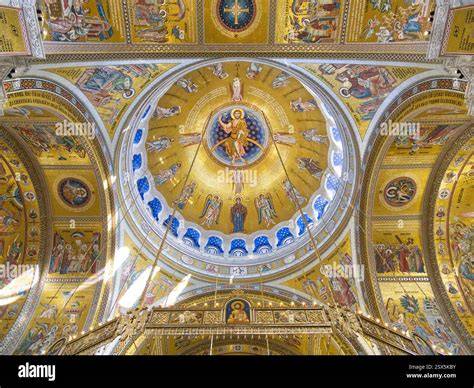
Backgrounds are typically painted solid gold to represent the eternal presence of radiant luminosity saturating the earthly dimensions of time and space. One of the church domes in the exhibit contains a large mosaic that portrays Christ against a glimmering gold background. I learned that the background represents the ethereal heavenly realm we read about in the Book of Revelation.
Gold, which was commonly used as a background in mosaics, represents the divine light and glory of God. It is also “[…] associated with wealth, royalty and heavenly rewards and riches.” Gold does not function as ordinary scenery; it removes the sacred figure from an identifiable earthly location and places the image within the timeless radiance of heaven.
As I viewed the mosaics, their color and light engulfed me, creating an uplifting, sacred spirit. Byzantine mosaics sparkle whereas other art is sometimes more subdued. The effect of brilliance serves the theological purpose of presenting the material world as capable of reflecting divine glory.
Why mosaics were so important
Why does Byzantine art employ mosaics frequently? It is because they were seen as the supreme media for expressing our adoration of God. Creating a mosaic is an extremely expensive technique involving the insertion of colored stones, or gold and silver fused in glass.
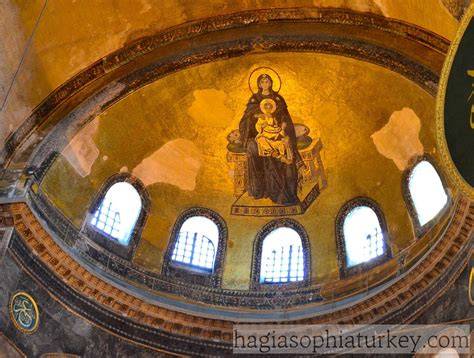
These are then put onto fresh plaster to create wall and ceiling images of virtually indestructible brilliance. Gold, ivory, and precious stones were used in the mosaics of great churches, like the Hagia Sophia, representing not only the wealth of the Empire but the importance and value they put on religion and the Church.
The church of St. Sophia was adorned in the sixth century with a splendour worthy of Solomon. The interior was sumptuously decorated with mosaics upon a golden background. Some of the walls were ornamented with designs of grape-vines with golden leaves. Pictures of animals decorated the walls of the portico.
At Parenzo, in Istria, and at Bauit, in Egypt, superb mosaic pictorial ornamentation dating from the sixth century is still preserved. The numerous mosaic pictures, which are to be found everywhere, still strove to imitate classical models; their symbolism reminds us of the general symbolic tendency of early Christianity, and their form gradually becomes more stiff and fixed.
Icons as “windows into heaven”
The word icon comes from the Greek είκών-eikōn, meaning “image.” In the Christian tradition, an icon is not merely a decorative object or a naturalistic portrait. It is a sacred image that directs the mind and heart toward the person or mystery represented.
As another Church Father, Saint Basil the Great, said, “With a soundless voice the icons teach those who behold them.” Saint Basil the Great wrote: “What the Book of the Gospels explains by means of words, the iconographer shows by means of his works.”
Saint John Chrysostom kept an icon of Saint Paul before him whenever he studied the Epistles of Saint Paul, for inspiration and to invoke the Apostle’s blessing. Once when Saint John looked up from the text, the icon of Saint Paul seemed to come alive and the Apostle spoke to him.
Another purpose of this art is sacramental, to awaken the soul by the force of revelation and the promise of salvation. There is an ingress to spiritual presence, a complex irresistible invitation to “otherness”, and the initiation of an interior dialogue.
Saint Luke and the beginnings of iconography
Church tradition teaches that the first iconographer was Saint Luke the Evangelist. He painted the holy image of the Virgin Mary on a panel, a face which he himself had seen.
He brought his first icons to the Mother of God herself, who approved them and proclaimed: “May the grace of Him Who was born of me, through me, be imparted to these icons.” There are at least five highly-venerated icons of the Virgin painted by Saint Luke which are still venerated today.
He is also known to have painted icons of Saints Peter and Paul. The beginnings of iconography can also be found in the catacomb paintings of the second and third centuries.
The development of Byzantine sacred art
Byzantine art is a combination of Eastern and classical Western art. It is inspired by the classical art of Greece and Rome, but also the art of the Near East. As the Empire expanded and formed relationships (be it through trade or otherwise) across the globe, not only did the influence of Byzantium spread, but foreign motifs and styles made their way back to the Empire.
For the first 200 years of the Byzantine Empire, artists worked in the same style as the artists of ancient Greece and Rome. However, as time went on, Byzantium developed its own, unique style which eschewed the realism of Greek and Roman art in favor of a flatter, stiffer style.
It was the art of the Eastern Roman Empire and of its capital Byzantium, or Constantinople. Christian art was dependent for the representation of its new conceptions upon the forms which the time and place of its origin happened to offer.
In the beginning, whether at Rome, Ravenna, or Byzantium (Constantinople), it was equally influenced by classical art and by Eastern inclination to allegory. It is a distinguishing characteristic of Constantinople, however, that it was able to maintain a more uniform classical tradition in the face of manifold Oriental influences.
Major historical phases
| Period or phase | Characteristic development |
|---|---|
| Second and third centuries | The beginnings of iconography can be found in catacomb paintings. |
| Early Byzantine period | Icons retained Roman naturalism, perspectival depth, volume, realistic features, and graded shadows. |
| Sixth century | Iconography became most fully developed and widely spread in the Empire under Justinian the Great. |
| Seventh and eighth centuries | Iconography was subject to controversy during the period of Iconoclasm. |
| 787 A.D. | The Second Council of Nicaea upheld the veneration of icons. |
| 843 | Empress Theodora permanently reinstated the veneration of icons, commemorated as “the Triumph of Orthodoxy.” |
| 867-1054 | The Macedonian dynasty launched what would come to be thought a golden age for the Byzantine Empire. |
| 1261 onward | The Palaiologan style developed after the recapture of Constantinople and continued to influence Byzantine iconography. |
Early Byzantine naturalism
Between the foundation of Constantinople and the advent of the threat from the Arab peninsula, iconography was a study in imperial magnificence and triumph. This was the time of the great imperial mosaics and churches at Ravenna and Constantinople.
The art of the imperial Christian churches reflected the desire of the emperors and their courts to showcase a faith that was both victorious and deeply rooted in the classical past. The new faith was seeking a distinctive visual language that could communicate theological truths while maintaining connections to the Roman artistic tradition that would have been familiar to most at the time across the empire-a “catholic” language that could communicate to everyone.
This period also saw the development of our standard iconic prototypes that would later become central to Byzantine sacred art and after that incorporated into the western canon. We recognise them today, 1700 years later; the image of Christ as Pantocrator, the Virgin and Child, Anastasis and standard hagiography for the biblical narratives, depictions of saints and martyrs, with their identifying symbols.
The use of light and shadow, and linear perspective to create volume and depth is a hallmark of early Byzantine naturalism. This icon, depicting the Virgin flanked by angels, shows a remarkable continuity with late Roman portraiture.
The figures are monumental and lifelike, reflecting the classical influence that lingered in this period. These are fully rendered 3 dimensional figures, taking up space. Icons from this period, the few that survive, still bear the hallmarks of Roman naturalism: the use of perspectival depth and volume and realistic human features, graded shadows for drapery and faces all taking up 3-dimensional space.
The Iconoclastic controversy
Iconography, as an integral part of Christian life, was subject to great controversy in the seventh and eighth centuries. The Iconoclasts (“icon-smashers”) were suspicious of any sacred art which represented human beings or God and demanded the destruction of icons.
The Iconodules (venerators of icons) vigorously defended the place of icons in the life of the Church. Iconoclasm may have been influenced by Jewish and Moslem ideas, and also reflected a “puritan” outlook in Christianity which saw in all images a latent idolatry.
The core issue was whether sacred images should be venerated as a means of communication between heaven and earth, or removed and destroyed as idolatrous. Iconoclasts argued that depicting Christ in an image was a denial of his full divinity, while iconodules insisted that the Incarnation itself made Christ representable.
During this time, countless icons were destroyed by imperial orders, and many churches were stripped of their figural decorations. Artistic production slowed dramatically, as many artists and skilled craftsmen-a whole industry-fled, many to come west to seek papal protection.
In interior decorations of churches, the emphasis shifted away from images toward symbolic representations like the cross. This mosaic exemplifies the shift towards non-figurative art during this period.
The Iconoclastic Period was a turbulent chapter in Byzantine history, marked by intense theological debates and political upheavals, that also started the rift between the east under the emperor, and the west dominated by the papacy.
The Iconodule position was upheld by the Seventh and last Ecumenical Council, which met in Nicaea in 787 A.D. The Second Council of Nicaea marked the temporary end of iconoclasm, formally affirming the veneration of icons as not only acceptable for Christians but part of the required practice of the Faith-to declare icons heretical was now heresy.
Another attack on icons by the Emperor Leo III during the next century was overturned when Empress Theodora permanently reinstated the veneration of icons in 843, a victory which is commemorated as “the Triumph of Orthodoxy.”
One of the chief champions of icons during this period was Saint John of Damascus, who wrote in his famous “Defense of Icons”: “Through the icons of Christ we contemplate His bodily form, His miracles, and His sufferings, and we are sanctified…The icons of the Saints are filled with the Holy Spirit.”
The mature Byzantine style
After the final resolution of Iconoclasm, the Byzantine world experienced a renaissance in sacred art, with the restoration of icon veneration, and a revival of the social and economic prominence of sacred art. This was the time of the development of a more uniform iconographic style that was to become what we now think of as Byzantine sacred art.
The classical naturalism of earlier centuries gave way, after the trauma of iconoclasm, to a more stylized, spiritualised and symbolic aesthetic. Figures became elongated, more ethereal and less concerned with naturalistic realism. The illusion of perspectival depth was abandoned.
Gold backgrounds or flat colour for backgrounds became ubiquitous, symbolising the divine light and timeless space of heaven. Theologically, icons were now seen as vital for conveying theological truths.
The doctrine established at Nicaea II affirmed that icons were not merely art but visual theology, a direct, personal encounter with God and heaven. The new stylised artistic language aimed to portray spiritual reality rather than imitate the natural world or create an illusion of seeing through time.
The Macedonian and Komnenian periods
The Macedonian dynasty (c. 867-1054) launched what would come to be thought a golden age for the Byzantine Empire, with territorial expansion and recovery of lost territory, increased trade and economic prosperity and cultural flourishing.
Named after Emperor Basil I “the Macedonian”, who helped revive classical learning and the arts, it is often called the Macedonian Renaissance. The empire regained some lost territories and the capital, Constantinople, became a thriving centre of Christian culture and scholarship.
The Komnenian dynasty (11th and 12th c.) continued this cultural renaissance, while increased contact with the West during the Crusades brought new artistic influences into the Byzantine sphere, and took the Byzantine work into the west.
The Komnenian style is marked by emotional intensity and dynamic, fluid compositions with everything looking as though it’s moving. Komnenian icons have a sense of heightened drama, even when the figure is still, with bold colours, sharp lines and angular features, and dramatic facial expressions, especially for the Passion scenes or depictions of the Virgin.
It is not difficult to see a stylistic connection between this period of Byzantine art and the development of Romanesque in Italy, by Constantinopolitan artists imported to do the work in the west.
The Palaiologan period
After the catastrophe of the Sack of Constantinople in 1204 during the Fourth Crusade-which included the theft of much of its precious artistic and religious treasures-in 1261 the city was reclaimed by the Byzantines after 57 years of Latin occupation.
Emperor Michael VIII Palaiologos made a triumphal entry-chasing out Baldwin II, the puppet emperor of the “Latin Empire”-and founded the Palaiologan dynasty. The city was in ruins and depopulated, but its recovery marked both a political and cultural turning point for all of Eastern Christendom.
The Palaiologan style, beginning after the recapture of Constantinople in 1261 and carrying forward to today, builds on the Komnenian movement with greater elegance and complexity, and starts leaning back towards more naturalistic figures, more believable drapery, etc.
This icon of Archangel Michael is a fine example of Palaiologan-era iconography, 14th or early 15th century. The face of Michael is still idealised and stylised-this isn’t “realism” in our sense-but shows a soft modelling of the cheeks and a more human, emotionally accessible expression.
The treatment of the garments, especially the rhythmic folds and subtle highlights, shows grace and movement without losing the icon's contemplative stillness or symbolic symmetry. Michael holds a transparent orb inscribed with Greek letters (Α and Ω) and a cross, signifying Christ’s cosmic authority.
There’s more depth and layering of colour here than in earlier, flatter styles. The wings are delicately feathered, and the hair is given volume, softness and gloss.
Symbols used in Byzantine imagery
Christian symbols are a staple of Byzantine art. Prominently featured are symbols such as the Cross, keys, wheat, keys, chalices, animals, etc., each having a special meaning to faith.
- A man holding a key or keys would be depicting St. Peter holding the key or keys to heaven.
- Wheat represents not only harvest and fertility, but the bread of the sacrament at the Last Supper.
- The cross signifies Christ’s Passion, death, and victory, and is also held by martyrs as a sign of following Christ unto death.
- The halo signifies sanctity and draws attention to the face of Christ, the Virgin Mary, or a saint.
- Gold represents divine light, glory, royalty, and heavenly rewards.
- A scroll may contain a saint’s own words, a scriptural quotation, or a teaching associated with the saint’s life.
Colors and their theological meaning
Color was also an important symbol in Byzantine art. Gold, which was commonly used as a background in mosaics, represents the divine light and glory of God. Purple represents royalty but is also used in the robes of important religious figures; these robes are commonly outlined in red.
Selection of colors is also often fixed: blue for Christ’s mantle or outer garment, red for the tunic or inner garment; deep wine-red for the Virgin Mary’s outer garment; etc.
These colors are not simply an artist’s personal choices. They belong to a traditional visual vocabulary through which the identity, dignity, and theological role of a sacred figure can be recognized.
Gestures, clothing, halos, and faces
Described as “theology in line and color,” iconography traditionally uses particular artistic devices and stylization to communicate the spiritual world to the beholder. One of the first things one notices is the standardization of the forms of holy persons.
Upon seeing an icon we can immediately recognize that this is Christ, this is Saint Paul, this is Saint Nicholas, etc. Both the forms of the Saints and the composition of events from the Gospels are fixed and archetypal, although they will vary slightly depending on the iconographer.
Another outstanding feature of iconography is the extreme stylization and non-naturalistic depiction of the clothing of the figures. The folds of the clothes are depicted by means of geometric forms-ovals, rectangles, triangles-demonstrating a heavenly order.
This stylization also appears in all the elements of the faces and body members of the persons in the icon. Their faces do not resemble mere human beings, but through stylization, they show us the faces of human nature transformed into the divine.
The hands are often thin and expressive, commonly in various gestures of blessing. The halos around the heads of Christ, the Virgin Mary, and the Saints are painted as a clearly delineated circle, signifying their sanctity and drawing our attention to their faces.
Space, time, and inverted perspective
Even nature itself is transformed by the hand of the iconographer. Buildings, mountains, trees, and animals are usually depicted in a very simplified, schematic way, rather than attempting to render a photographic likeness.
The iconographer does not stop there in his use of a technique to depict a spiritually-transformed reality. He alters both time and space.
Events that took place at different times are represented simultaneously in the composition as if they took place simultaneously-such as is seen in Monastery Icons’ depiction of the Nativity of Christ, for example, where we see simultaneously in one icon the Virgin with the swaddled Infant, the midwives bathing the Child Jesus, the angel announcing the Savior’s birth to the shepherds, and the Magi coming to adore the Messiah.
Nor does the iconographer adhere to a systematic use of perspective to create the illusion of three-dimensionality. Instead, he frequently uses an inverted perspective to show, where objects in the foreground are smaller than spiritually more significant objects or persons behind them.
This treatment of space does not attempt to imitate the way an ordinary observer sees a physical scene. It gives priority to spiritual significance, allowing the most important person or event to dominate the composition.
Christ, the Virgin Mary, and the saints
Christ as Pantocrator
When Constantine became emperor of the Roman Empire, he realized there is only one king in our life: Christ; hence the reason Christ is often portrayed in kingly fashion.
The image of Christ as Pantocrator became one of the standard iconic prototypes of Byzantine sacred art. It presents Christ as the ruler of all, combining majesty, judgment, authority, and divine presence.
In Byzantine art the meaning behind the image is more important than the exterior subject matter. The image of Christ is not intended merely to record what Jesus looked like historically; it presents the divine person of the incarnate Word and invites the observer into contemplation of salvation.
The Virgin and Child
The image of the Virgin and Child is another central Byzantine prototype. Hodegetria-Madonna and Child, the Virgin gesturing toward her divine Son-became an enduring form of Marian imagery.
This standard depiction is thought to be a close copy of the original Hodegetria prototype mosaic in Constantinople, that has since been lost. The Virgin’s gesture directs attention away from herself and toward Christ, affirming his identity and mission.
The Anastasis
The Anastasis is a standard prototype for the Resurrection. The repentant Adam is heaved bodily out of hell by the risen Christ.
The composition does not focus primarily on the physical mechanics of resurrection. It expresses Christ’s victory over death and the restoration of humanity, presenting salvation as a cosmic and theological event.
Saints and their identifying symbols
“Even if he has seen a certain saint in life, the iconographer does not paint him materialistically or naturally, but in a spiritual manner, illumined by divine grace,” wrote the renowned modern iconographer Photios Kontoglou.
Frequently a saint’s icon features some important reference to their life or words. Saint Christopher grasps his staff that miraculously blossomed as a palm tree, just as the Child Jesus foretold it would the day after His apparition to the saint.
Saint Therese of Lisieux said that after her death she would “let fall a shower of roses,” referring to the graces and heavenly gifts she would bestow, and these are represented in her icon by a cluster of pink roses.
Martyrs such as Saint Cecilia and Saint Barbara hold a cross, signifying their following Christ unto death-as we also find in icons of monks and nuns such as Saint Benedict and Saint Rose of Lima, who underwent the “green martyrdom” of the monastic life.
In many icons the saints hold a scroll that quotes their own words, such as Saint Patrick, whose scroll quotes his words on the Trinity from his famous Lorica, or a scriptural quote which highlights some outstanding feature of their life and struggle.
Other saints, like Saint Francis de Sales and Saint John Baptist de La Salle, hold copies of their own spiritual writings. Saint Basil the Great wrote: “What the Book of the Gospels explains by means of words, the iconographer shows by means of his works.”
How saints are identified
How does the iconographer know how to depict a particular saint? The appearances of hundreds of saints are described in various iconographers’ manuals.
Figures like Saint Nicholas and Saint Basil have been depicted in hundreds of icons through the centuries; a Christian from Greece or Russia would immediately recognize depictions of these and other saints, even though they may not be able to read the English text identifying them.
Some icons are created with the help of contemporary descriptions or paintings done during or shortly after the saint’s own lifetime-such as icons of Saint Francis and Saint Thomas More.
And with the help of photography, there are now actual photographs of the saints that the iconographer can refer to, as the iconographer did when painting the icons of Saint Therese of Lisieux and Saint Pius X.
The spiritual preparation of the iconographer
Since the creation of an icon is itself a sacred activity, the iconographer must be a person of prayer, not merely a technician. If his work is to inspire and illumine others, then it is essential that he leads a life of prayer and fasting that he may be inspired and illumined by the Holy Spirit.
His iconography becomes itself an expression of his spiritual life. Kontoglou writes: “The iconographers painted as they prayed.” The creation of an icon is therefore understood as a spiritual discipline rather than simply an artistic production.
Byzantine art compared with Western naturalism
In the Western approach to sacred art, such as those from the Renaissance, the artist most frequently depicts his subject in a purely naturalistic and representational style. He uses the same techniques as he would to depict a secular subject.
The theme may be religious, but the style remains the same. As the goal of the iconographer is utterly different, so are his techniques to accomplish this goal.
Iconography depicts the saints not as they were in actual life, but as they are in eternity. He communicates his vision of the heavenly world not through symbols, such as sunsets with golden clouds or angels playing harps, but through mystical forms and colors.
As Kontoglou writes, “Iconography expresses with spiritualized forms abstracted from natural phenomena, a world which is beyond phenomena, a spiritual world.”
Compare a Western representation of a common religious theme such as the crucifixion with its Byzantine equivalent. While the Western artist would emphasize the physical suffering of Christ and the emotions of the spectators, making the scene realistic from a physical viewpoint-even to an exaggerated degree-the Byzantine artist would express the theology of the event, the significance of Christ's redemptive death in God's plan of salvation, rather than its historical reality or the naturalism of the creatures.
Unlike figurative painting in the West, the Byzantine technique challenges rational discourse by infusing symbols untranslatable into logical structures or verbal expressions. It is at once intelligent and affective in the highest degree, making the divine presence substantive through pictorial form.
Despite the artistic distinctions between East and West, it is interesting to note how Byzantine art has heavily influenced the masters of the early Renaissance, and how its features appear in so many of the early works of these artists.
In Duccio's work a Byzantine derivation is clearly recognizable. The Byzantine influence is also evident in many of Giotto's works such as the Stefaneschi Triptych in which Christ's face is depicted by a distinctively Byzantine countenance.
Also the face of Mary in the Annunciation by Simone Martini closely resembles the Cambrai Madonna of the late Byzantine era. As a consequence of Byzantine influences on Western culture many of the post-Constantinian churches in Rome are heavily decorated with Byzantine art.
Byzantine imagery in the Catholic Church of the West
Although many of us associate iconography with the Church of the East, it is also the original tradition of sacred art in the Western Church. Mosaics, frescoes, and paintings in Rome, Spain, and France bear witness that the Byzantine style was the artistic tradition common to both Western and Eastern Christianity up to the twelfth century.
The influence of Byzantine art on Western culture after the Fall of Rome (476AD) cannot be underestimated. Many of the greatest painters commissioned by the Roman Church received their vigour from this Eastern tradition.
This was due to the West's need for art to assume the same sacred function of pedagogy and devotion. Byzantine art spread in the East as well as in Northern Italy and Sicily.
In regard to the influence of the Byzantine style on architecture, the art of Ravenna, though affected by other Eastern influences, strongly reminds us, in its splendid mosaics, of Constantinople. The Proconnesian capitals and other products of decorative art spread even more easily.
Like Ravenna, Southern Italy and Gaul came under the influence of the East and Constantinople. Even more specifically Byzantine is African art. In Rome the traces of Byzantine art are more difficult to discover than other Oriental influences.
Examples in churches and sacred objects
The interior of Hagia Sophia offers one of the clearest examples of the relationship between Byzantine imagery, imperial power, and Catholic Christian history. A silver choir-screen rose above pillars, in the capitals of which medallions of Christ, the Blessed Virgin, saints, and prophets were carved.
This is the so-called iconostasis. The altar was of gold inlaid with precious stones; the altar-cloth was of brocaded silk in which were woven pictures of Christ, the prophets and the apostles.
The ambo, according to description, was brilliant with gold, silver, precious stones, and ivory. A gold cross decorated with pictures in hammered work was presented by Justin II to the church of St. Peter and is still preserved at the Vatican.
A number of ivory book-covers are also still in existence. The illuminated manuscripts of Rossano and Sinope date from the sixth century.
In the treasury of San Marco may be seen Byzantine reliquaries, ivory triptychs, chalices, costly fabrics, and specimens of pictorial art. Some are large and some small, but taken altogether they show how a church of the eleventh century was transformed into a veritable treasure-house.
Materials and techniques
The power and pride of the new empire offered the means for great undertakings and gave the impulse to them. The Proconnesian marble, found in the vicinity of the capital, and the stone obtained from other rich quarries provided the material, and, long before this era, the art of working in stone had reached a high state of development, especially in Asia Minor.
Moreover, the East had been from ancient times the home of the minor arts. In Constantinople there flourished, along with the art of decorative sculpture, the arts of stone-carving, of working in metal and ivory, of ornamental bronze work, of enamelling, of weaving, and the art of miniature-painting.
From classical and ancient Christian art Byzantine genius derived a correct combination of the ideal with truth to nature, harmonious unity along with precision in details, as well as the fondness for mosaics, frescoes, and pictures on panels, in opposition to the dislike of non-Christian and sectarian Orientals to pictorial representation.
Purely Oriental, however, was the dislike constantly increasing for sculpture in the round-sculpture that can be seen from all sides-and the preference for the flat ornamentation in architecture.
To the same Oriental influence may be attributed the taste for costly and many-coloured stones and woven fabrics, for goldsmith-work, and enamel. The Byzantine Church did not approve of sculpture in the round-sculpture that can be seen from all sides.
The Church feared that it would recall the idols of the Greek and Roman religions. However, small carvings in relief, especially in ivory, were allowed as church decoration.
The political dimension of Byzantine imagery
Byzantine art also had a political side to it. When Constantine became emperor of the Roman Empire, he realized there is only one king in our life: Christ; hence the reason Christ is often portrayed in kingly fashion.
The introduction of Eastern court ceremonial by Constantine was accompanied in the domain of art by the appearances of extraordinary gorgeousness and pomp, expressed, however, with stiffness and formality.
The art of the imperial Christian churches reflected the desire of the emperors and their courts to showcase a faith that was both victorious and deeply rooted in the classical past. The splendour of mosaics, precious materials, imperial portraits, and ceremonial compositions therefore expressed both religious devotion and the public identity of the Christian empire.
Byzantine imagery and Catholic theology
Byzantine art borrowed heavily from the symbolism of the pre-Christian traditions of its time. It built up a symbolic vocabulary that could make manifest a wider range of states of the soul than had been present before.
Many of these symbols derive from explicit allegories found in the Hebrew Scriptures. Maturing into its own aesthetic theory, Byzantine art becomes deeply rooted in the interchangeability of the ideas of pulchrum, bonum, and verum.
Its ideal is revealed in the icon, a reflection of God's own beauty, goodness and truth, through the splendor of His Image that has its exemplar in the Divine Person of the Son. As there exists in Jesus Christ a perfect harmony of these three properties, so in Byzantine art each property is not comprehensible without the others.
Accordingly, as God's salvific work is realized in the Incarnation, so in Byzantine art this is perceived in the image of Christ the splendor of God. Thus Byzantine art has its principle in the divinity of Jesus Christ, the image of God in the Son, and not in the human nature of Christ; therefore the observer of such an image beholds the very holiness of God.
Due to the sacred character of this art an entire theology of iconography has evolved from it. As with Western abstract painting, though bearing an explicitly religious tone, the observer is able to discern a meaning beyond what is externally present.
Thus the sacramental property of this art is actualized insofar as the artwork directs the heart and mind to the reality represented. It becomes the locus of a spiritual experience, of transcendence, and the means of acquiring an actual grace.
Through the process of observation and contemplation it contributes to the evolution of matter into a spiritual dimension, thus contributing to the realization of humankind's final destiny. It therefore possesses an eschatological connotation which signifies that it is transfigurative-charged with a sanctifying action that renders visible the forces of the spiritual life.
Byzantine imagery after Constantinople
After the fall of Constantinople, the Holy Mountain of Athos became a great center of iconography. The many monastic churches that can be seen at Mount Athos today are the testimony of a centuries-long tradition that flowered at the hands of the monks who preserved it.
The Byzantine tradition of iconography also was emulated by the Serbian and Russian Christians, whose styles of iconography have undergone their own evolution over the centuries.
Its influence was also carried out to the outer corners of the Christian world; we can see the same motifs, the same language spoken, from Ireland, Scotland and Lindisfarne, to Cappadocia to Ethiopia.
It has survived over 1700 years without significant change, from its inception in the City of Constantinople during the early fourth century until the present day. Today Byzantine art remains one of the most potent and genuine artistic expressions of the Catholic verve.
Why Byzantine imagery remains important
In his book, “Yours Is the Church,” author Mike Aquilina says that when we see the greatest talents in the history of art seized by an idea and producing their greatest masterpieces, we have got to say that it must have been a powerful idea.
I concur, one cannot but be enraptured by the power of God that is especially found in Byzantine art. It is fundamentally theological, highly symbolic, imbued with a metaphysical intensity, and permeated by references towards the abstract.
Though most importantly it continues to be one of the greatest pictorial mediums to give praise and glory to God, and one of the most authentic visual manifestations of a faith revealing the pathway to human salvation through the power of the image.
It expresses a refinement of Catholic ideas that shines forth through its sacred beauty in the magnificent works adorning not only the great basilicas of Rome today, but many of the splendid churches throughout the lands that once occupied the entire Roman Empire.
So upon second glance, and after careful reflection, it is not difficult to see how the abstractions in Byzantine art evoke a sense of elevation, of the dematerialized and the spiritual in order to bestow upon its figures and scenes an air of divine exaltation. Indeed this is all entirely intentional.