A papal pectoral cross is a cross worn on a chain or cord around the neck so that it rests on the chest near the heart. The tradition of popes wearing a pectoral cross has a fascinating history and deep spiritual symbolism.
A pectoral cross, from the Latin pectoralis, “of the chest,” is worn especially by bishops, abbots, priests, and any prelate entitled to use the papal insignia. It may be modest or highly ornamental, with precious stones, and sometimes contains a relic of the True Cross or of a saint.
What a Papal Pectoral Cross Represents
The pectoral cross is not merely a piece of religious regalia or jewelry. It is a visible sign of faith and a daily reminder of the Passion of Jesus, the sacrifice of the martyrs, and the pastoral responsibility entrusted to a bishop or pope.
According to James-Charles Noonan, Jr. in his book The Church Visible, the cross “served originally as a reliquary of the True Cross, which, due to the singular import of this relic, encouraged the practice of wearing the relic close to the heart by the highest Church officials.”
For many centuries each pectoral cross contained a small piece of the True Cross, but this tradition was not practiced in every part of the world and the relics were not always traceable. The pectoral cross also carries much symbolism, which is revealed in the vesting prayers of the bishop when he puts on the cross, reminding him of the Passion of Jesus and the sacrifice of the martyrs.
“Deign Thou, Lord Jesus Christ, to guard me, from all the snares of every enemy, by the sign of Thy most holy Cross: and deign Thou to grant to me, Thy unworthy servant, that as I hold before my breast this Cross with the relics of Thy Saints within it, so may I ever keep in mind the memory of the Passion, and the victories of the Holy Martyrs.”
This tradition also reminds bishops of Jesus’ words to his disciples, “If anyone wishes to come after me, he must deny himself and take up his cross daily and follow me” (Luke 9:23).
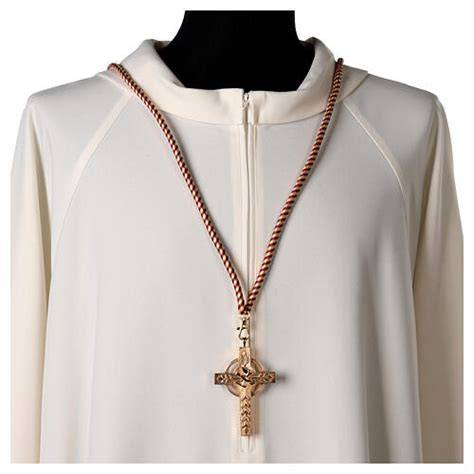
Early History of the Pectoral Cross
The use of pectoral crosses dates back to the early Christian centuries. Initially, they were symbols of faith and protection for bishops and priests. Over time, they evolved into an important liturgical and honorary element of ecclesiastical tradition.
One of the earliest mentions of a pectoral cross is that of Pope Hilarius in 461. A few centuries later, in 811, we hear that Nicephorus, the Patriarch of Constantinople, sent Pope Leo III a gold pectoral cross, and in the course of time it became customary for the Roman pontiff to wear this type of cross on the most solemn occasions.
Another account states that one of the first popes to wear a pectoral cross was Pope Leo III, in the year 811. He was given the cross as a gift from Nicephorus, the Patriarch of Constantinople. The cross was made of gold and soon it became customary for popes to wear a pectoral cross as an outward symbol of their prestige and power.
Innocent III, 1161-1216, is said to be the first pope to wear a pectoral cross, which became more commonly used as time went on. Pope St. Pius V, 1504-1572, made the wearing of one mandatory for bishops.
From Reliquary to Ecclesiastical Insignia
Pectoral crosses and engolpia are an integral part of priestly attire, with deep symbolism and rich historical and artistic value. Engolpia, often depicting the Virgin Mary, Christ, or saints, have Byzantine roots and are a distinctive feature of hierarchs.
Made of precious metals, decorated with enamel or precious stones, they carry a message of spiritual protection and hierarchical authority. Special engolpia contain small relics of saints or pieces of the True Cross. They are considered extremely sacred and are often passed down from generation to generation.
For centuries the pectoral cross worn by popes, cardinals, and bishops has been the symbol of their prestige and temporal power. To highlight their high rank and prestige, crosses were made from gold and were sometimes embellished with gems and precious stones.
We can still see some of these pectoral crosses in museums, and we certainly can admire them for their great beauty and fine craftsmanship. At the same time, the history of the pectoral cross shows that its meaning has never been limited to artistic value or official rank.
Types and Styles of Pectoral Crosses
Liturgical Pectoral Crosses
Liturgical pectoral crosses are worn during the Divine Liturgy and other religious ceremonies. They are usually larger and more imposing, with rich decoration reflecting the importance of the occasion.
Everyday Pectoral Crosses
Everyday pectoral crosses are smaller and more discreet, suitable for daily use. Although less impressive, they retain all their religious significance.
Ceremonial Crosses
Ceremonial crosses are specially designed for major feasts and important ceremonies. They are characterized by exceptional craftsmanship and use of precious materials.
Stylistic Categories
- Byzantine style: symmetrical designs with the Crucified Christ at the center, use of enamel in vivid colors such as blue, red, and green, intricate floral and geometric patterns, and golden details with precious stones.
- Russian style: larger size and more imposing presence, use of enamel in pastel shades, iconography including saints and biblical scenes, and elaborate filigree decorative elements.
- Neoclassical style: clean geometric lines, emphasis on proportion and symmetry, and elegance through simplicity.
- Contemporary style: minimalist approaches, new materials and techniques, preservation of symbolism with modern aesthetics, and adaptation to current preferences.
Commemorative Crosses
Commemorative crosses are created to honor specific occasions such as ordinations, anniversaries, or important ecclesiastical events. They often bear inscriptions and dates.
Material, Design, and Meaning
The cross may be modest, or more ornamental with precious stones. Pectoral crosses are typically made of gold and many early crosses were adorned with jewels and precious stones.
Construction materials range from gold-plated bronze to 925° silver or gold, and the materials affect both the price and the durability of the jewelry over time. Yet the material alone does not determine the spiritual importance of a pectoral cross.
The objects should be understood not only by the wearer, but also by those who see them. Unfortunately many people today no longer understand religious symbols.
All unique pieces have great symbolic significance. A cross can express a particular theological emphasis, commemorate an ecclesiastical event, preserve a relic, or communicate the pastoral ideals of the person who wears it.
Pope Francis and the Choice of a Simple Cross
When Pope Francis appeared on the balcony of St. Peter’s Basilica for the first time, it was immediately apparent to Vatican watchers that the 266th pontiff was different. He wore a simple cassock and was adorned only by a plain pectoral cross.
When a bishop is elected pope, one of his first tasks is to decide on the style of his cross. When Pope Francis was elected, he chose to keep the pectoral cross that he wore while a bishop in Argentina.
On the day of his election, March 13, 2013, during his vesting prior to being presented to the world from the balcony of St. Peter’s Basilica, Pope Francis decided to do without the gold pectoral cross. When Monsignor Guido Marini, Master of Ceremonies, presented him with the papal vestments, the Pope put on the simple traditional white attire, but refused the red velvet mozzetta trimmed with white ermine fur, a symbol of regality.
In the same way, Francis turned down the gold pectoral cross, explaining that he wanted to keep the one he had always worn as a bishop and cardinal in his native Argentina. Pope Francis refused the customary gold cross that was offered to him when he became pope, choosing instead to continue to wear the same cross he wore for many years as archbishop and cardinal in his native Argentina.
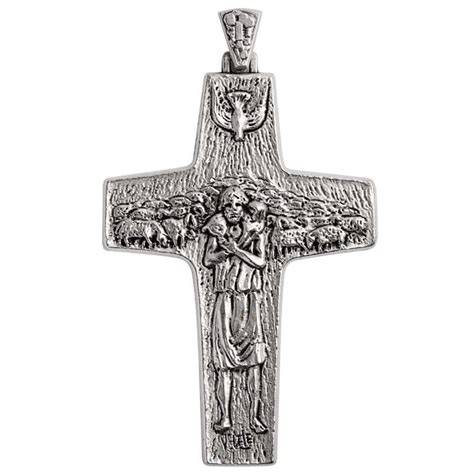
The Silver Cross of Pope Francis
The pectoral cross Pope Francis wears is not made from gold, but rather from silver. This much humbler emblem of spiritual authority has become symbolic of the Pope’s apostolic mission, which is inspired by the Franciscan ideal of evangelical poverty.
In striking contrast to previous pectoral crosses, Pope Francis’ cross is made of silver, and there are no stones or jewels. The cross is not simply an example of minimal design; its material and appearance communicate a deliberate refusal of ostentation.
When he first spoke to the world from the balcony of St. Peter’s Basilica it appeared dark, having an almost rusty hue, leading some journalists to the erroneous conclusion that it was made of iron.
Now it is well-known that silver turns dark when it comes into contact with humidity, and it is therefore little wonder if that cross, clenched by so many hands, kissed by so many lips, and bathed by so many tears, would eventually become dark.
In the meantime the Pope’s collaborators had polished it and discovered that it really was made from silver.
The Good Shepherd Image
Pope Francis’ choice was a bit controversial for he opted not to include the traditional body of Jesus on his cross. Rather, the Holy Father chose a design where Jesus is portrayed as a shepherd.
The cross worn by Pope Francis is a distinctive representation of the Good Shepherd. Its design features an intricate portrayal of Jesus as the caring shepherd carrying a lost sheep on his shoulders.
In the center is the figure of a man who represents Jesus, the Good Shepherd, who has found one of his sheep and carries it while the other sheep follow closely. The image of Jesus as the Good Shepherd is seen on the center of the cross. Jesus is holding a lamb around his shoulders as He leads a flock of sheep.
The sheep represent all of us who follow Jesus and His desire to have everyone follow Him. As was typical of Jesus, He is simply dressed and barefoot.
The details of the cross are rooted in the Gospel of Luke, that is, the parable of the good shepherd and the lost sheep. Luke 15:4-7 says, “What man among you having a hundred sheep and losing one of them would not leave the ninety-nine in the desert and go after the lost one until he finds it?”
The Good Shepherd imagery finds its roots in biblical references, particularly in the Gospel of John, where Jesus identifies himself as the shepherd who cares for and protects his flock. The symbolism reflects Christ’s deep care for humanity, portraying him as the guide and protector of his followers.
The Dove and the Holy Spirit
Above is a dove symbolizing the presence of the Holy Spirit. At the top of the cross, the dove representing the Holy Spirit descends from God the Father to God the Son, helping those who are lost and in darkness, and bringing them new life.
The dove gives the composition a Trinitarian dimension: the Father is recalled above, the Son is represented by the shepherd, and the Holy Spirit appears in the form traditionally associated with the dove.
The linear style is intended to be a symbol for a new ecclesiastical era, a poor Church among the poor, as Pope Francis has indicated.
The Cross and Pope Francis’ Pastoral Mission
When Archbishop Bergoglio became the Archbishop of Buenos Aires and later a cardinal and Primate of the Argentine Church, he continued to lead the lifestyle of a simple parish priest.
He refused to reside at the Archbishop’s House, preferring instead to live in a small flat with a retired priest, and he cooked his own meals. At that time Archbishop Bergoglio did not even have a car. He just used the buses or the subway.
Whenever he had any free time available from his numerous duties as Archbishop, he went to the slums of Buenos Aires, known as favelas. During the trip from the Archbishop’s House to the favelas, located on the outskirts of the city, he would often clutch his pectoral cross - the symbol of his desire to shepherd the poor.
The cross had more than a sentimental value for the man who wore it; it also meant something for those he visited. The outcasts of society in the favelas touched it too; they kissed it and bathed it with their tears while the Archbishop listened to their stories.
It is as if the world’s suffering had been impressed on it, darkening it. On his way home, the Archbishop would hold the cross tightly and ask God to lift all the enormous weight of suffering afflicting the people he had visited, and transfer it onto the cross in his hands, asking Christ for help and solace.
The pectoral cross we see on the Pope, therefore, gradually became his inseparable companion during these journeys of his into the hell and suffering of the favelas. We need not be surprised, therefore, that he was determined to keep it, against tradition and protocol, once he became Pope.
Origins of the Good Shepherd Cross
According to F.C. Ziegler Co., Pope Francis’ cross was designed by Antonio Vedele and made by craftsman Guiseppe Albrizzi of Pavia, Italy.
The artist who forged and crafted Archbishop Bergoglio’s pectoral cross was Giuseppe Albrizzi, an Italian craftsman who lives in Vidigulfo, a small town near Pavia in northern Italy.
Was Archbishop Bergoglio’s pectoral cross actually conceived and forged here, on these iron tables? Indeed it was. This was way back in 1998. It was then a simple silver cross like many others, and now it has become a household image commented upon by journalists from all over the world.
Albrizzi’s workshop is a small, family-run business. The workshop contains religious objects such as chalices, patens, ciboria, rings, pastoral staffs, monstrances, tabernacles, and crosses.
A Design Called “The Good Shepherd Cross”
In 1996 Albrizzi’s former employer, Antonio Vedele, decided to shut down his firm because of ill-health, and at that stage he gave Albrizzi some of his equipment which would otherwise have been dumped.
One day Vedele showed Albrizzi one of his drawings and said, “This is a pectoral cross. I have called it, ‘The Good Shepherd Cross’. Here, you can have it. Give it flesh and you’ll see that people will like it!”
A few months later Vedele died. He was only 67, and his loss was a great grief for Albrizzi. Albrizzi decided to produce that cross in memory of his old friend and to place his name on it.
Albrizzi did not want to create a very expensive article. Thinking that it might appeal to some bishop or abbot, he made the cross of silver in order to sell it at a reasonable price.
It was eventually bought by Raniero Mancinelli, a retailer who owns an important shop of religious articles in Borgo Pio, a few steps away from St. Peter’s Square in Rome. One day, in the spring of 1998, a South-American priest walked into that shop, saw that pectoral cross, and decided to buy it.
The priest told Mancinelli that he needed a present for a friend of his who had just been nominated Archbishop of Buenos Aires. This was, in fact, the then-Archbishop Jorge Bergoglio.
Humility, Service, and Inclusive Leadership
The depiction of the Good Shepherd carrying a lost sheep is a powerful visual representation of humility and service. It aligns with Pope Francis’s emphasis on a humble and servant-oriented approach to leadership within the Catholic Church.
The image of the Good Shepherd must have struck a chord in his heart. It corresponded perfectly to his pastoral ideals, and he never stopped wearing it, not even when, a few years later, he was nominated a cardinal, not even when, a few years later still, he became Pope.
In the hands of Pope Francis, the cross worn by the Pontiff is not merely a piece of religious regalia; it is a powerful symbol that encapsulates the essence of his papacy.
The Good Shepherd’s cross, adorning the neck of Pope Francis, serves as a visual narrative of compassion, humility, and a commitment to the teachings of Christ.
Pope Francis’s choice of the Good Shepherd cross resonates with the faithful on a personal level. The relatable imagery invites Catholics to reflect on Christ’s compassion and encourages a sense of closeness to the Church’s leadership.
The simplicity of the cross communicates an inclusive message. Pope Francis’s papacy is characterized by a welcoming attitude, emphasizing the Church’s role as a refuge for all, regardless of their circumstances or past.
Just as Jesus did, he has reached out to countless people suffering from all types of maladies, even washing and kissing the feet of the sick. He has said he chose to be named after St. Francis because St. Francis is “the man of poverty, the man of peace, the man who loves and protects creation.”
So while it may seem like a simple piece of jewelry, the cross Pope Francis and other bishops wear is a daily reminder that keeps them focused on their special task of leading souls closer to Jesus Christ.
Papal Crosses Through the Ages
Papal crosses have evolved over centuries, each reflecting the unique style and priorities of the reigning Pope. While some pontiffs favored ornate designs, Pope Francis’s choice of a simple cross represents a shift towards a more accessible and relatable Church leadership.
For centuries, the pectoral cross worn by popes, cardinals, and bishops was associated with prestige, rank, and temporal power, especially when it was made of gold and decorated with jewels. Pope Francis’s silver Good Shepherd cross presents a different emphasis, placing pastoral care, humility, and service at the center.
Pope Francis’s cross stands as a testament to his commitment to humility and simplicity. As a symbol that transcends papal regalia, it leaves a lasting legacy, influencing perceptions of the papacy in the contemporary era.
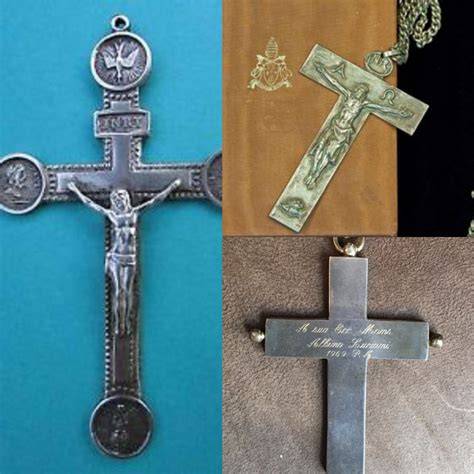
Historic Papal Pectoral Crosses
Pope Leo XII’s Jubilee Cross
A rare and beautiful pectoral cross from the Jubilee Year of 1826 has a cruciform design, an image of the Holy Spirit, images of Saints Peter and Paul outside the arms of Christ, and on the reverse side, images of the cross keys and tiara, symbols of the popes, together with the 1826 Jubilee Year of Pope Leo XII.
The pectoral cross is in excellent condition and is a beautiful addition to the Papal Artifacts’ Collection.
More than half a million pilgrims journeyed to Rome for the 19th Holy Year, for which Pope Leo XII substituted Santa Maria in Trastevere for St Paul’s as a pilgrimage site, since the latter was being rebuilt after a fire.
The 1825 Jubilee Year was extended into 1826, making this a rare addition to the Collection. In 1850, unsettled conditions in Rome, with the temporary exile of Pope Pius IX, prevented calling a Holy Year.
Pope Paul VI and the Bogotá Synod Cross
A pectoral cross was given as a gift from Pope Paul VI to all bishops participating in the Bogotá Synod of 1968. This cross is in its original case with his coat of arms on the cover.
Enrico Manfrini, the famous Italian artist, designed this cross.
Pope Paul VI’s Cross and Diamond Ring
When Pope St. Paul VI visited the United States in 1965, he asked that his cross and a diamond ring be auctioned off, with proceeds given to human relief funds.
The two pieces originally sold for $64,000, and the money was divided among four UN agencies. In 2014, the 18K gold cross, decorated with diamonds and emeralds, was valued at $1.25 million dollars when its current owners placed it up for auction.
Pope John Paul I’s Bishop’s Cross
The artifact is a pectoral cross belonging to the future Pope John Paul I. It contains a relic of Saint Francis de Sales in it.
Albino Luciani was consecrated Bishop by Pope John XXIII on December 27, 1958. The pectoral cross is a valued item in the Collection.
Pectoral Crosses with Relics
Some pectoral crosses contain a relic of the cross or of a saint. These crosses unite the visible sign of the cross with the physical memory of a holy person or a central event of Christian faith.
Crosses with relics are considered extremely sacred and are often passed down from generation to generation. Their significance comes not only from the material enclosed within them, but also from the connection between the relic, the wearer, and the spiritual mission represented by the cross.
The presence of relics recalls the Passion of Christ and the victories of the holy martyrs. It also places the ministry of the bishop or pope within the continuing history of the Church and its witnesses.
Pope Leo XIV’s Relic Cross
On the day of his election, Pope Leo XIV wore a pectoral cross containing relics of saints linked to the Augustinian order: those of Saint Augustine and the saint’s mother, Saint Monica.
The pectoral cross worn by Pope Leo XIV on the day of his election, the 8th of May, carries a powerful message of episcopal holiness. Embedded within it are fragments of bone from saints deeply connected to the Augustinian tradition-witnesses to faith whose lives reflect fidelity, reform, service, and martyrdom.
At the centre of the cross is a relic of Saint Augustine, the great Church Father who taught that looking inward is key to encountering God and understanding His Word-something to be embraced with both faith and reason, so it may be shared with others.
The cross, which Pope Leo XIV wore when he first appeared to the world from the central balcony of St Peter’s Basilica, is rich in symbolism.
The Saints Represented in the Cross
Alongside the relic of the Bishop of Hippo-spiritual father of the Augustinian Order and enduring guide through his Rule and writings-are fragments from four other saints: Monica, Thomas of Villanova, Blessed Anselmo Polanco, and Venerable Giuseppe Bartolomeo Menochio.
| Figure | Meaning within the Augustinian tradition |
|---|---|
| Saint Augustine | The spiritual father of the Augustinian Order, associated with community life, apostolic service, spirituality, study, and the search for God through faith and reason. |
| Saint Monica | Strength, perseverance, tears, tireless prayer, and the enduring bond between a mother and her converted son. |
| Saint Thomas of Villanova | Reform of religious life, care for the poor, missionary support, theological learning, and pastoral service. |
| Blessed Anselmo Polanco | Fidelity to his people, loyalty to the Pope, martyrdom, and steadfast Gospel witness. |
| Venerable Giuseppe Bartolomeo Menochio | Loyalty to the Pope, endurance during hardship, and complete dedication to the service of the Roman people. |
The Cross as a Gift of the Augustinian Order
The relics were chosen by Fr Josef Sciberras, Postulator General of the Augustinian Order, as a present from the General Curia to their confrère, Cardinal Robert Prevost, when he was created cardinal on the 30th of September 2023.
Each relic represents a figure whose life reflects a key aspect of sanctity within the Augustinian family. The relics of Saints Augustine, Monica, Thomas of Villanova, Blessed Polanco, and Venerable Menochio were kept in the lipsanotheca of the Augustinian Postulation.
Fr Sciberras entrusted them to relic expert Antonino Cottone, who placed them inside the pectoral cross later presented to the man who would become Pope.
Fr Sciberras recalled that Cardinal Prevost was “very moved” when the cross was given to him during a celebration at the refectory of the International College of Saint Monica.
He knew that he would be carrying close to his heart relics of both Saint Augustine and his mother, Monica. “The day before the conclave,” Fr Sciberras shared, “I sent him a message, encouraging him to wear the cross we had given him, for the protection of Saints Augustine and Monica.”
“I don’t know whether it was because of my message or not, but when I saw he was wearing it when taking the oath-and again when he stepped out onto the balcony of the basilica-I was deeply moved.”
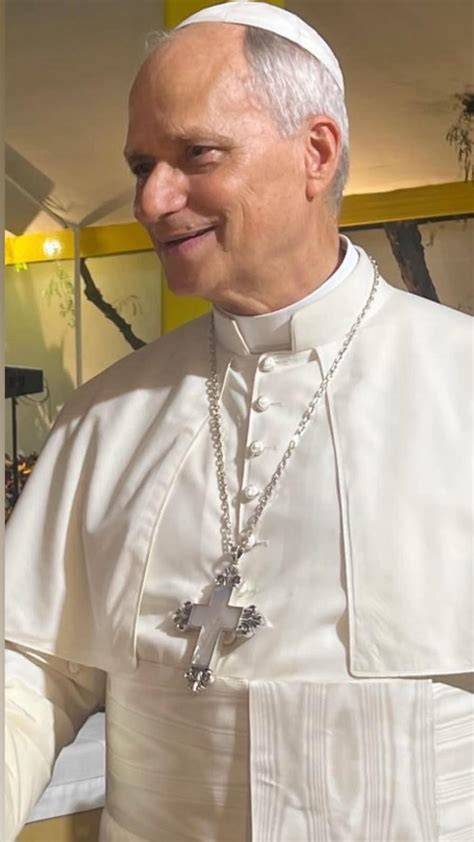
Augustine and Monica
The fragment of Saint Augustine’s bone is a reminder of the Order of Saint Augustine, established by the Apostolic See in 1244. Over the centuries, the Order has followed his ideal of community life, apostolic service, spirituality, and study.
The relic of Saint Monica highlights the deep and enduring bond between Augustine and his mother. Hers was a life marked by strength and perseverance, and through her tears and tireless prayers, she helped bring about her son’s conversion.
Augustine praised her virtues in his Confessions, seeing them as gifts from God. Pope Francis had a particular devotion to Saint Monica, and as both cardinal and Pope, he would often visit her tomb in the Basilica of Saint Augustine in Rome’s Campo Marzio.
For the Augustinian Order, Monica’s life and her son’s path to conversion and consecration are deeply intertwined-cornerstones of Augustinian spirituality.
Thomas of Villanova
Saint Thomas of Villanova, who served as Archbishop of Valencia in the 15th and 16th centuries, was a major reformer of religious life and a true shepherd, one who “smelled of his sheep,” to borrow a phrase used often by Pope Francis.
He was known for his tireless care for the poor and his support of missions in the New World. A brilliant theologian, he also founded a seminary in Valencia in 1550, which still exists today, even before the Council of Trent’s reforms on priestly formation.
Anselmo Polanco
Blessed Anselmo Polanco, Bishop of Teruel, was martyred during the Spanish Civil War (1936-1939). He remained steadfast in his duty to his people until the end, once declaring, “As long as even one of my flock remains, I will stay.”
Loyal both to the Pope and to his people, he was killed for his unshakable faith and Gospel witness.
Bartolomeo Menochio
Venerable Giuseppe Bartolomeo Menochio, Bishop of Porphyry and Prefect of the Apostolic Sacristy, served as Pontifical Sacristan from 1800.
During the Napoleonic era, he stood firm in his loyalty to the Pope and endured great hardship for it. A central figure in the life of the Church in Rome, he died “in the odour of sanctity” on 25 March 1823.
Pope John Paul II recognised his heroic virtues in 1991. Menochio is remembered as a devoted bishop and the only one who refused to swear allegiance to Napoleon, choosing instead to dedicate his life fully to the service of the Roman people.
A Visible Sign of Faith and Pastoral Mission
“This cross isn’t just a decorative object,” Fr Sciberras explains. “It’s a visible sign of faith and a clear reflection of pastoral commitment.”
“The relics it contains are all linked to the Augustinian tradition, and each one represents fidelity, reform, service, or martyrdom-virtues that now guide and sustain the ministry of the new Pope.”
The relic cross of Pope Leo XIV demonstrates how a pectoral cross can unite several meanings at once: personal identity, ecclesiastical tradition, relic veneration, episcopal holiness, and the concrete virtues required for pastoral service.
How a Pectoral Cross Is Chosen
Choosing the appropriate pectoral cross or engolpion depends on various factors. Priests usually wear crosses, while bishops and metropolitans wear engolpia.
For daily use, simpler designs are preferred, while for major feasts or festive vespers, more luxurious pieces are chosen. The artistic value, style, and detail of the craftsmanship also play an important role.
Many priests choose designs that reflect their own spirituality or the tradition of the local Church. The form of a cross may therefore communicate both the office of its wearer and the particular spiritual emphasis that he wishes to keep before him.
- Role and rank of the cleric: priests usually wear crosses, while bishops and metropolitans wear engolpia.
- Occasion: simpler designs are preferred for daily use, while more luxurious pieces may be chosen for major feasts or festive vespers.
- Aesthetics and personal preference: style, artistic value, and craftsmanship can reflect the wearer’s spirituality or local ecclesiastical tradition.
- Construction materials: gold-plated bronze, 925° silver, and gold affect the durability and appearance of the cross over time.
- Relics: some crosses contain relics of saints or pieces of the True Cross and have a particular devotional significance.
- Commemoration: inscriptions and dates may connect a cross with an ordination, anniversary, Jubilee, or important ecclesiastical event.
Care and Preservation
Daily Care
- Gently clean with a soft cloth after each use.
- Avoid contact with chemical products.
- Store in a safe place when not in use.
Periodic Maintenance
- Professional cleaning every few months.
- Check for wear or loose parts.
- Restore enamel or gilding when needed.
Care is especially important for crosses made with delicate enamel, gilding, precious stones, or relic compartments. Preservation protects both the craftsmanship and the devotional meaning carried by the object.
The Continuing Significance of the Papal Pectoral Cross
The history of the papal pectoral cross moves from early Christian symbols of faith and protection to reliquaries, liturgical insignia, artistic works, and visible signs of episcopal responsibility.
Its significance can be expressed through the cross’s material, iconography, relics, historical setting, and relationship to the ministry of its wearer. A gold cross decorated with precious stones may emphasize ceremonial dignity and ecclesiastical history, while a simple silver cross may emphasize humility, pastoral closeness, and evangelical poverty.
Pope Francis’s Good Shepherd cross communicates compassion, humility, service, and a concern for the lost and poor. Pope Leo XIV’s relic cross communicates Augustinian identity, holiness, fidelity, reform, service, and martyrdom.
In each case, the cross rests close to the heart because it is meant to remain close to the spiritual center of the wearer’s mission: remembering Christ, serving the Church, and leading souls closer to Jesus Christ.